
Feel the grit on side of a trout with your hand. Feel the thousands of little shields that protect the fish from its parasites and its predators. Look at the scales; these are result of millions of years of evolution. They are a record of the fish’s life, each ridge and bump tells you something about the fish: how fast it grew, where it’s been, whether it had a good winter or not. To most folks, the scales is noticed only when we’ve scraped them off before cooking, but if you look closely, you’ll see a beautifull design.
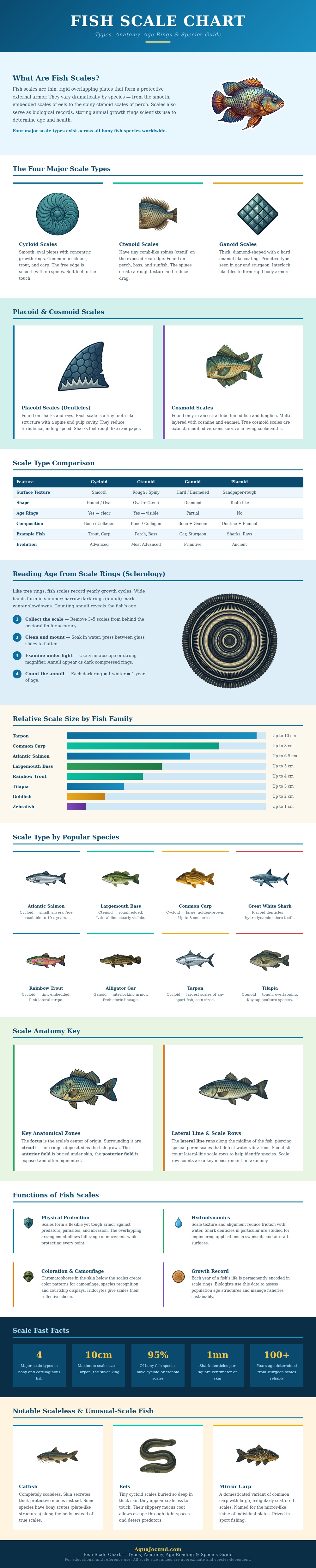
Today, there are four main scale varieties in the water. The two you’re likely to see most as a freshwater angler is cycloid and ctenoid scales. A cycloid is oval with a smooth surface. Because these scales decrease friction for more streamlined swimming, you’ll find them on salmon and carp. Ctenoid scales look similar but feature small comb-like teeth on their trailing edge. Those tiny spines further minimize drag. You’ll see that rough texture on bass and perch.
What Fish Scales Are Made Of
Ganoid scales are what gar fish have. It is a type of structure called scale armor. Individual scales fits together like a bunch of diamond shaped tile pieces. They are ancient. They look prehistoric. Not so for sharks. Structurally, denticles, or the scales that cover their skin, is exactly like teeth. They’re made of a hard outer enamel-like material with a cavity filled with pulp, making them structurally identical to teeth. Because they’re like teeth, they make the shark’s surface toothy, producing what engineers call micro-turbulence. This makes it easy for sharks to swim with less resistance different than smooth surfaces do. Engineers have studied this design for decades because it is more efficient. The key is biological design.
Scales of fish also capture time. Each year they adds on another ring like tree rings do. When it’s warm and full of food, they grow wider light bands in the summer. When it gets slow and cold (winter)… They slow growth, forming narrow dark rings called annuli. By counting those rings under a microscope, scientists can accurate judge a fish’s age. You can try this at home by cleaning scales from behind the pectoral fin. Lay them out flat between two glass slide. The calcium will show its history. It’s that easy and transforms your kitchen counter into biology class.
Scales come in many different sizes. Some species can reaches over 10 cm (such as those on tarpon). The giant silver fish plates gleam in the sun. Others are barely a centimeter wide (like those found on zebrafish). This is where it gets interesting. Scale counts allow taxonomists to differentiate between closely-related species by counting number of scale rows that parallel the lateral line. And this is very strict: genetics dictates the pattern. What environment or what you eat may make your body shape and color change, but not your scale patterning.
All fish aren’t armored Catfish: Many catfish lack armor. Their defense is thick, protective skin. Tiny scales is buried far below surface in the dermis. These slippery creatures feel smooth. Even among scaled family members, there are mutations. Mirror carp have big clusters of plate-like scales that decorate otherwise bare skin, making a pattern of sorts. Evolution experiments with such differences.
Once you know about scales, your perspective shifts. When you’re looking at fish on the end of a line, or inside your tank, they’re no longer objects to get past or simply ornaments. They represent biological information. They also provide protection, camouflage and hydrodynamics. The next time you grab a fish, feel it with your hands. What does it feel like? Maybe you would of had a bit of livig history in your hand…one ring at a time.
