
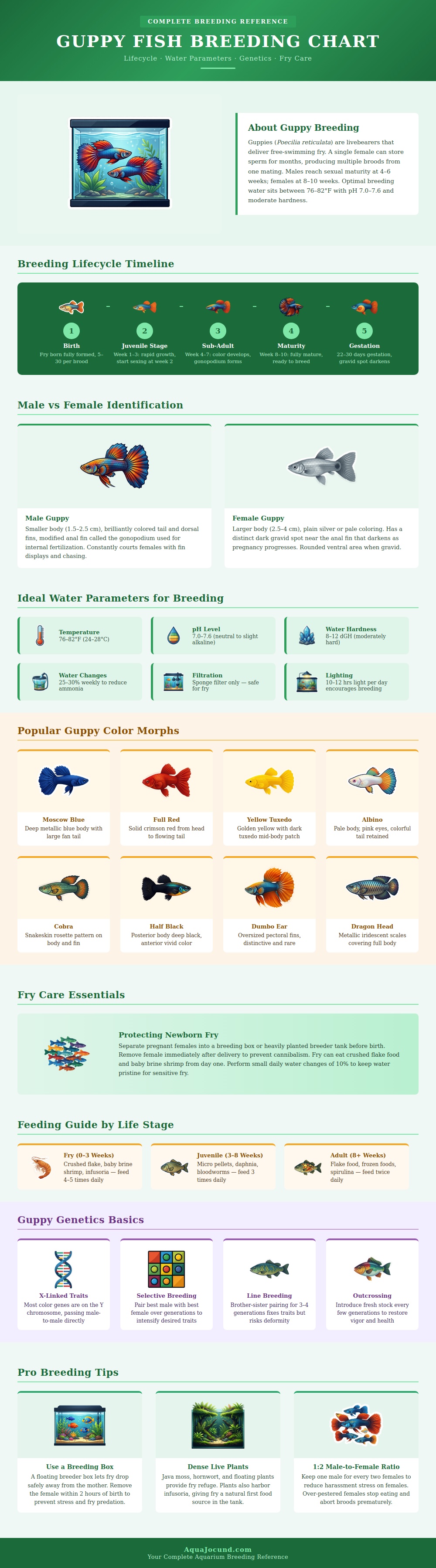
Take guppies, for example: You begin with a male and female pair and before long, your tank is full. Why? Guppies are productive livebearing fish, meaning they don’t lay eggs but rather give birth to complete, developed offspring. This infographic charts that life cycle, from mating to adult. Knowing this timeline changes how you approach managing the tank because it turns it from a question of survival into one of population health.
Guppies are efficient breeders because they are great at reproducing; a female can hold sperm for months after only mating once. In other words, one mating event lead to multiple broods (over time), and there’s no need to have a male present continuously for breeding purposes. That said, always observe your females. As the offspring grow inside, the pregnancy spot located near her tail turn darker in color (refer to the chart). If it reaches almost black and if she appears boxy, then she’ll be ready to drop soon.
How to Breed Guppies
When guppies give birth, timing is everything. Why? Guppies will eat their offspring if given the chance. And it’s not maliciousness; it’s simply biology. According to the guide, if you don’t remove the mom from the newborns, there might be no newborns left soon, as you’ll discover when you check the bottom of your tank.
To ensure survival of fry, separate the mom right after birth. Using a breeding box or a heavily planted nursery area gives the fry a fighting chance, but dense plants like java moss offer natural cover that plastic boxes cannot replicate. These leaves conceal the little fish until they’re big enough to escape quickly.
What happens to the surviving fry? That depends on water quality. Because the gill development is not complete, newborn guppies are vulnerable to an ammonia spike. They die from dirty water quicker different than they do from starvation. The reference chart specifies optimal water parameters, stressing importance of regular (but small) water changes instead of infrequent (but large) ones. To keep their metabolic rate steady, maintain a stable temperature between seventy-six and eighty-two degrees Fahrenheit. If the water is warm, it will also speed up their growth, meaning that under favorable conditions you’ll witness juvenile doubles in a matter of weeks.
Perfect isn’t as important than consistent. They’re only as good as what you feed them They have tiny stomachs but big appetites. Fry need to be fed multiple times a day. For the smallest fry, try baby brine shrimp or other crushed flake food, which contain enough protein to support growth. Once they grow up into juvenile size, offer micro pellets and on occasion, daphnia, etc., for treats. All of this will ensure proper nutrition without polluting the tank with leftover food.
Overfeeding is easy to do and it is why many aquarists end up with cloudy tanks and sick fish. Guppies have added complexity regarding color genetics. Males pass on color directly to son (through the Y chromosome) for most guppy colors. Bright red males begin with a bright red father. Popular color morphs include those listed in the chart, such as Full Red and Moscow Blue. Selective breeding amplifies these traits. To breed specifically for color takes some record keeping and patience. You’re running an experiment over time. Line breeding stabilizes desired traits; excessive in-breeding create weaker fish that may be deformed. Bringing in fresh stock after a few generations keeps the line healthy.
Males will chase females relentlessly in an attempt at mating, which is not good for your guppy tank. Too many males can stress out your females. When this happens, the females won’t eat, they’ll lose color, and sometimes even abort their brood(s). To minimize this problem, the guide suggests a male-to-female ratio. Two or three females per single male provides the females with some breathing room. It stabilizes the social dynamic while reducing the pressure put on each female. This is a simple change that resolves behavioral issues common to beginning hobbyists.
Guppy breeding isn’t about forcing things; it’s about helping them. Create the conditions for success, ensure they’re fed well, then let nature take its course. There’s nothing better than watching tiny dots turn into beautiful adult guppies. It reminds you that your tank is alive and part of the natural world. Have a plan and pay attention to water parameters. If you do this, your tank will become livig and something other than still decoration.
