
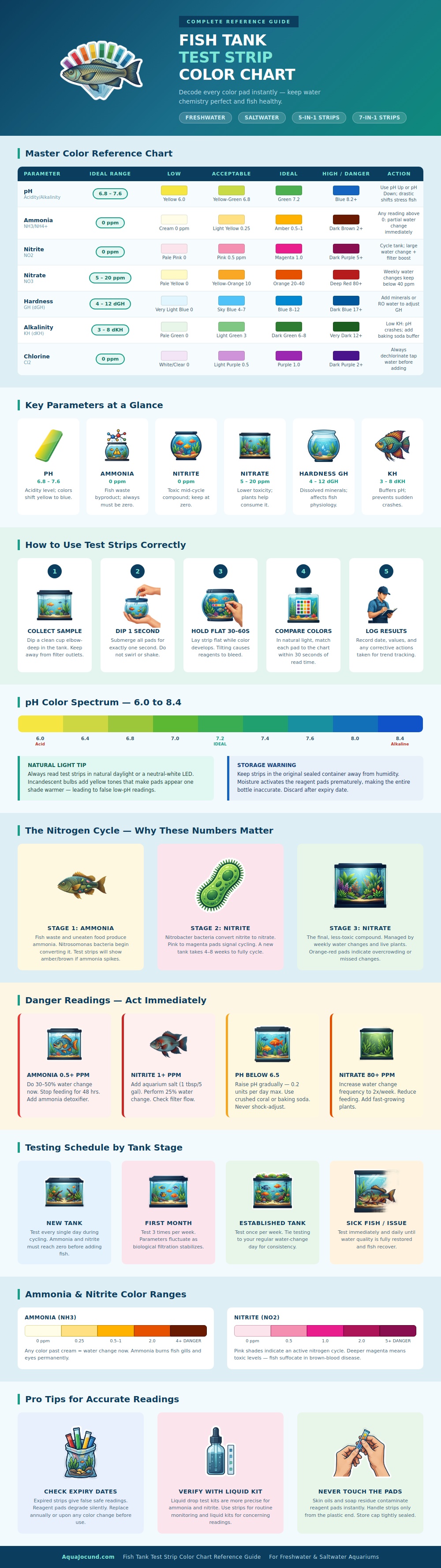
When your fish start gulping air and you don’t know why, it’s time to learn about water chemistry through test strips. That gulping isn’t just random. Usualy, there is an invisible problem with the water chemistry. Test strips take all those invisible dangers and make them visible with a few simple colors that you can then correct early on. And if you look at the chart above, it explain what each of those colors mean. It’s an abstract science that becomes clearly readable after a little practice by anyone.
Pay attention to your water. Check ammonia and nitrite regularlly. A healthy tank will register zero on both. Ammonia, which originates from fish waste and rotting food, is dangerous at any concentration. Quickly do a partial water change if the ammonia strip turn any shade of brown or amber. This will help reduce toxicity.
How to Read Your Fish Tank Test Strips
Nitrite occur as bacteria break down ammonia and is just as lethal to your fish. A pink or magenta pad indicate that your biological filter isn’t keeping up with existing waste load. There’s no way around it; this biological process take time. However, changing the water and cutting back on feeding can support biology until those colors dissapears.
Next we have Nitrate. Unlike the above compounds, nitrate is not as toxic but it’s still something to be aware of. Nitrate assist with clarity in planted tanks as plants use it for growth. Over time excess nitrate will lead to algae blooms and stress your livestock. According to the visual guide, accumulation will show up as orange/red colored pads. While this isn’t an emergency, it is a maintenance item. Weekly water change will maintain these numbers within range. Deep red? You’re either over-feeding your fish or under-changing the tank’s water. It is a small detail that prevents panicked attempts to fix things later when maintenance are neglected.
So what about pH? Is your water acidic or alkaline? The chart indicate blue for alkaline and yellow for acidic. Fish does best in the neutral zone; that’s most fresh water. Notice how gradual changes aren’t necessarily bad? Fish slowly adjust to water changes, so drastic fluctuations is worst. Just like high ammonia, a rapid drop in pH can instantly kill fish too. Yet many folks go after perfection without regard for stability. Keep your pH stable, not tweaked all the time, and you’ll have happier fish to.
These are alkalinity (KH) and hardness (GH). Alkalinity buffer your pH from drastic fluctuations that will hurt your eco-system. Hardness is measured as general hardness. It has to do with minerals in your water and how they impacts egg development and overall fish body functions. You can add crushed coral or baking soda to your tank if your KH is low to raise it. This makes your pH less volatile and protects your tank while you aren’t around.
The measurement is great but how do you use the strips? To test accurately, you must dip the strip for exactly 1 second, remove it without shaking, and lay it on a flat surface. Allow time for colors to fully appear. Compare to the chart and use good natural light; artificial light inside will skew how you percieve the color. Don’t rub the reagent pad with your fingers, those oils mess up the chemical immediately. Keep the strips stored in a dry area (not in humid areas like bathrooms) or chemicals become inactive prior to expiration.
While cycling a new tank and building up the bacteria that keeps it clean, you should of test it every day. After that, a weekly test will do. If something appear off, check it right away. Trust what you see more than what your schedule says, good aquariums is all about keeping things in balance. The color chart is there to back up what your fish are telling you. Post it where you can see it and be honest with yourself when checking those colors. This helps keep pets active and water clear.
