
When you first encounter molly fish in a pet store, there is a specific moment you face when looking at all the variety. There’s a lot of stuff labeled as “molly.” But there is quite a bit of variation on the colors, some are black, some glow gold, and some look like chocolate milk.
Assuming it’s all random chance simply doesn’t accounts for what’s going on. You also miss out on knowing more about them, such as their health, their genetics, and their care requirement. Knowing such things makes fish keeping less guessing and more a planned activity.
How to Choose and Care for Molly Fish
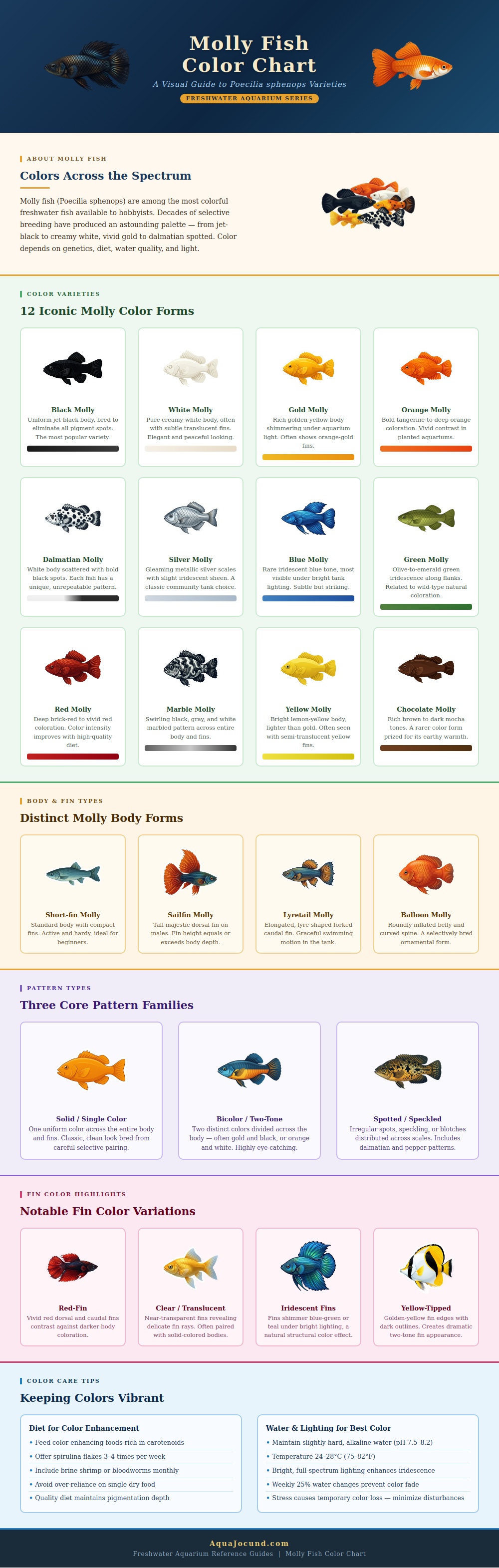
Breeders often take pigment spots off so all are dark. For example, black mollies is popular for this reason. Because it’s a solid color, it pairs well with green plant colors but it will also reflect poor water quality (dull color). The other trick with marble and dalmatian patterns is that no two is alike. Each individual fish has different swirls or spots making them unpredictable.
This chart connects pattern with body type. Even if two fish have the same basic color, one might be a sailfin (tall dorsal fin) while another are a short-finned version. Remember that balloon mollies have been bred for appearance (not necessarily fitness). They tend to have rounder belly and curved back.
Beyond body color, pay attention to fin presentation. As demonstrated by the guide, there are typical fin shape such as iridescent fins which have a blue-green sheen in bright light. This has nothing to do with pigment density but rather with how scales’ underlying structure reflect light. There is also bicolor forms in which the fish is divided into two colors along the length of the body. Often this creates contrasting patterns like orange and white or gold and black.
Look for these clues when trying to gauge maturity and health. Crisp color distinctions combined with bright colors. Whether the molly is a common silver or a rare blue, are signs of a healthy molly.
To maintain color richness, you can’t just purchase the correct species of fish. How your diet affect color is significant too. Providing pigment-rich food such as spirulina flakes on a regular basis help in keeping colors rich. Carotenoid-rich live foods (e.g., brine shrimp) also helps to maintain true reds and bright yellows/golds. If not fed these nutrient-dense foods, even colorful mollies will lose their vibrancy over time.
Also, remember, mollies like alkaline water with a hint of hardness. Poor water quality stress them out, resulting in immediate loss of color. Loss of color is an early sign of health problems that can act as a warning system before more serious issues develops.
For example, do you want a fancy sailfin or a basic lyretail? Do you care about how it swims or what it look like? A sailfin’s dramatic shape makes it stand out in the community tank while a lyretail swims elegantly with its forked tail. There isn’t one right choice over another; both just demand slightly different tank layouts to maximize their appearance.
It’s not just about color of your fish but rather developing a space where they can thrive as nature intended. Taking care of mollies is not just about buying them, but about keeping them alive for a long time. It’s an investment into a living display that will evolve daily, hourly, even during each water change or feeding. Every color you choose would of surprised you if you set things up right for their care.
Begin with good food and clean water. Keep ’em healthy, keep ’em bright!
