
Do you recall the time you bought that goldfish at the five-and-dime? As a kid, you put it in a plain old glass bowl about the size of its tail. Within a month, it was gone. That has done the hobby a lot of harm. It labels these animals as being low maintenance, simple creature. The truth is they’re long-lived, complex fish with very real needs.
For more than a thousand years, goldfish have been subjected to selective breeding. From their slim wild ancestors living in rivers across Asia, they morphed into the round-bodied, finned beauties we know today, the fancy goldfish that populate our aquariums. Knowing this not only allows you to select a companion that suits your lifestyle but also one that won’t suffer in inappropriate home.
Goldfish Types and Care Tips
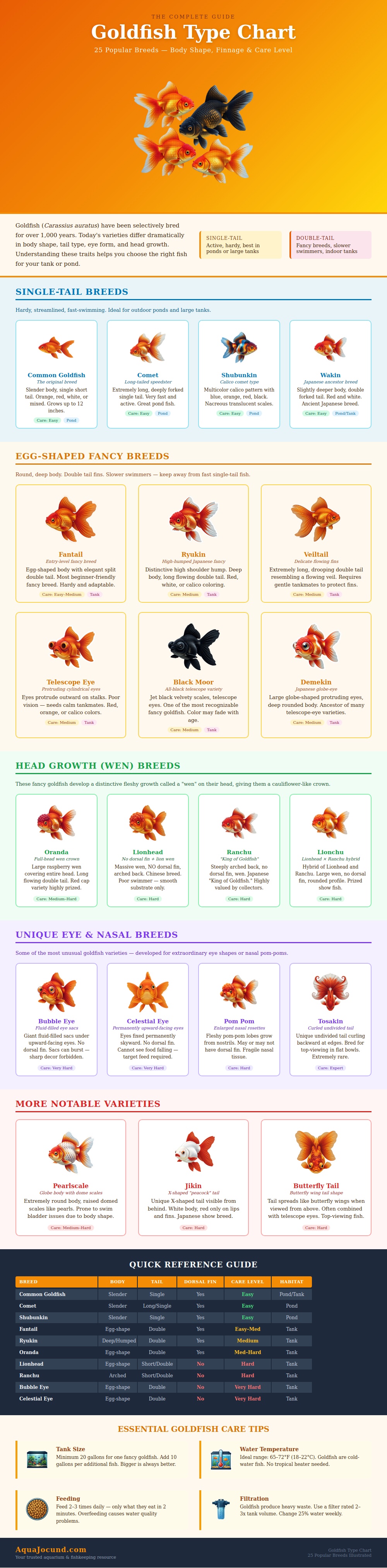
As seen in the visual breakdown above, these breeds split into two camps. And it’s not so much a matter of species as it is their physical architecture.
First there are those that have a single tail. These tend to have streamlined, torpedo-like bodies like their wild counterparts. These guys is built for endurance and speed. They do best in a very large tank indoors or an outdoor pond where they can actively swim without banging into something. Comet, shubunkin, and common goldfish all fit here. They’re hardy, relatively easy to maintain. And they’ll grow pretty big. A dozen inches or more isn’t uncommon. They’ll tolerate seasonal temperature swings well if you have a garden pond. Their high energy level make them entertaining every day.
The double-tail fancy breeds is on the opposite side. These guys (and gals) bear little resemblance to their ancestors. Their bodies are shaped more like eggs. As a result, they’re sluggish swimmers. Because of this body shape, they can absorbs buoyancy problems when overfed and/or housed in poor water conditions. Types such as the veiltail, ryukin, and fantail represent the “fancy” end of the scale, and are highlighted in the chart. Due to their graceful, long-flowing fins, all of these need large, well-filtered tanks that don’t expose them to any harsh current. Because of their fragility, they shouldn’t of been mixed with any other fish who might nip them during their daily business.
A common mistake beginners make is mixing fancy with pond species in the same tank. Those faster, more aggressive fish will win out on feedings and the slower ones gets stressed by their very existence. It just doesn’t work.
Finally, there are those that are downright exotic due to strange eye shape or other head growths. The ranchu, lionhead, and oranda all sport fleshy wens on their heads. Their crowns is almost like cauliflower. That means they must be monitored carefuly regarding cleanliness as the folds can trap debris.
Breeds with protruding eyes has fragile eye structure or poor vision. Examples include celestial eye, bubble eye, and black moor. Those eyes demand pristine water quality and tank mates willing to leave them alone. In a way, keeping such fish is as much about specific care as it is survival. Instead of merely a pet, you are now tending to a delicate artifact.
As you move through the range of fish from single-tails up into the most elaborate fancies, your care requirements changes drastically. For example, while single-tails can be somewhat forgiving, celestial eyes and bubble eyes is physically vulnerable and require an experienced hand.
Regardless of breed, a bigger tank is always better. If you have one fancy goldfish, you need at least 20 gallons. That’s not a recommendation, it’s a requirement. You’ll never get good water quality without it. Compared to their bodies, these fish generates a lot of waste. Therefore, you must use some strong filtration (it’s non-negotiable). Performing regular partial water changes will control ammonia and reduce other potential problems associated with overcrowding. Unfortunatley, these problems plague many overstocked tank.
Where do you begin? Begin by getting honest about your commitment (and space). Do you desire something stronger to keep in a pond? Go for a single-tail variety. Are you looking to admire fancy fins in your livig room? Opt for a fancy breed. Be sure to buy the right-sized tank. It’s not enough to just survive (you want your goldfish to thrive).
Providing the right environment for a goldfish’s biology will help you move past the sad, bowl-of-water stereotype. You will get lost in an enjoyable hobby of appreciating these amazing creatures.
