Feeding Amount by Body Weight Calculator
Calculate fish feeding amount from biomass, percent body weight, life stage, water temperature, food moisture, meal count, waste factor, and growth goal.
⚙Calculator inputs
Feeding amount estimate
Enter biomass and ration settings, then calculate.
Calculation breakdown
📊Ration by stage comparison grid
🧪Food and ration reference
| Life stage | Typical daily % body weight | Common meals/day | Use for |
|---|---|---|---|
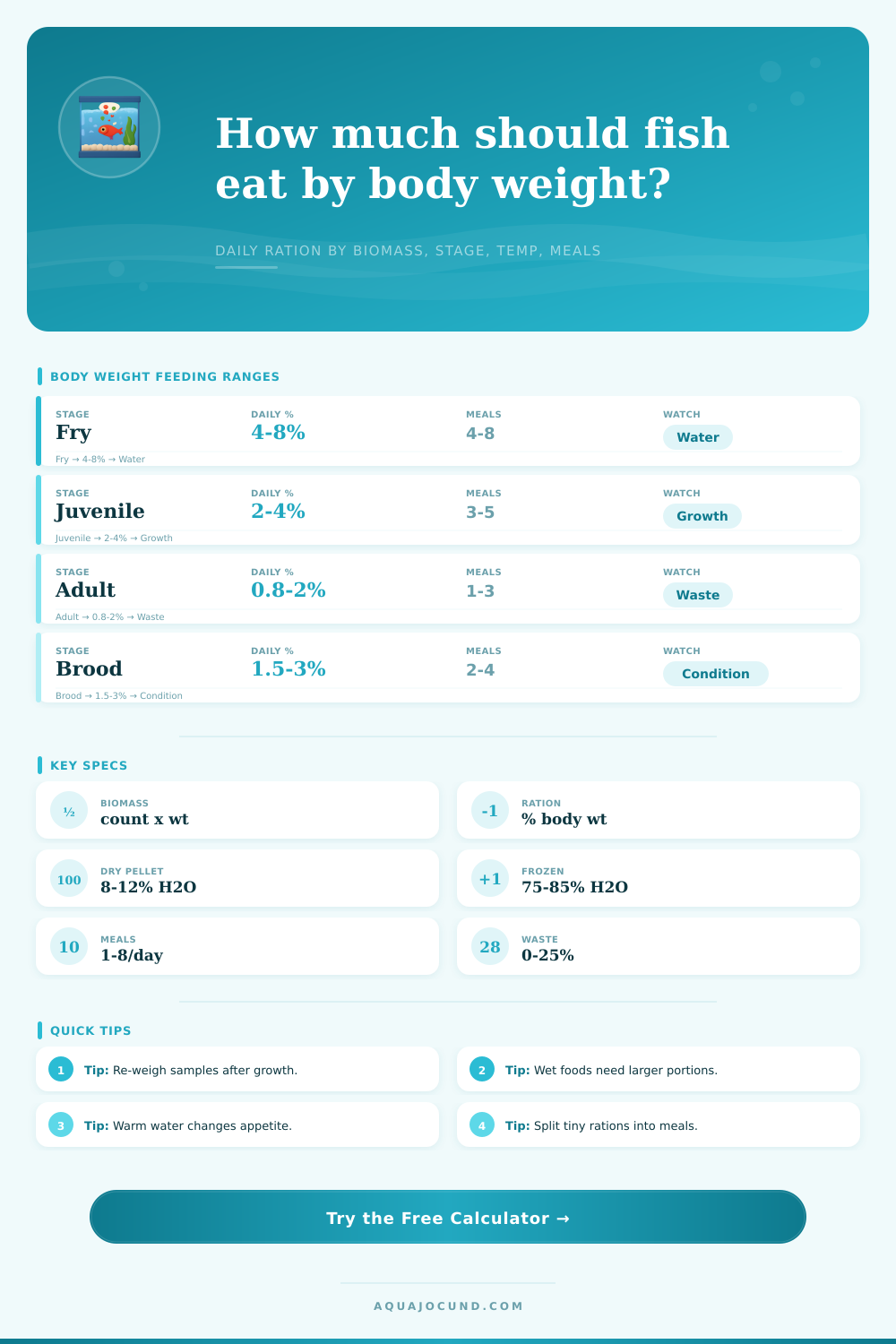
| Fry | 4 to 8% | 4 to 8 | Rapid growth, tiny stomach capacity, frequent small servings. |
| Juvenile | 2 to 4% | 3 to 5 | Growth-focused fish that are still adding body mass quickly. |
| Subadult | 1.5 to 3% | 2 to 4 | Fish nearing adult size but still filling out. |
| Adult maintenance | 0.8 to 2% | 1 to 3 | Stable adult displays where waste control matters. |
| Broodstock | 1.5 to 3% | 2 to 4 | Conditioning and recovery periods with richer foods. |
| Slow adult | 0.4 to 1.2% | 1 to 2 | Cooler water, older fish, or deliberate lean feeding. |
| Feeding group | Best temp range | Guide ration | Protein guide | Watch point |
|---|---|---|---|---|
| Small tropical community | 74 to 80°F / 23 to 27°C | 1.0 to 2.5% | 32 to 42% | Fine foods disappear quickly; overfeeding still clouds water. |
| Betta | 76 to 82°F / 24 to 28°C | 0.8 to 1.8% | 35 to 45% | Small individual portions are easy to overestimate. |
| Goldfish | 64 to 74°F / 18 to 23°C | 0.6 to 1.8% | 28 to 36% | High solids load and cool-water appetite swings. |
| Koi and pond carp | 59 to 82°F / 15 to 28°C | 0.5 to 2.0% | 30 to 38% | Season and temperature should drive daily ration changes. |
| Tilapia growout | 75 to 88°F / 24 to 31°C | 1.5 to 4.0% | 28 to 40% | Heavy feeding needs strong filtration and oxygen. |
| Marine carnivore mix | 75 to 80°F / 24 to 27°C | 0.8 to 2.0% | 40 to 55% | Frozen food moisture makes portions look large. |
| Food form | Typical moisture | Dry matter effect | Portion note |
|---|---|---|---|
| Dry pellet or flake | 8 to 12% | High dry matter | Small as-fed portions can contain a lot of nutrition. |
| Semi-moist pellet | 18 to 30% | Moderate dry matter | Portion is larger than dry pellet for the same dry ration. |
| Gel food | 65 to 75% | Low dry matter | Weigh larger portions and remove leftovers promptly. |
| Frozen food | 75 to 85% | Very low dry matter | Thawed weight includes substantial water. |
| Live food | 80 to 90% | Very low dry matter | Useful for small meals, but nutrition varies by culture. |
| Scenario | Example biomass | Daily ration guide | Meal split | Calculation focus |
|---|---|---|---|---|
| 10 gal betta | 0.2 oz / 6 g | 1.0 to 1.5% | 1 to 2 | Very small weighed servings. |
| 55 gal community | 0.5 lb / 0.24 kg | 1.5 to 2.5% | 2 to 4 | Multiple species and size classes. |
| Goldfish trio | 1.9 lb / 0.86 kg | 0.6 to 1.2% | 1 to 2 | Waste and cool-water appetite. |
| Koi pond | 28 lb / 12.7 kg | 0.8 to 1.8% | 2 to 4 | Seasonal pond feeding. |
| Tilapia tank | 24 kg / 53 lb | 2.0 to 4.0% | 3 to 6 | Growth and oxygen demand. |
| Marine frozen mix | 0.9 lb / 0.41 kg | 0.8 to 1.8% | 2 to 3 | Moisture-adjusted thawed food. |
The vast majority of people who start keeping fish simply pour some food on the surface of their tank. When the fish swims up and suck it down they think that means they’re hungry. So maybe you put a bit more on there. Before long, the cloudiness of water becomes apparent. It seems innocuous because the fish was swimming around while you did it. In reality, you’ve just poisoned your tank with ammonia. This is one of the quickest routes to an ammonia spike.
Math, not chance, is what typically separate a healthy ecosystem from a time-sucking mess. Understanding precisely how much biomass you have under your care will greatly change your game plan when it comes to feeding. After you input how much fish you have, the calculator (above) will do the math for you. You do not need to convert units. You don’t have to guess at any coefficients. It won’t let you get away with ignoring things folks routinely gloss over until their filtration dies.
Why You Should Use Math to Feed Your Fish
For example, you must factor in life stage of your fish since fry require massive caloric intake relative to their size while adults often eats merely to maintain status quo. An adult eating for maintenance may get away with eating half as much food than a juvenile, which might need 3% of its own bodyweight each day. The calculator use these and other factors listed below to automatically adjust feedings so that neither you nor your fish gets too little food (if they are still growing) or too much (if they are fully grown).
You must also know what you feed your fish. If you switch between dry and wet feeds, different portion sizes apply based off the moisture content of the food. The reference table on the page lays this out clearly showing how portion size must scale up when switching from dry to wet feeds. Another sneaky variable is moisture. Water doesn’t add any nutrients. Because of this, a small pinch of a dry pellet is loaded with nutrients, while a tiny piece of a freeze-dried worm contain virtually none due to its high moisture content. By volume, frozen foods is largely water and ice so if you put the same quantity of thawed frozen shrimp into your tank as you do of dry flake food, you’ll be feeding way more volume but much fewer nutrients. This is where many people gets tripped up when they switch from one type of food to another because they think putting a big pile of frozen food in their tank is a big meal; it’s not. The table on the page spells it out for you showing how portion size needs to increase when transitioning to frozen foods.
Temperature also affects how efficiently a fish digest its food. Metabolic rate plummets drastically in cold water. What happens? In the winter, those fish who gulped their meal in summer might was sitting there bloated with an undigested meal. Because it knows your water temperature and uses this number in its calculation, it will adjust the base ration to account for lower metabolism due to colder water. For example, it knows that the same pond in mid-summer requires considerably more input than the same pond in late autumn. That’s important because it means it won’t allow waste build up in the months when biological filtration is slowing down anyway.
What good would of it do to feed what you THINK they ought to eat (based on how hungry they were last month), versus what they CAN actualy digest? In reality, theory meets the waste factor. There is no such thing as a perfect, waste-free feeding event. Fish will reject some pellets after taking a quick taste test. Others will go undigested due to sinking before they are eaten. To help offset these types of handling losses (and other dissolved bits) you can adjust the waste percentage using the tool. This gives you a buffer against starving your stock while ensuring they get necessary nutrients without having to be perfect down to the gram every single time. Better to estimate on the high side and avoid starvation due to caution.
Feeding is ultimately about respecting both the fish and the water itself. Each gram of uneaten food converts to ammonia, which stresses not only the fish but all inhabitants of the tank. It takes just five minutes to weigh your biomass and input the numbers into the calculator. Then you’re done with the guesswork. There are no more clouds of dust settling on the bottom, and the water is clearer with brighter colors. That sprinkle becomes a measured investment, not a hazard.
The trick is to treat feeding as a data point, not an afterthought. Your filter will thank you for the clarity.