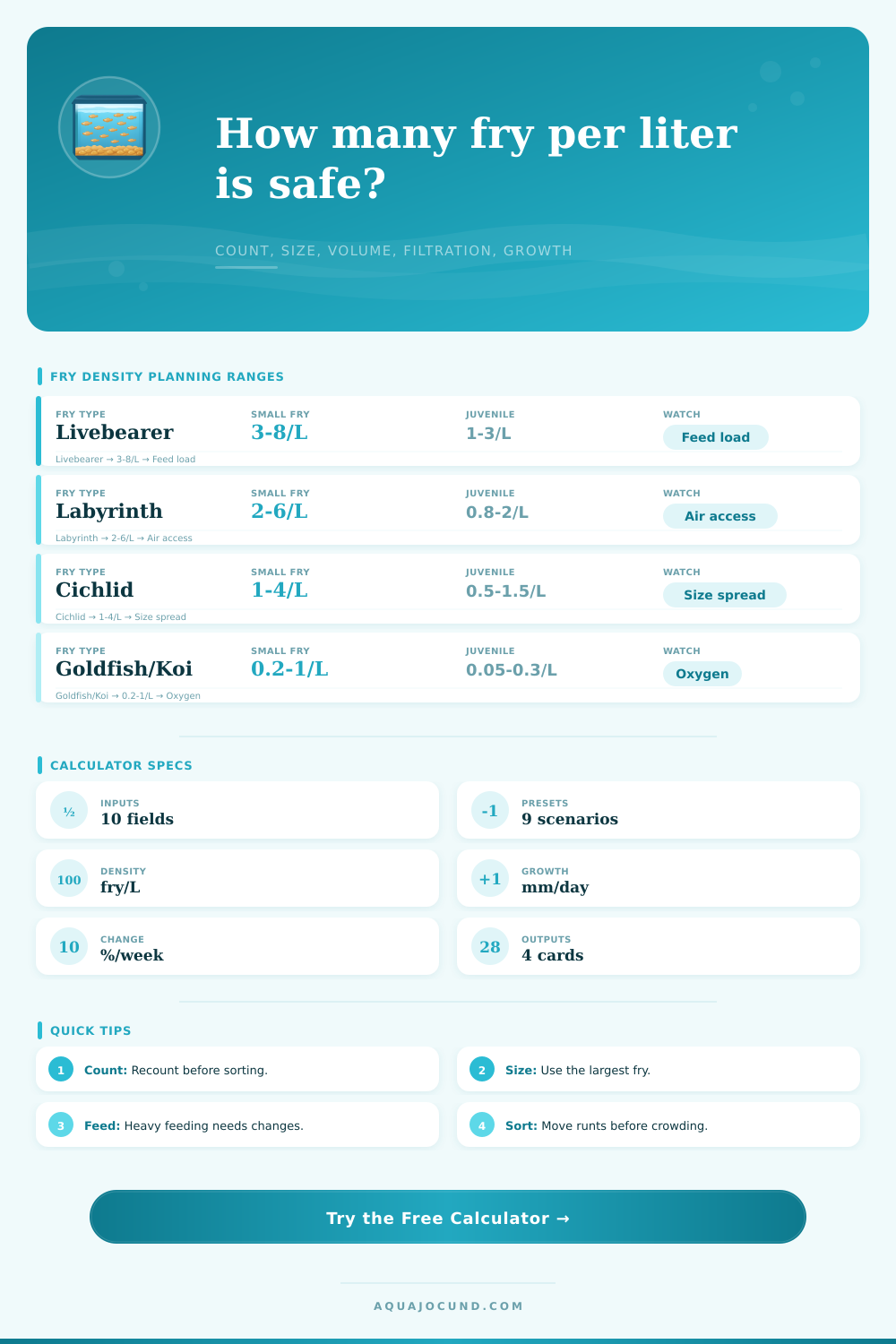
Fry Per Liter Density Calculator
Estimate fry per liter, safe nursery density, extra water needed, and grow-out pressure from fry count, size, species growth, filtration, aeration, feeding, water changes, and duration.
| Profile | Base density | Growth | Planning note |
|---|---|---|---|
| Guppy / Endler livebearer | 6 fry/L at 8 mm | 0.35 mm/day | Handles moderate nursery density with frequent feeding. |
| Betta / gourami fry | 5 fry/L at 7 mm | 0.28 mm/day | Needs warm still water, air access, and careful sorting. |
| Angelfish fry | 3 fry/L at 8 mm | 0.42 mm/day | Density should fall quickly as body depth increases. |
| Corydoras fry | 4 fry/L at 8 mm | 0.30 mm/day | Bottom feeding makes cleanup and oxygen important. |
| Goldfish fry | 0.9 fry/L at 10 mm | 0.70 mm/day | High oxygen demand; split early in warm grow-out. |
| Koi fry | 0.5 fry/L at 12 mm | 1.00 mm/day | Very fast growth; density planning changes weekly. |
| Tilapia fry | 2 fry/L at 12 mm | 0.85 mm/day | Strong biofilter and aeration are usually required. |
| Discus fry | 1.5 fry/L at 10 mm | 0.45 mm/day | Warm water and heavy feeding reduce the usable cap. |
| Input | Low value effect | High value effect | Calculator use |
|---|---|---|---|
| Filtration | Caps density below profile baseline | Allows more stable feed processing | Multiplies safe density by 0.75-1.45 |
| Aeration | Less oxygen reserve at night | Supports high respiration and biofilter demand | Multiplies safe density by 0.85-1.30 |
| Feeding frequency | Lower growth, less waste pulse | More growth and more cleanup pressure | Adjusts waste penalty from 1-8 feeds/day |
| Water change | Nitrate and dissolved organics rise faster | More stable nursery water | Improves cap up to frequent-change limits |
| Nursery | Approx dimensions | Net volume | Example density use |
|---|---|---|---|
| 2.5 gal fry box | 12 x 6 x 8 in / 30 x 15 x 20 cm | 9.5 L / 2.5 gal | Small livebearer hold or first sort. |
| 5 gal nursery | 16 x 8 x 10 in / 41 x 20 x 25 cm | 19 L / 5 gal | Betta, cory, or light cichlid batch. |
| 10 gal grow-out | 20 x 10 x 12 in / 51 x 25 x 30 cm | 38 L / 10 gal | Common first grow-out tank. |
| 20 long grow-out | 30 x 12 x 12 in / 76 x 30 x 30 cm | 76 L / 20 gal | Useful for sorting by size. |
| 40 breeder grow-out | 36 x 18 x 16 in / 91 x 46 x 41 cm | 151 L / 40 gal | Wide footprint for heavy feeding. |
| 100 gal vat | 48 x 30 x 16 in / 122 x 76 x 41 cm | 379 L / 100 gal | Koi, goldfish, or tilapia batches. |
| Weekly change | Density posture | Best use | Watch point |
|---|---|---|---|
| 0-20% | Conservative only | Lightly fed tiny batches | Ammonia and surface film |
| 25-50% | Standard nursery | Most home breeder grow-outs | Uneaten food pockets |
| 60-100% | High feed support | Fast growth and warm water | Match temperature and hardness |
| Over 100% | Intensive management | Daily partial changes | Stability between changes |
So you start with a tank full of little fry and are happy as can be right up to day 3 when something goes wrong. Then you wonder why half of them is dead and the water is clouding over. You have a biological budget for volume not just an empty space. Moving from number counting to waste management trips most beginning breeders. Why? Because they see all that empty space in their tanks and think it will hold some more fishs.
If you input your equipment and species then this calculator does the math for you. It prevents you from guesstimating any conversions and makes you consider oxygen level and filtration capacity. The problem with density is that fry aren’t static items, they grow. What works for you today might be problematic tomorrow if water changes hasn’t kept up with growth.
Why Fry Die in Small Tanks
While certain species can handles more (e.g., live bearers such as guppies), their metabolism is slower relative to there waste output. So, while a batch of them might be perfectly spaced on day one, they could of suffocating by day ten as they grow. In contrast, other species like koi or goldfish has rapid metabolic rates and will produce ammonia quickly at the same size. Just because something is small doesn’t mean you should treat all fry alike. You’ll notice from the reference table above that high-growth kinds must be diluted immediately regardless of the current count.
Filtration harbors good bacterial population responsible for breaking down toxins; therefore, inputs are crucial. A sponge filter provides the gentle flow needed to keep biological balance and also protects tiny mouth from damage. Surface agitation is necessary for oxygen uptake during darkness. Without it, gill function are impaired when stressed. Even a focus on debris removal overlooks that gills need dissolved oxygen to work effectively when stressed. Boosting the gas exchange rate at the surface with additional aeration allows for greater metabolic load support without loss of stock.
Frequent small meals result in cleaner water than infrequent large meals. That’s why frequent feedings (small meals) can impact water quality. The food doesn’t rot on bottom and use up oxygen during decomposition like large infrequent feedings do. If you’re feeding small amounts, the fry can consume only what is necessary; otherwise the leftovers will rot and consume oxygen from the bottom of the tank. In addition, heavy feeding for growth also means more biological load that need to be processed by your filter. When you’re raising fish over time in a small tank, feeding frequency matters.
This is where the tool come into play. It takes into account feeding frequency to adjust safe density. No filter can endure exponentially forever; that’s why regular water changes serve as a reset button. Water changes also replace all of those accumulated toxins with new minerals. However, sudden, big shifts (changing parameters too fast) shock your tank and are less beneficial than small changes. It is more important to be consistent then it is to make big changes because you might not remove all of the dissolved organics from your water. To maintain stable water chemistry between changes, you must match the change percentage to the density load. A stable water environment enables fry to spend energy focusing on growing instead of stressing out their immune systems.
Fish don’t always make it. There’s natural loss due to genetics, disease, and predation. The calculator allows you to adjust your estimated survival rate down accordingly. Don’t plan for 100% of what won’t be alive anyway. Plan for the survivors. While this may sound harsh, it’s necessary when planning. Breeding fish is about managing what survives rather than fretting over what didn’t.
Label volumes can be deceiving (sponges & decor distort volume) so plan for now rather than later. Regulary measure the net amount of water you have and test ammonia to confirm your estimates. Look at the fish, are they acting listless even though all your numbers appears safe? Believe what you see. Adjust accordingly. Conservatively estimate the volume and keep a close eye on it. Good water quality just needs enough room.