🐟 Breeding Pair Tank Size Calculator
Estimate a breeding tank from species pair size, territory radius, spawn-site space, aggression, fry grow-out buffer, filtration, aeration, hiding structure, and water-change routine.
🎯Breeding Pair Presets
⚙Calculator Inputs
📊Breeding Species Comparison Grid
🧪Calculator Reference Cards
📋Breeding Pair Species Table
| Species profile | Typical pair size | Territory radius | Spawn-site space |
|---|---|---|---|
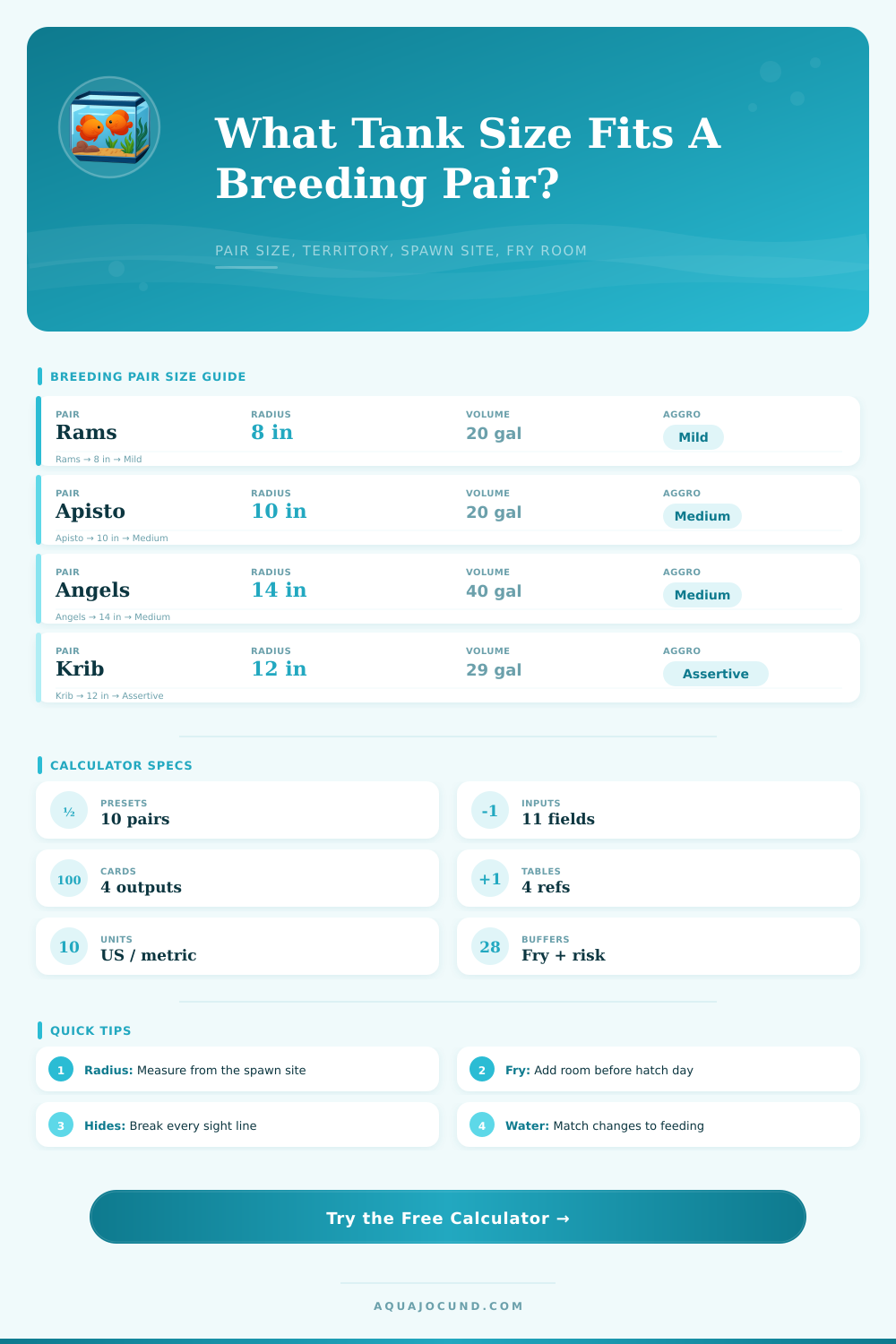
| Betta trial pair | 2.5-3 in / 6-8 cm | 8 in / 20 cm | 60 sq in bubble-nest zone |
| Livebearer group | 1.5-2.5 in / 4-6 cm | 6 in / 15 cm | 40 sq in plant thicket |
| Apistogramma | 2.5-3 in / 6-8 cm | 10 in / 25 cm | 80 sq in cave zone |
| German blue ram | 2.5-3 in / 6-8 cm | 8 in / 20 cm | 70 sq in flat-stone area |
| Kribensis | 3.5-4 in / 9-10 cm | 12 in / 30 cm | 120 sq in cave apron |
| Shell dweller | 1.5-2 in / 4-5 cm | 9 in / 23 cm | 110 sq in shell bed |
| Angelfish | 5-6 in / 13-15 cm | 14 in / 36 cm | 160 sq in slate or cone |
| Discus | 5.5-6.5 in / 14-17 cm | 16 in / 41 cm | 190 sq in cone zone |
⚠Aggression And Territory Factors
| Aggression class | Area factor | When to use it | Calculator effect |
|---|---|---|---|
| Calm pair | 0.90x | Peaceful pair, low chasing | Slightly reduces territory area. |
| Mild territorial | 1.00x | Normal guarding around eggs | Baseline breeding zone. |
| Medium territorial | 1.18x | Cichlids with clear nest defense | Adds room around the spawn site. |
| Assertive pair | 1.40x | Pair may chase outside nest zone | Raises area and volume demand. |
| High risk pair | 1.70x | Hard pairing or strong brood defense | Builds in separation space. |
🛡Spawn Site And Hiding Structure Table
| Structure level | Factor | Typical materials | Use in calculation |
|---|---|---|---|
| Bare or open tank | 1.15x | Open glass, one object | More area because fish see each other constantly. |
| Some cover | 1.07x | One cave, sparse plants | Small penalty for limited retreat options. |
| Good breaks | 1.00x | Caves, wood, plants, sponge | Baseline hiding assumption. |
| Dense cover | 0.94x | Multiple caves, shells, thickets | Modest reduction while preserving fry room. |
💧Water Change And Filtration Table
| Routine | Weekly change | Best breeding use | Planning note |
|---|---|---|---|
| 25% weekly | 25% | Light feeding, eggs only | May be lean once fry are eating heavily. |
| 40% weekly | 40% | General pair tanks | Balanced default for most presets. |
| 25% twice weekly | 50% | Small fry batches | Smoother than one large weekly change. |
| 10% daily | 70% | Sensitive fry or heavy feeding | Keeps water fresh with small daily swings. |
| Grow-out heavy | 80% | Dense fry holding | Pairs with strong sponge and preconditioned water. |
“Twenty gallons is plenty of room for a couple of rams,” and yet, before a week go by you find yourself watching your cichlids stress one another out. The reason is that you measure in gallons whereas they live life in square inches on the substrate. Your fish don’t care how much water there is above their heads; all that matters to them is how much floor space they can stake out without being pinned into a corner by glass or a pesky relative. Understanding this change in perspective make the difference between a broken fin and a successful spawn.
That’s where the tool comes in. It turns the behavior of territory into a measure of size. First enter the size of the territory, i.e., what’s the radius of area they defend around the actual spawn site (bubble nest, flat stone, clay pot etc.)? Describe what is immediatly around that location. Then pick your aggression class to determine how far it reaches.
Why Your Fish Need More Tank Space
Some species are more aggressive than others. For example, an assertive cichlid species will patrol its perimeter and needs a larger “buffer” zone. A livebearer that is relatively calm require much less. If you underestimate their aggression, spawns will fail and fish will face chronic stress. This happens because a tank that is too small does not break up their lines of sight.
Keep in mind, the fry require room prior to hatching. This isn’t something you should of leave till after the eggs become larvae that swim around. Don’t wait until the fry are crowded because then you will be dealing with parents eating their young if they don’t back off from their brood. A fry grow-out buffer in input saves those precious few days so the parents can protect the fry without killing them. So what seems like a tiny % increase on paper actualy means no separating the family at a vulnerable point in the fry’s development.
If you look through the reference tables above, you’ll see the variation among species and understand why angelfish pairs typically require 40+ gallons vs. Some dwarf cichlids is manageable in ~20. It’s not just body size. It’s about the volume of water necessary to dilute waste during heavy feedings as well as the verticality. The size of your tank depends on filtration choices as well. A gentle sponge filter sounds great. You can keep those fry out of it! But what happens when the tank is too small? Even gentle flow become turbulent because the water has nowhere to slow down. Large volumes dampen the intensity of current so you have greater control over the immediate environment surrounding the nest. It’s why the calculator takes into account not just physical dimensions of the tank but type of filtration and whether or not water changes are done routinely.
If a tank must have ten percent changes each day, then it may be practically smaller than a tank with only weekly changes because the workload impact how consistently it can be maintained at good quality. Part of the habitat structure include clean water. The footprint recommendations will suggest ratios as well. The reason long tanks tend to be better for breeding pairs is that it gives them time to set up their own lines of separation. In a square tank, there’s a small area in the middle where you’ll face constant conflict. A longer setup allows one individual to stay near the entry and take care of the eggs while the other can patrol their end without having to deal with each other all day.
This is due to basic animal behavior. This isn’t just about putting fish into a box…it’s your home design. Breeding tanks are one of those things where you do a lot of predicting of potential future stressors. The calculator does the geometry, but the judgment calls comes from you. Are these fish especially nippy? Do you intend to leave the fry with the parents for weeks? Every answer either increases or decreases the needed volume.
The point isn’t to identify the smallest volume you can get away with. The point is to identify the volume at which the fish cease worrying about the boundaries and instead start focusing on the business of making babies. When the boundaries feel secure, everything else happens too. Begin with those square inches of bottom, enclose the volume around it, and you’ll probably notice that water line goes up as you get better results.