Salt Bath PPT Calculator
Plan bath salinity by volume, starting salinity, target ppt, salt product, duration, ramp water, weighing unit, and sensitivity class. Protocol math only.
🎯Quick Presets
⚙Calculator Inputs
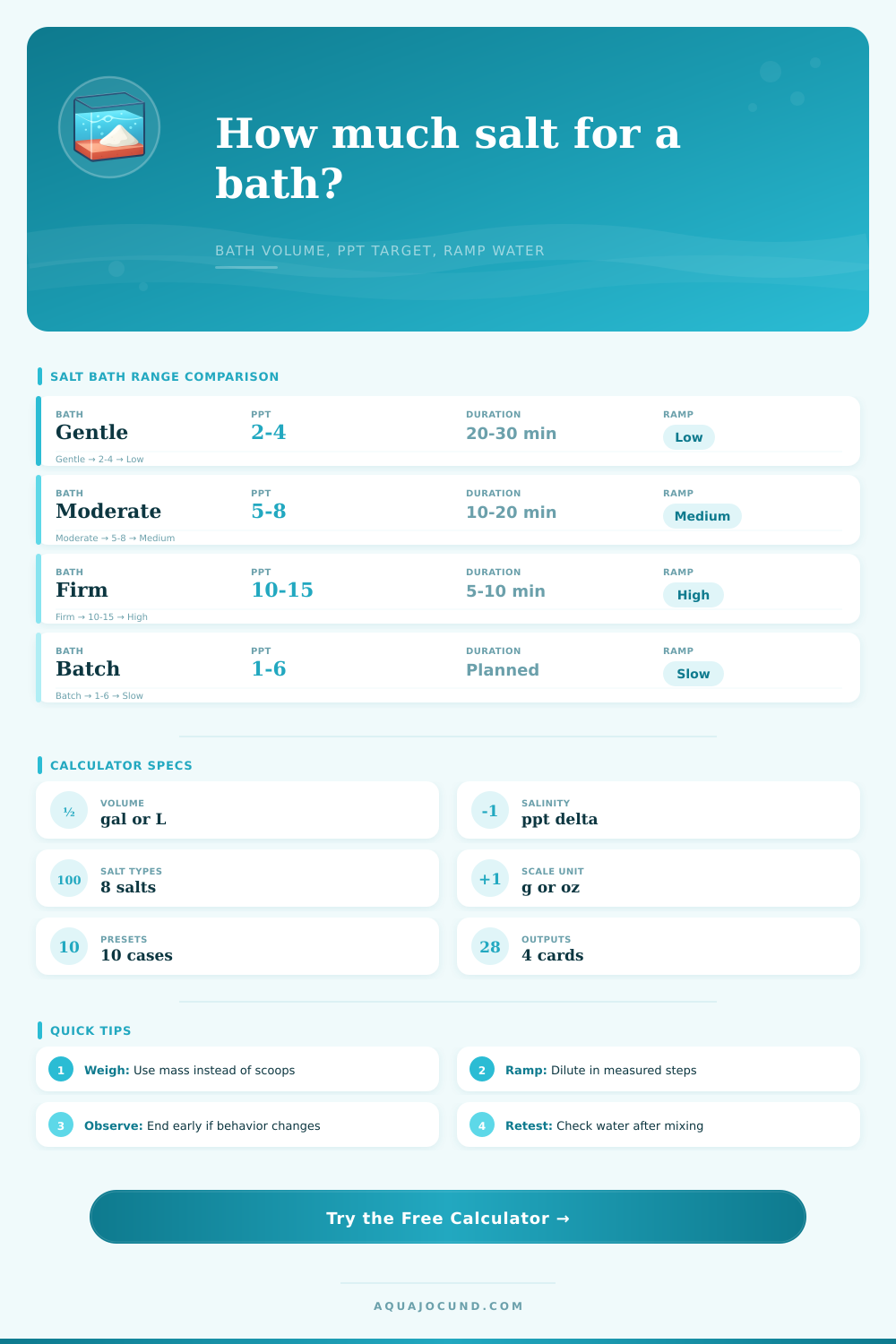
📊Salt Bath Range Comparison Grid
🧂Salt Type Measuring Grid
📋Salt Product Reference
| Salt type | Default purity | Approx grams per tsp | Protocol math note |
|---|---|---|---|
| Aquarium salt crystals | 99.5% | 5.7 g | Plain sodium chloride baseline for bath calculations. |
| Fine plain sodium chloride | 99.8% | 6.0 g | Dense grains; weigh rather than scoop when possible. |
| Kosher salt flakes | 99.0% | 4.8 g | Flaky volume measures run lighter than fine salt. |
| Coarse sea salt | 98.5% | 5.1 g | Coarse crystals dissolve more slowly in small baths. |
| Solar pond salt | 99.0% | 5.4 g | Large crystals need complete pre-dissolving. |
| Marine salt mix | 86.0% | 5.5 g | Contains minerals and buffers; math is active-salt adjusted. |
| Epsom salt bath math | 100.0% | 5.0 g | Different compound; included only for mass-per-ppt math. |
💧Bath Container Examples
| Container | Working volume | Pure salt for +5 ppt | Pure salt for +10 ppt |
|---|---|---|---|
| Half-gallon cup | 0.5 gal / 1.9 L | 9.5 g | 18.9 g |
| One-gallon jug | 1 gal / 3.8 L | 18.9 g | 37.9 g |
| Small bucket | 2.5 gal / 9.5 L | 47.3 g | 94.6 g |
| Standard bucket | 5 gal / 18.9 L | 94.6 g | 189.3 g |
| Metric tub | 10 L / 2.6 gal | 50 g | 100 g |
| Koi bowl | 20 gal / 75.7 L | 378.5 g | 757.1 g |
⏱Sensitivity And Duration Reference
| Sensitivity class | Review band | Duration check | Calculator response |
|---|---|---|---|
| Hardy scaled fish | 15 ppt | 10 minutes | Flags above either value. |
| Standard community fish | 8 ppt | 10 minutes | Moderate default check. |
| Sensitive or small fish | 5 ppt | 5 minutes | Suggests lower math band. |
| Scaleless fish | 3 ppt | 3 minutes | Flags quickly for review. |
| Fry, shrimp, snails, plants | 2 ppt | 2 minutes | Marks protocol as high caution. |
| Brackish-tolerant fish | 20 ppt | 10 minutes | Allows wider salinity math. |
📈Ramp Water Dilution Table
| Ramp event | Formula | What changes | Planning use |
|---|---|---|---|
| Ramp-in water | salt mass / new volume | Final bath ppt decreases | Use when dilution happens before the timed hold. |
| Hold period | target ppt x liters | Salt mass stays fixed | Time and sensitivity class are checked separately. |
| Ramp-out water | ppt x old volume / new volume | Exit ppt decreases | Shows dilution after adding recovery water. |
| Reserve hold-back | dose x reserve percent | First weigh amount decreases | Leaves room for retesting before final adjustment. |
You need salt bath accuracy because guessing is bad medicine. It seems like a sloshy mess to have a bucket of water, but sometimes it’s just a little difference that can mean treated vs injured. Use the salt calculator to determine how much salt to add. It eliminates worry of whether you’re helping parasite or hurting fish.
The initial component of any equation is volume. Working water is something few people get right. If you’ve got a five gallon bucket, put a fish in there and tell me it’s full. It isn’t. There has to be a correction for head space and displacement. Entering the usable fill level with the tool will correct starting point before you add salt. Otherwise, you are dissolving crystals in less water then you think, which causes your concentration to run high.
How to Use a Salt Bath Calculator
The goal of a saltwater dip depends on what is in tank. Catfish and other scaleless fish such as loaches don’t handle higher osmotic pressure well. They has narrower time frames and stricter salinity limits. On the flip side, some hardy fish can stand tougher solutions longer. There’s a class (sensitivity) for each species which raises a red flag if you’re going over safe limits with either concentration or duration. That’s more of a safety net than a set-in-stone rule book. It says “hey, maybe think twice” before you commit to a plan that seems OK on paper but might not be so great in practice.
The variable most hobbyists overlook is salt purity. While aquarium salts are close to being pure NaCl (sodium chloride), other products like marine mixes include minerals and buffers which change amount of active mass per gram. Using one without accounting for this variation in purity result in a weaker bath than expected. To account for these variations, the tool requests the purity of product used. This way regardless if you’re using kosher flakes, or finer crystals, the salinity of result will match what you want. The density of different salt forms varies widely, so always weigh instead of scooping.
In reality, however, ramping salt concentrations up and down is a dynamic process. Most protocols describe holding an animal until end of the hold period, then adding freshwater slowly to reduce solution. That reduces concentration of your solution at the exit point, easing the fish’s return to regular water without shock. That ramping out volume affects parts per thousand, and the calculator measures that effect as well. As it models change from ramp-in and ramp-out volumes, it shows you what salinity will be on the way out (exit) so you know how much the water will be diluted when you release the animal. You’ll have some idea ahead of time instead of being forced into reacting to situation.
In addition to measuring your salt, the temperature is equally important. Thermal shock will compound stress of treatment if cold salt water meets a warm room. You can record difference in temperatures so you remember to precondition your bath water. It not only avoids mixing the water for you, but it also helps you realize how moddern this factor is before you set the timer.
Typical errors include inexperience or mixing issues. This happen either from mixing badly or from being impatient, which causes undissolved salts to concentrate in pockets on bottom. Stir till clear… No exceptions. The recommended concentrations in the table at the bottom of the page are guides. They is intended to stay safely within known ranges for different bath strengths, from a very gentle dip to something firmer. Results don’t require going right to edge. A precise mix is confidence-building. Knowing exactly what’s in your solution gives you time to watch fish instead of calculating.
The calculator up top will do those calculations for you. It’ll make the dilutions and the conversions so you don’t have to think while doing the work. Believe the process, believe your eyes more. Let biology take over and if the animal appears distressed, stop the bath before the timer runs out. Biology beats every calculation.
All of this said, however, there’s one thing that really matters: A salt bath is a controlled insult to the osmotic balance of a living thing. Because the variables are so tightly controlled, salt pulls out parasites more quickly than it damages healthy tissue (provided the variables is right). If you get them right, what was once a risky gamble becomes a manageable procedure. What was once a mystery becomes a tool you can rely on… A bucket.