💧 Liquid Med Drops Per Gallon Calculator
Convert a liquid aquarium product label from mL per gallon into calibrated drops, rounded totals, split portions, and water-change redose amounts using label math only.
Custom mode follows the exact mL-per-gallon rate on your product label.
Calculation Breakdown
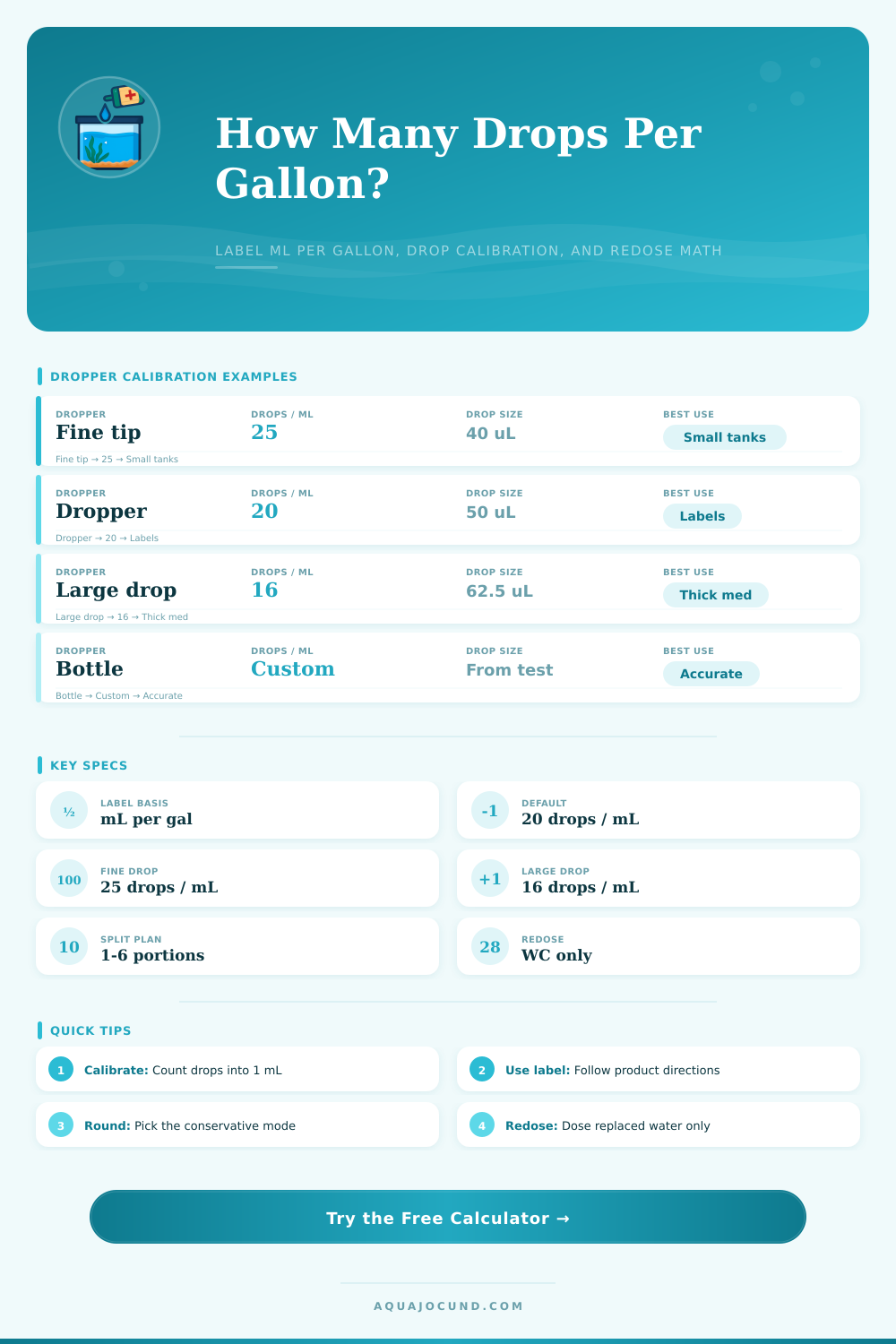
| Calibration | Drops per mL | Approx drop size | 1 drop equals | Notes |
|---|---|---|---|---|
| Fine plastic tip | 25 | 40 uL | 0.040 mL | Small increments |
| Common label assumption | 20 | 50 uL | 0.050 mL | Default |
| Large or thick drop | 16 | 62.5 uL | 0.0625 mL | Calibrate |
| Bottle | User count | 1000 / drops per mL | 1 / drops per mL | Count drops into a 1 mL syringe or marked vial. |
| Preset | Label rate | Default drops / mL | Drop size | Use in calculator |
|---|---|---|---|---|
| Low-rate liquid label | 0.10 mL / gal | 25 | 40 uL | Very small label amounts and fine droppers. |
| Standard dropper label | 0.50 mL / gal | 20 | 50 uL | General mL-to-drops conversion. |
| Concentrated liquid label | 0.25 mL / gal | 20 | 50 uL | When the bottle lists a smaller mL-per-gallon rate. |
| Thicker solution label | 1.00 mL / gal | 16 | 62.5 uL | Use bottle calibration because viscosity changes drops. |
| Tank | Typical dimensions | Nominal volume | Net at 12% displacement | Drops at 0.5 mL / gal and 20 drops / mL |
|---|---|---|---|---|
| 5.5 gallon | 16 x 8 x 10 in / 41 x 20 x 25 cm | 5.5 gal | 4.8 gal | 48 drops |
| 10 gallon | 20 x 10 x 12 in / 51 x 25 x 30 cm | 10 gal | 8.8 gal | 88 drops |
| 20 long | 30 x 12 x 12 in / 76 x 30 x 30 cm | 20 gal | 17.6 gal | 176 drops |
| 40 breeder | 36 x 18 x 16 in / 91 x 46 x 41 cm | 40 gal | 35.2 gal | 352 drops |
| 75 gallon | 48 x 18 x 21 in / 122 x 46 x 53 cm | 75 gal | 66.0 gal | 660 drops |
| Mode | What it does | Best when | Math example |
|---|---|---|---|
| Nearest whole drop | Rounds to the closest full drop. | General measuring. | 42.4 drops becomes 42 drops. |
| Round down | Never exceeds the calculated drop count. | You want conservative label math. | 42.9 drops becomes 42 drops. |
| Round up | Never falls below the calculated drop count. | The label says to complete the amount. | 42.1 drops becomes 43 drops. |
| Water-change redose | Multiplies full dose by replaced-water percent. | Only replacement water needs the label amount. | 25% change uses 25% of the full dose. |
According to the label you’re supposed to add 5 milliliters per gallon. Your dropper? It doesn’t talk in milliliters. It talks in drops, and that’s where most of us screw up with aquarium dosing. We have a precise, chemical-based instruction we want to follow and we try to convert it to very imprecise mechanical action.
How large those individual drops is can be the difference between overdosing and not dosing enough. A drop is something most folks take for granted. It’s one unit of measure, right? Nope. Depending on the viscosity (thickness) of whatever it is you’re measuring, the type of bottle (shape of tip), and the force used to depress the cap, there can be huge variations in what constitutes a “drop.”
How to Count Drops for Your Fish Tank
I’ve seen some bottles with thin plastic tip that dispense super-tiny droplets in very accurate bead. These may contains as many as twenty-five drops per milliliter. Conversely, if contents are thicker (like a gel-type supplement) being squeezed from a wide-mouthed dropper, maybe you get only sixteen big ol’ drops per milliliter.
Do you see where this goes? Take another product with an assumed standard rate but don’t use the same-sized drop as was used in their test and you’ll potentially be off by almost half the dose. When working with delicate water parameters or handling sensitive fish, that’s quite a margin.
Because you shouldn’t be doing mental math with a slippery bottle dangling unsteadily near your tank, here’s a tool to handle conversion for you (see above). It’ll take whatever milliliter rate appears on the package and convert it to the precise number of drops per calibrated dropper. Use a syringe to count out exactly how many drops equal a milliliter…much better than guesswork.
Then, it will adjust for true volume of your tank. Because nominal tank size isn’t a hydrological fact…it’s a marketing figure. A “ten gallon” bucket doesn’t contain ten gallons of anything when full; there’s air space at the top plus displacement from substrate, rock, etc. Failing to account for displacement result in overdoses that stress livestock.
The ability to split doses is also a differentiator. While some medications may be best given as a single dose, others may be better given more frequently and in smaller quantities. With this option, you can break up your entire dose into several parts at specified time increments, this can help keep your meds at a steady concentration instead of shocking your bodys natural filter.
Also, if you’re calculating dosing after a water change, the calculator will give you your redosing amount. If you replace exactly what you removed (e.g., 25% water change), then you’ll still have an active treatment while avoiding any potential compound error.
There is one more level of customization: rounding options. You have the choice to either round up, down or to next whole drop depending on how aggressive or conservative you need to dose. Rounding down gives you that buffer zone for delicate livestock (fry or shrimp). And when dealing with resistant bacteria, you can round up to guarantee some potency.
Included as part of the tool are reference tables that will allow you to quickly compare against common tank sizes/volumes/droppers. Those standard figures will allow you to confirm if your hand calculations matches what’s been seen within the industry.
Aquarium chemistry is not an exact science. Aquarium chemistry means acting with purpose. Knowing how much water you actualy have and how your system delivers liquid turns guesswork into control. And the calculator takes the guess out of math so you can concentrate on the fish. As the title implies, you can connect what the bottle says to what is realy happening in your tank. This makes routine maintenance into a controlled experiment.