Quarantine End Date Calculator
Build a dated aquarium quarantine calendar from start date, observation days, optional windows, missed days, blackout days, restarts, and final checks.
📌Schedule Presets
📆Quarantine Calendar Inputs
📊Chosen Plan Snapshot
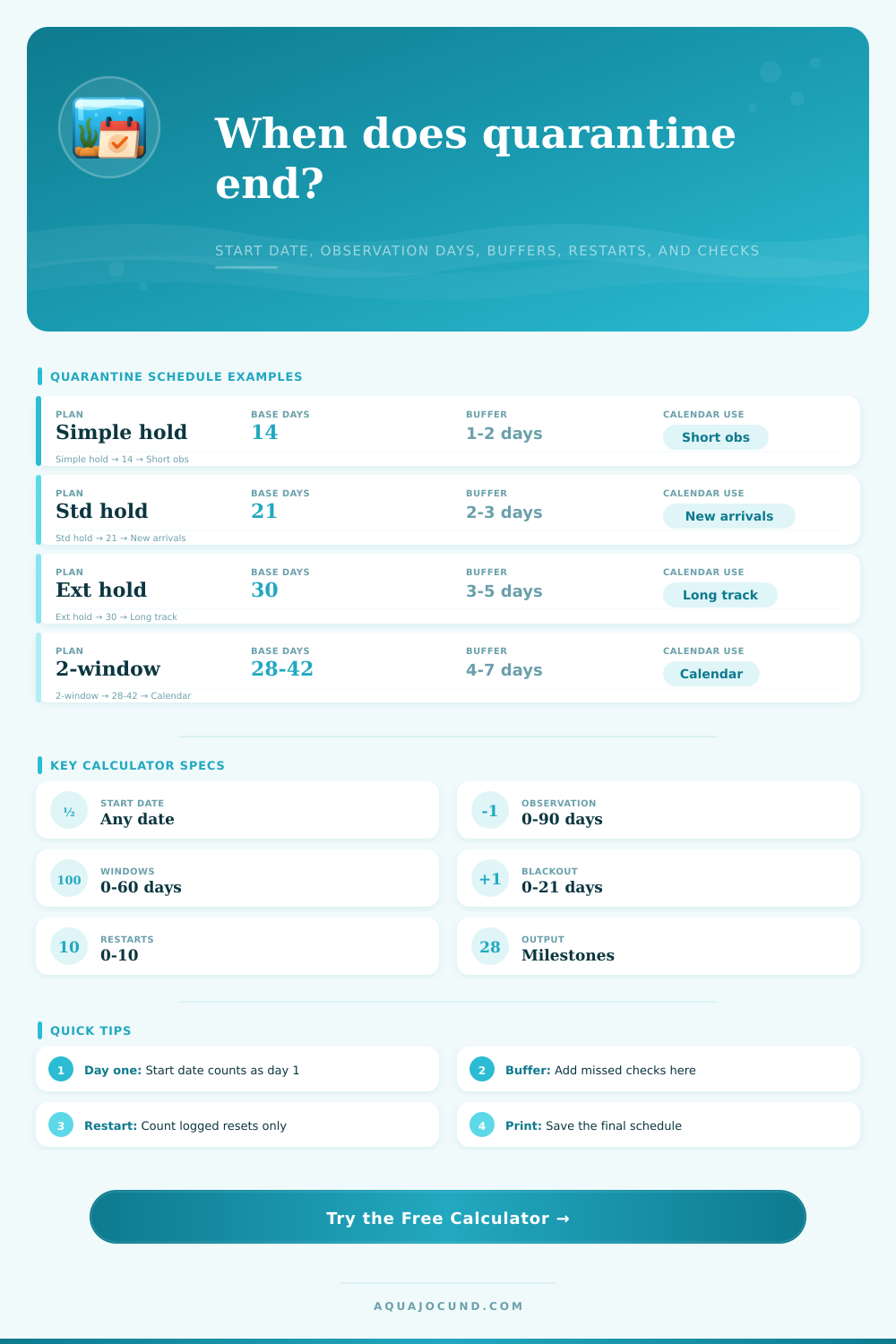
🧭Quarantine Schedule Comparison Grid
| Schedule Type | Typical Base | Common Add-Ons | Calendar Output Fit |
|---|---|---|---|
| Simple observation hold | 10-14 days | 1-2 final check days | Milestones |
| Standard new-arrival hold | 21 days | 2-3 buffer days | Milestones or weekly |
| Extended tracking hold | 30 days | 3-5 buffer days | Weekly checkpoints |
| Two-window calendar | 28-42 days | Window gap, blackout, final checks | Calendar |
| Restart-ready calendar | 21-30 days | Restart trigger extension | Calendar |
⚙Window Pattern Reference
| Pattern | Observation | Window Days | Default Use In Calculator |
|---|---|---|---|
| Observation only | 14-30 | 0 | Dates without treatment windows |
| Short holding window | 10-14 | 0 | Short calendar tracking |
| Std holding window | 21 | 0 | New-arrival date planning |
| Ext holding window | 30 | 0 | Longer observation calendars |
| Single treatment window | 14 | 7-14 | One optional treatment block |
| Two treatment windows | 14 | 14 + 14 | Two dated blocks with a rest gap |
| Blackout-heavy plan | 21 | 7-14 | Add water-change blackout days |
| Restart-ready plan | 21-30 | 0-14 | Add restart-trigger extensions |
📋Calendar Output Modes
| Mode | Rows Shown | Best For | Print Notes |
|---|---|---|---|
| Milestone schedule | Stage starts and ends | Fast end-date planning | Shortest printout |
| Weekly checkpoints | Day 1, weekly marks, stage changes | Longer quarantine calendars | Good for clipboard notes |
| Detailed daily rows | Every day up to 120 days | Missed-day tracking | Longest printout |
| Result cards | 4 summary cards | Quick calendar answer | Always included |
🔁Restart And Buffer Reference
| Input | What It Adds | Example | Where It Appears |
|---|---|---|---|
| Missed-day buffer | Extra calendar days | 2 missed checks = 2 added days | After base stages |
| Water-change blackout | Blocked calendar days | 3 blackout days = 3 added days | After windows |
| Restart trigger count | Triggers multiplied by days per restart | 1 x 7 = 7 added days | Before final checks |
| Final check days | Closing verification days | 2 final checks = 2 added days | End of schedule |
The fish is newly acquired. They may have come with some germ from where they were. On one hand, you want to release them in your tank as soon as possible. You want to incorporate them into the community. At the same time, you don’t want to expose your current population to any disease, etc… That becomes a question about how long they should be quarantined.
They should be quarantined long enough to find out if they gets sick or show signs of stress before it is too late. But not so long that you needlessly keep the animal(s) isolated. A quarantine end date calculator will help you turn those fuzzy wishes into actionable dates. Rather than making an estimate about when to put a new arrival in the main tank, you’ll know exactly when based on check periods plus reasonable delay windows.
How Long Should You Quarantine Your New Fish?
Twenty one. That’s how long it takes. Why? Because, under normal circumstances, parasites will have completed their life cycle in three weeks if it was going to happen. Most common parasite have life cycles that surface within three weeks if the environment triggers them.
The time period is based off a perfect scenario. Water quality is perfect. The medication regimen was perfect. The observation schedule was perfect. Guess what…that’s never reality for anyone maintaining any aquarium. Work got in the way of watching for symptoms. Family responsibilities gets in the way of monitoring water parameters. Whatever happened…the fish weren’t checked every day.
This is another common misconception. Some people think they have to stick exactly to the starting date. They don’t understand that it’s not a hard and fast deadline…it’s a guideline. The buffer inputs fix those gaps. When you miss a day (or more) and don’t do water changes, you can enter those days into the calculator. Two days for a missed check isn’t overkill. It’s an allowance for human error. By skipping a check, you run the risk of missing first sign of symptoms. Adding the extra days lengthens the hold period and gives you back the required safety margin.
Blackout days also serves as buffers for the times when you’re not home or otherwise unable to treat the water. Adding them pushes out the end date but it keeps you from releasing too soon and causing problems in your main tank.
Treatment windows are used by some hobbyist. That is to say they split up quarantine into phases like observation, medication, and then a recovery period. The calendar supports this with the ability to create distinct blocks for each stage. It can even show a rest interval between treatments where you give the fish time to bounce back from the chemical impact of the medicine. It isn’t a simple “hold for three weeks” kind of schedule, but it is better for your sensitive pets that don’t handle long-term medication. The calendar output shows when each block ends so you know if you’re in a rest period or still treating.
Other features such as restart triggers matter too. Day fifteen doesn’t mean that we let the clock continue without pause if we see some symptom of something. The clock extends and/or resets if the first ten days didn’t solve whatever it was. This means that logging a restart trigger extend the end date by however many days it was supposed to be there, because the fish still has the problem. Better to have the fish in quarantine longer than risk exposing others with a carrier on day twenty-two instead of zero. Once logged, the tool automaticly figures out how long the quarantine needs to go based on your trigger count.
There are comparison reference tables to compare approaches. For example, sensitive catfish may need extra buffers and longer monitoring compared to hardy tetras that can just go straight into a holding tank. It all boils down to your level of risk tolerance and where the fish originated. Fish obtained from a reputible breeder might only need minimal buffering and shorter holds. On the other hand, if you bought them at your local LFS which has a high volume of turnover, then take more care.
Waiting sucks. Patience is needed in quarantine. There might be no changes in the tank. And it’s boring work. But all of this would of been worth a healthy main tank. Using the calculator takes any guesswork out of waiting. You know exactly when to expect the time to be up. Then, on that last day, if the fish looks good, you know for sure that you can put him back. The calendar holds you accountable until that moment.
Just take your first day, use the buffer days, and stick to the plan for releasing. That way, your new fish gets a shot but your main tank stays safe.