Salinity Ramp Schedule Calculator
Build a day-by-day salinity ramp from current ppt, target ppt, safe daily change, tank volume, source salinity, step volume, livestock sensitivity, and pause days.
🎯Quick Presets
⚙Calculator Inputs
📊Ramp Style Comparison
📅Schedule Preview
| Day | Action | Exchange | Start ppt | End ppt | Note |
|---|---|---|---|---|---|
| Run | Calculator | - | - | - | Schedule rows appear after calculation. |
🐟Livestock Sensitivity Reference
| Profile | Default cap | Suggested pause | Calculator note |
|---|---|---|---|
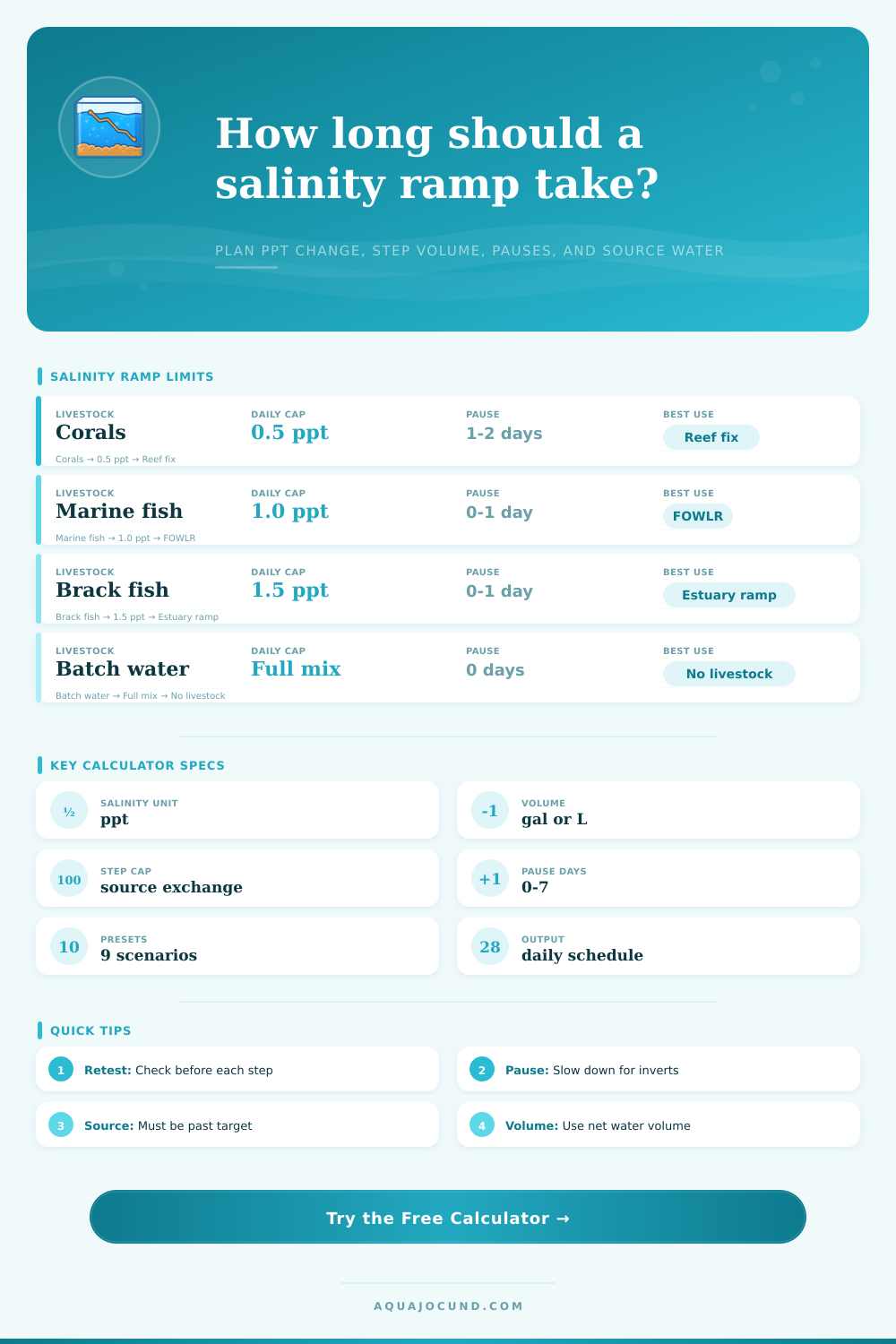
| Corals and mobile inverts | 0.5 ppt/day | 1-2 days | Use for reefs, anemones, snails, shrimp, and mixed coral systems. |
| Shrimp/crabs only | 0.4 ppt/day | 1-2 days | Most conservative livestock profile in this calculator. |
| Marine fish display | 1.0 ppt/day | 0-1 day | Useful for stable fish systems with calibrated testing. |
| FOWLR hardy fish | 1.2 ppt/day | 0-1 day | Allows a slightly stronger ramp while still staging changes. |
| Brackish hardy fish | 1.5 ppt/day | 0-1 day | Matches gradual estuary-style ramps for tolerant species. |
| Quarantine/hypo recovery | 0.5 ppt/day | 1 day | Designed for careful return toward normal marine salinity. |
📏Common Tank Size Step Examples
| Nominal tank | Approx dimensions | Net planning volume | 5% step volume |
|---|---|---|---|
| 10 gallon nano | 20 × 10 × 12 in / 51 × 25 × 30 cm | 8.8 gal / 33 L | 0.44 gal / 1.7 L |
| 20 gallon long | 30 × 12 × 12 in / 76 × 30 × 30 cm | 17.6 gal / 67 L | 0.88 gal / 3.3 L |
| 40 breeder | 36 × 18 × 16 in / 91 × 46 × 41 cm | 35 gal / 132 L | 1.75 gal / 6.6 L |
| 75 gallon reef | 48 × 18 × 21 in / 122 × 46 × 53 cm | 66 gal / 250 L | 3.3 gal / 12.5 L |
| 120 gallon reef | 48 × 24 × 24 in / 122 × 61 × 61 cm | 106 gal / 401 L | 5.3 gal / 20.1 L |
🌊Source Salinity Reference
| Source water | Typical ppt | Ramp direction | Planning note |
|---|---|---|---|
| RO/DI or freshwater | 0 ppt | Lower salinity | Useful for controlled dilution or brackish downshifts. |
| Low brackish mix | 5-8 ppt | Raise low systems | Gentler than full marine water for small brackish ramps. |
| Mid brackish mix | 12-18 ppt | Raise brackish systems | Common for puffer, goby, mono, and scats planning. |
| Standard marine mix | 34-35 ppt | Raise marine systems | Typical replacement water for reef and FOWLR targets. |
| High salinity correction mix | 36-40 ppt | Small upward correction | Works only when the step volume is small and well mixed. |
⚖Ramp Method Table
| Method | How the calculator applies it | Best fit | Watch point |
|---|---|---|---|
| Metered exchange | Limits each active day by both volume and profile cap. | Display tanks with livestock present. | May need more days if source water is close to tank ppt. |
| Steady calendar | Uses the smaller of calendar delta, source leverage, and safety cap. | Planned ramps with a fixed deadline. | A short deadline can still be too aggressive. |
| Minimum handling | Uses larger safe steps to reduce disturbance events. | Hardy fish or quarantine logistics. | Retest carefully because each step matters more. |
| Batch correction | Ignores livestock cap and calculates source exchange as prepared water. | Empty tanks, bins, and premixed water. | Do not use as a display-tank livestock schedule. |
A common problem in any reef tank is salinity drift, which will make you crazy, but correcting too fast is bad for your livestock. It seems instinctive to rush over to bucket of mixed salt water, pour some in the tank and call it done, but you are stressing your corals and other marine livestock. Salinity is an osmotic pressure that dictates every biological process in your tank, from photosynthesis to molting. A rapid change doesn’t allow the animal time to adapt; instead, it break down physically.
The calculator will help you go from impulse to plan. The key idea here is patience. Instead of simply filling up with water, it adjust how much water is exchanged to make transition work, calculated specifically for your tank size. For example, a coral reef environment will not adapt as well than a fish only system, and things like crustaceans (e.g., crabs & shrimp) is usually even less tolerant than fish. It provides day by day limits based off sensitivity profiles so no delicate polyp get shocked by accident. This design requires you to go along with biology, not against it.
How To Fix Salinity Safely
Measuring your water volume is not as simple as using nominal tank size. Actual water volume isn’t equal to labeled tank size due to the thickness of sand, rocks, heaters, filters, etc. Using the sticker size to make volume calculations means you’ll overshoot your salt level by default. Why do we need such a specific number for our input fields? Because speed isn’t nearly as important as accuracy. Each step of the adjustment ramp is compounded by a slight change in the assumed volume. Rather than rushing and risking triggering mass bleaching, it’s better to be safe and add an additional day.
Can I adjust salinity? The answer depends on the source water quality. To decrease salinity, you must have lower-salinity (or fresh) mix and your source must fall outside of your goal range in direction of the desired change. To increase salinity, your mix must exceed your goal and your source must fall outside of your goal range going in the opposite direction. It’s a physical limitation, which is why the calculator will mark plans as impossible given your configuration. That’s nice; it prevents you from wasting time pumping.
Depending on your tolerance for disturbance there are different ramp styles. Some styles has a metered exchange limiting the amount of daily change and volume exchanged. Consistent schedules spread the workload across an even timeframe. Fewer active days come from taking bigger, lower-risk steps, but those bigger steps poses higher risks when math doesn’t work out. Lots of steps mean lots of fish-handling in and around tank. This poses more stress to shy species and can disturbs sediment. The style matches your schedule and your tolerance for livestock.
No spreadsheet can take the place of testing, that is still the most important variable. Meters may not read exactly right and your mixing may not be exact either so the calculator includes safety reserves. Never add another liter until you have retested. Your physical test result is what matters, not the prediction. The schedule is there to guide you into making slow enough changes so that life has time to adjust. If you reach the end feeling like you fixed a broken system then you did it wrong. You should of feel like you got the tank safely home.