🧪 Acid Dose to Lower KH Calculator
Estimate water-prep acid dose from batch volume, current KH, target KH, acid capacity, step limit, rest time, and planning margin.
| Acid option | Approx capacity | Input role | Best calculator use | Planning note |
|---|---|---|---|---|
| Hydrochloric acid 31.45% | 10.0 meq/ml | Strong single-proton acid | Large hard-water prep batches | Small measuring errors change KH a lot |
| Hydrochloric acid 10% | 2.88 meq/ml | Dilute single-proton acid | Moderate batches and easier measuring | Still retest after each step |
| Sulfuric acid 35% | 8.99 meq/ml | Two equivalents per mole | Alkalinity reduction estimates | Ion contribution differs from HCl |
| Phosphoric acid 85% | 14.6 meq/ml | Multi-proton acid, approximate | Only when phosphate input is intended | Effective capacity varies by endpoint |
| Citric acid 50% solution | 7.81 meq/ml | Organic acid, approximate | Test-batch planning | Buffering behavior may not track strong acids |
| White vinegar 5% | 0.83 meq/ml | Dilute acetic acid | Small test jars and gentle adjustments | Requires much larger volume |
| Commercial KH reducer | Enter label value | Custom capacity | Product-specific dosing math | Use the label neutralization value if provided |
| Target change | Acid demand | Step approach | Retest timing | Use when |
|---|---|---|---|---|
| 0.5 dKH | 0.178 meq/L | Usually one small step | After mixing clears | Fine-tuning a prepared batch |
| 1 dKH | 0.357 meq/L | One conservative step | After aeration/rest period | Routine tap-water trimming |
| 2 dKH | 0.713 meq/L | Two 1 dKH steps | Between each addition | Common hard-water batch prep |
| 4 dKH | 1.426 meq/L | Four 1 dKH steps or smaller | Over one to two days | Large adjustment before blending |
| 8 dKH | 2.853 meq/L | Many staged additions | Plan extended rest time | Very hard source water |
| Batch | Volume | Metric volume | Acid demand for 1 dKH | 31.45% HCl equivalent |
|---|---|---|---|---|
| Test jar | 1 gal | 3.8 L | 1.35 meq | 0.14 ml before margin |
| Nano change | 5 gal | 18.9 L | 6.75 meq | 0.68 ml before margin |
| Small bucket | 10 gal | 37.9 L | 13.5 meq | 1.35 ml before margin |
| Comm batch | 20 gal | 75.7 L | 27.0 meq | 2.70 ml before margin |
| Mixing barrel | 55 gal | 208 L | 74.2 meq | 7.42 ml before margin |
| Vat / pond prep | 150 gal | 568 L | 202 meq | 20.2 ml before margin |
| Item | Formula | Why it matters | Calculator handling |
|---|---|---|---|
| KH drop | Current KH - target KH | Only positive drops need acid | Negative values become zero dose |
| KH to alkalinity | dKH x 0.3566 meq/L | Converts carbonate hardness to acid demand | Uses 17.848 mg/L as CaCO3 per dKH |
| Total acid demand | meq/L x liters | Scales the dose to the batch | Adds optional unmeasured buffering allowance |
| Raw dose | Total meq / meq per ml | Turns demand into liquid volume | Uses selected or custom capacity |
| Starting dose | Raw dose x margin factor | Creates a lower first estimate | Margin reduces the first planned addition |
| Step count | Ceiling(drop / max step) | Splits big changes into retestable portions | Minimum one step for positive drops |
The problem with having hard water while keeping sensitive species is this: you take a bucket and pour in tap water that looks clear but may contain chemicals lethal to your fish. To adjust this, you’ll have to add a chemical or mix one with other chemicals to lower that buffer (KH). But here’s the catch. That buffer is going to be high; too high if your goal is to keep certain tropical fish or shrimp. Why? High buffers are also alkaline buffers. This means that unless you know exactly how many drops of acid it takes to lower the buffer, you will crash the pH completely!
You don’t need to guess because the stoichiometry is handled by the calculator above. Depending on how much of what reagent you’re using and how big your batch is, it calculates exactly how much acid you need to add to achieve the KH drop you want. Why? Because its simple chemistry. 10 dKH requires way more acid then 6 dKH if both gallons of water are going to be dropped to 5 dKH. But all of that changes as soon as we talk about the volume of liquid. For example, dropping a five-gallon nano tank from 6 dKH to 5 dKH only require a fraction of the acid used when that same drop occurs in a hundred-gallon mixing barrel. That same drop in a five-gallon nano tank bucket takes a fraction of the acid needed for a hundred-gallon mixing barrel. A five gallon bucket for a nano. The tool will scale this accordingly and remove any mental math which typically causes people to dose incorrecty.
How to Lower Water Hardness Safely
The majority of home aquarists get tripped up here when choosing the proper type of acid. Not all acids are created equal in terms of concentration or safety, so while some are safer, others might not be practical for the job. For example, full-strength hydrochloric acid is effective yet hazardous. Just a little mismeasuring will result in adding far too many milliequivalents to the water. This leads to a sudden drop in pH, which is a stressful event for your livestocks. Vinegar, on the other hand, is less harmful because it’s diluted, but using enough to be effective usually negates the point of treating a small amount of water. This table on the page breaks down their respective neutralization capabilities and explains why you’d use milliliters of 31 percent muriatic acid and why vinegar (at five percent) could take tablespoons for the same effect.
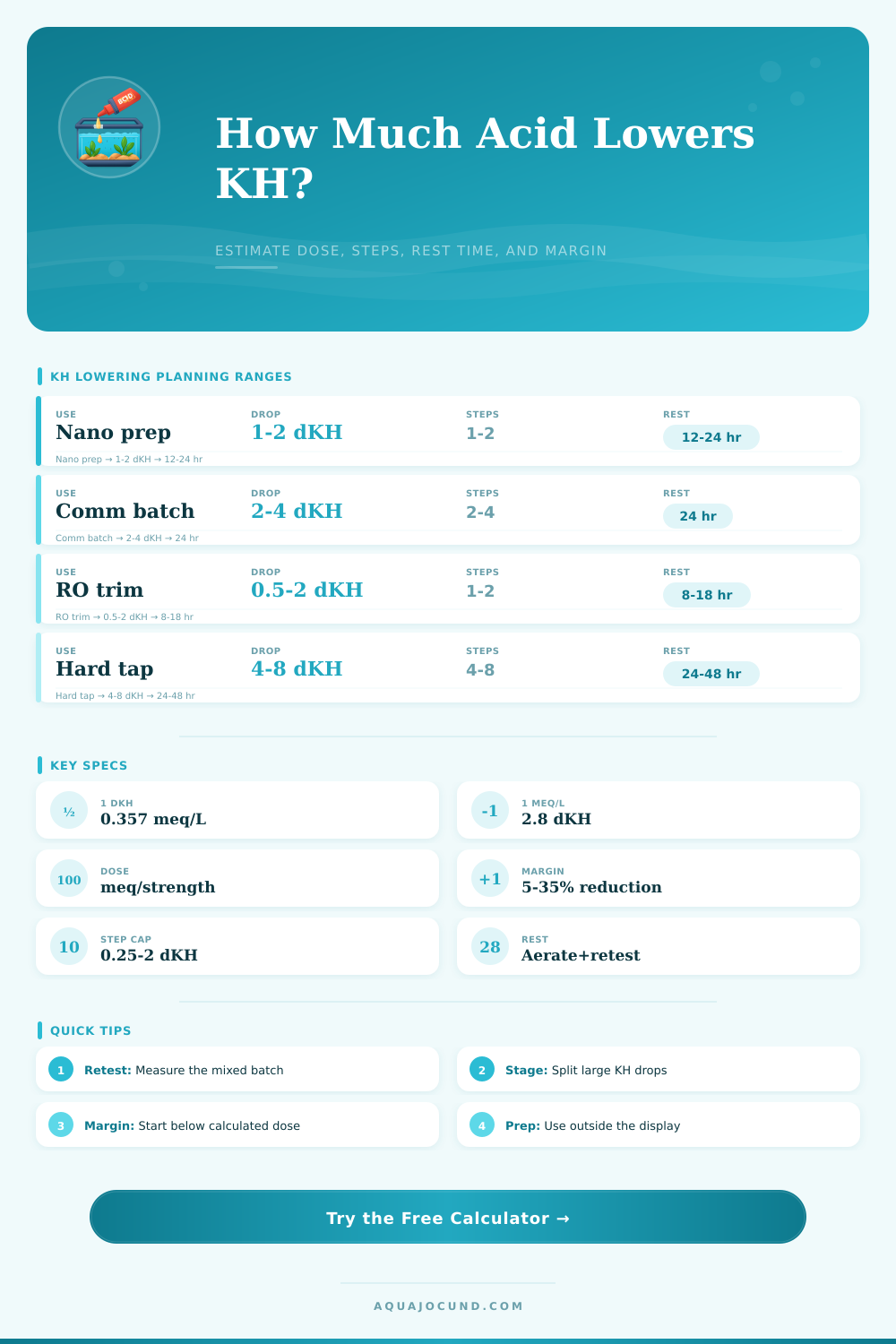
The second thing is that planning is everything. Unless your test kit is super accurate and doesn’t have extra buffering from unmeasured minerals in the water, I don’t recommend dumping the full amount the calculator suggests into your tank all at once. It’s asking for trouble. Rather, you need to stage it out. The calculator allows you to specify the max drop at each step along with how long to wait before adding more. This way you are forced to work incrementally. Add some acid, let it sit and react, aerate for a while to get rid of CO2, and then retest. Repeat until the KH isn’t too high anymore. Doing things this way keeps you safe from irreversible errors.
Another one of its safety features is a safety margin. This means you can lower the recommended starting dose by a percent. So if you want to start below the theoretically needed amount, you don’t risk overshooting. If you’re using tap water for example, there may be some unaccounted-for impurities that give alkalinity but which a typical test would not pick up. There could also be carbonate rocks within your tank’s substrate. The unmeasured buffer lets you take this into account as well. A little bit added here will serve as a cushion against these unknowns.
For example, they had presets for most common situations, such as trimming down KH for a shrimp tank or making big vats of stuff for a discus tank. They load up common target ranges/volumes which saves time. But don’t take them at face value. Before you start, always check what your water parameters are already. A good test kit can help. What you put into this thing is only as good as what it gets. If your starting KH measurement is incorrect, then all subsequent results will also be skewed.
There is a mix of patience and science involved with making good water. You don’t want to rush it or the parameters will be unstable and potentially shock the fish when you do your water change. Aerate between each step. The pH change can cause cloudiness, which is often a sign of mineral precipitation. That’s normal if you have really hard water, but it should settle quickly. Otherwise just let it sit and use the batch later.
You’re no longer willing to take what the city hands you through the tap, you’re manipulating the water yourself to suit your livestock’s biology. Think of it like having a map (the calculator), but you need to be careful driving. Go easy on the acid, go slow, and test often. With practice, making soft water can become routine, something that no longer stresses you as much as it used to. Soon enough, you’ll know the rhythm and your fish will appreciate the stable home you’ve created for them. Each measured dose at a time. You should of known how hard it was.