GH From Added Salts Calculator
Estimate aquarium general hardness from calcium and magnesium salts, then compare batch dGH, final tank dGH, Ca ppm, Mg ppm, and Ca:Mg balance.
Calculated hardness contribution
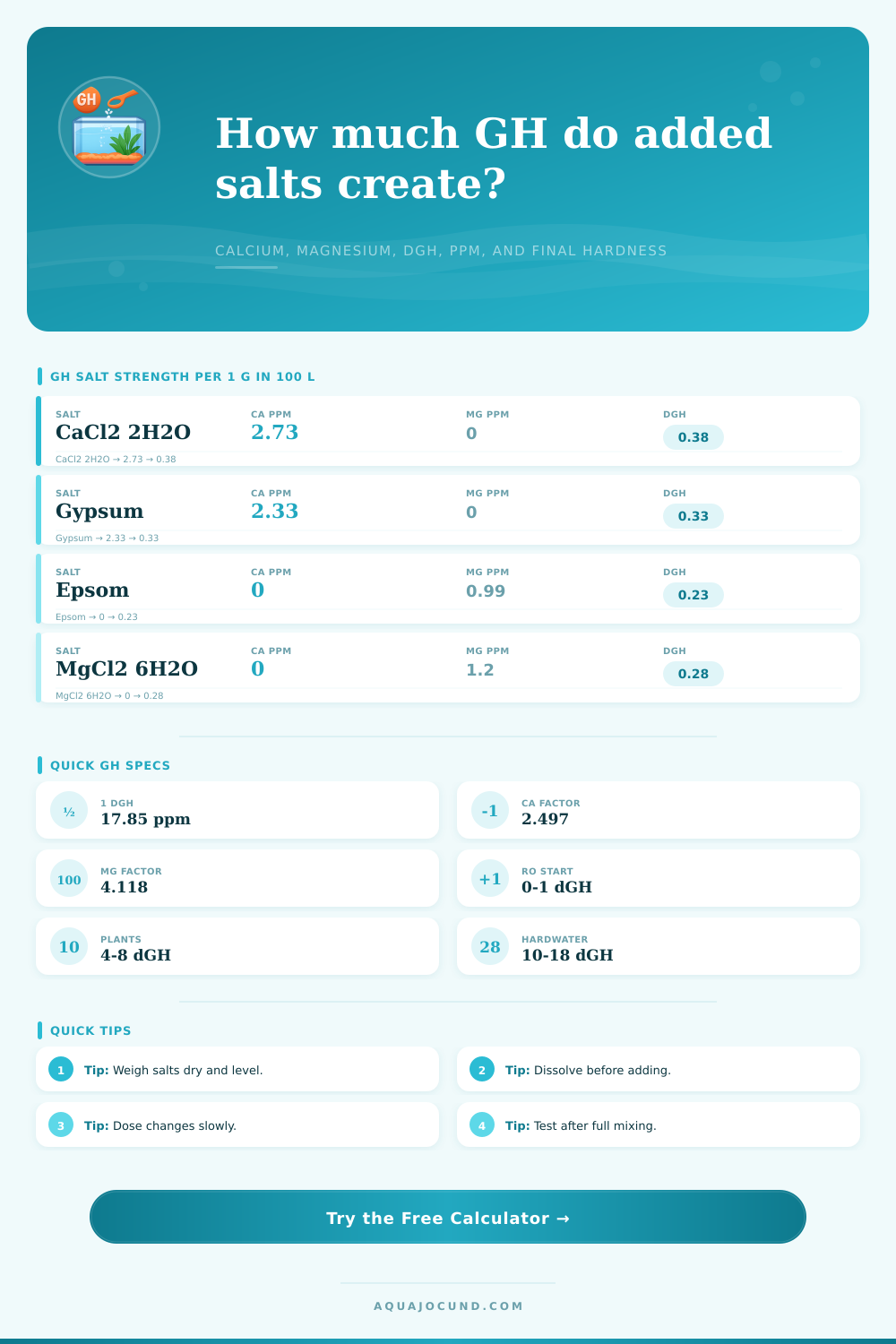
Calcium chloride dihydrate
0.38 dGH per 1 g / 100 LFast dissolving calcium source with no magnesium; useful when Ca needs to move more than Mg.
Gypsum
0.33 dGH per 1 g / 100 LAdds calcium and sulfate; dissolves more slowly than chloride salts and is often mixed ahead.
Epsom salt
0.23 dGH per 1 g / 100 LCommon magnesium sulfate source; raises GH without adding calcium or carbonate alkalinity.
Magnesium chloride hexahydrate
0.28 dGH per 1 g / 100 LA compact magnesium source that dissolves readily; useful for chloride-tolerant freshwater mixes.
| Dry source | Main ion counted by GH | Element fraction by weight | 1 g in 100 L adds |
|---|---|---|---|
| Calcium chloride dihydrate, CaCl2·2H2O | Calcium | 27.26% Ca | 2.73 ppm Ca, 0.38 dGH |
| Gypsum, CaSO4·2H2O | Calcium | 23.28% Ca | 2.33 ppm Ca, 0.33 dGH |
| Epsom salt, MgSO4·7H2O | Magnesium | 9.86% Mg | 0.99 ppm Mg, 0.23 dGH |
| Magnesium chloride hexahydrate, MgCl2·6H2O | Magnesium | 11.96% Mg | 1.20 ppm Mg, 0.28 dGH |
| Calcium carbonate, CaCO3 | Calcium plus carbonate | 40.04% Ca | 0.56 dGH if fully dissolved |
| Aquarium style | Typical GH range | Mineral emphasis | Planning note |
|---|---|---|---|
| Softwater blackwater fish | 1-4 dGH | Very light Ca and Mg | Raise slowly; many setups need stability more than high GH. |
| Planted community aquarium | 4-8 dGH | Moderate calcium with some magnesium | Keep Mg present when using calcium-only tap boosters. |
| Neocaridina shrimp and snails | 6-10 dGH | Balanced Ca with measurable Mg | Shell and molt support generally dislikes abrupt swings. |
| Livebearers and rainbowfish | 8-14 dGH | Calcium-forward hardness | Watch KH separately because GH salts may not raise alkalinity. |
| Rift lake cichlid systems | 10-18 dGH | Higher Ca and Mg | Use GH, KH, and pH as separate checks before livestock changes. |
| Nominal tank | Working volume | 1 dGH from CaCl2·2H2O | 1 dGH from Epsom salt |
|---|---|---|---|
| 5 gal nano | 18.9 L | 0.49 g | 0.83 g |
| 10 gal shrimp tank | 37.9 L | 0.99 g | 1.67 g |
| 20 long planted tank | 75.7 L | 1.98 g | 3.33 g |
| 40 breeder growout | 151 L | 3.96 g | 6.66 g |
| 75 gal display | 284 L | 7.44 g | 12.51 g |
| Measure | Conversion | Used for | Caution |
|---|---|---|---|
| 1 dGH | 17.848 ppm as CaCO3 | General hardness test kit scale | GH is not the same measurement as KH. |
| Calcium to CaCO3 equivalent | Ca ppm × 2.497 | Turning calcium into GH contribution | Only dissolved calcium counts in the water sample. |
| Magnesium to CaCO3 equivalent | Mg ppm × 4.118 | Turning magnesium into GH contribution | Magnesium has a larger GH factor per ppm. |
| Ca:Mg ratio | Calcium ppm / magnesium ppm | Comparing mineral balance | Species needs vary; use GH test results as confirmation. |
Why do most aquarists use salt? This is because their tap water lack enough minerals (i.e., it’s too soft) or they used a reverse osmosis system that filtered out the minerals. Adding just one thing won’t give you what you want. What are you adding, general hardness? General hardness is a chemical equation containing magnesium and calcium ions. Each of these ion adds something different to the overall number shown on your test strip.
Hard water is necessary if you’re keeping shrimp, since molting require hard water. On the other hand, you must have soft parameters for delicate fry. Guessing is dangerous with this tension between hardness and softness. With the calculator above, let the math be done for you. It calculates how many grams of each compound will result in exactly x amount of dGH so you no longer guess by eye.
How to Balance Salt in Your Tank
Salt differences are about ion content and molecular weight So what’s the deal? Why does one act so different than another? Calcium Chloride Dihydrate is a concentrated form of calcium. Its density allow it to pack a big punch for hardness. One little chunk go far in terms of adding hardness.
Magnesium Sulfate Heptahydrate (Epsom Salt), Here you have an addition of hardness, just less per gram. While it contain magnesium, there are other portions of the molecule with sulfate and heavy water molecules that don’t contribute to overall hardness. Therefore, treating them like equal amounts may result in overshooting your desired hardness goal with calcium. In turn, you’ll leave magnesium behind. This can lead to imbalances in shell of shrimp. It can inhibit plant growth too when those plants relies on magnesium for making chlorophyll.
You’re asked how much water you’re treating (literally), and what your starting volume is. That’s important if you’re treating a running system and dosing directly into it or mixing up some new water and planning to add it later. The former will be the total volume of the tank(s). The latter will be whatever size container you have new water in, this could be something like a bucket. The tool adjusts based off whether you provide your current volume or the percentage of water being treated and modifies the resulting calculation accordingly. You’ll get the actual concentration, not a theoretical pure number.
It also enable you to account for the purity of salt itself. Many salts bought at stores come with a bit of water or other anti-caking agents added. Setting the purity % lower in the calc takes that inert content into account. This keeps you from under dosing because you weighed filler in addition to the active ingredients.
This hinges largely on magnesium. Hobbyists are inclined to concentrate on calcium because they feel it’s something more substantial. But magnesium impact how fish perceive their environment and affects plant health. As the table on the page illustrates, magnesium converts to dGH at a higher ratio then calcium. That is, one part per million magnesium contribute more to the hardness value than one part per million calcium. Failure to consider magnesium will result in incorrect targets.
For example, you may believe you’ve achieved eight degrees of hardness. But if everything was calcium, it wouldn’t of been a complete biological environment. Your final defense is testing. What looks good on paper doesn’t always play out well in real life. Ions can bind to sediment. Solubility depend on pH. Added minerals don’t react with existing carbonate hardness the way a simple calculator thinks they should.
Take those theoretical amounts and use them as a guideline. Mix the heck of it. Let it circulate for at least an hour. Test it again using a liquid test kit. Is the result different? Adjust the following dose to match. Don’t make up the difference by dumping in more salt right now. Gradual change is far less shocking than any quick adjustment could ever be.
In summary, increasing GH isn’t so much an issue of volume as it is balance. A high level of hardness isn’t necessary to have a healthy tank. What’s needed is the correct amount of magnesium-to-calcium in relation to your livestock. Harder, higher pH water is better for cichlids. Acidic, low-mineral content water is preferred by discus. Use the appropriate salt mix based on what your goal is.
Don’t go by a one size fits all recipe. Take the time to use the math to find your way; it’ll be like having a road map. Then make observations along the way to steer yourself towards your destination. Go slow, take your measurements and let the water stabilize to a point where it supports life instead of just hitting a number on the chart.