💧 Target GH From Tap and RO Calculator
Blend tap water and RO water to a target GH, account for remineralizer boost, check species range, round mixing volumes, and predict water-change GH.
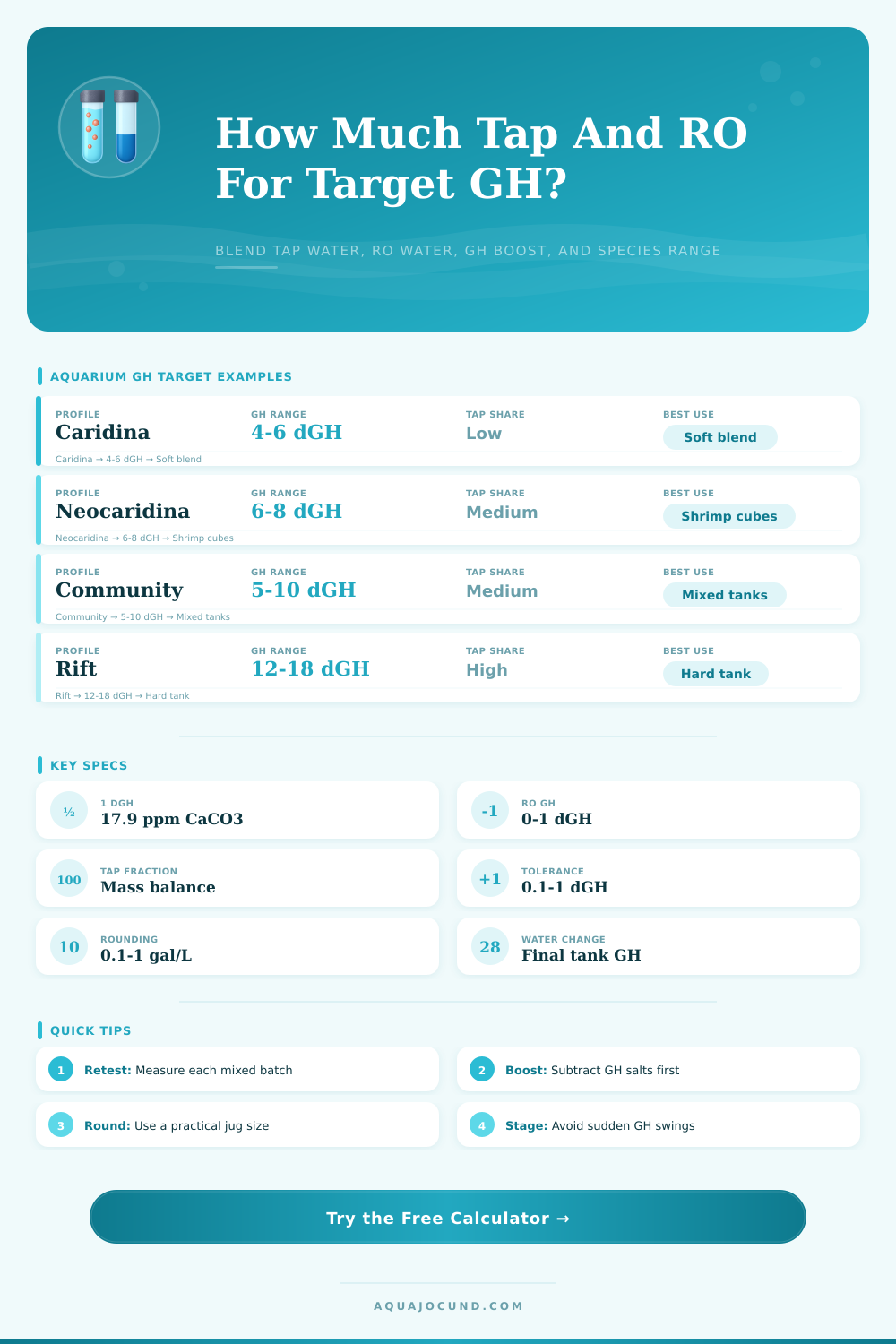
Typical Caridina shrimp target: 4-6 dGH.
Blend Breakdown
| Species profile | Common GH target | Blend note | Change caution |
|---|---|---|---|
| Caridina shrimp | 4-6 dGH | Usually mostly RO with controlled GH remineralizer | Slow |
| Neocaridina shrimp | 6-8 dGH | Often a moderate tap/RO blend if tap is clean | Steady |
| Softwater rasboras/tetras | 2-6 dGH | RO-heavy blend when tap GH is high | Slow |
| Planted community | 4-8 dGH | Tap/RO balance plus Ca/Mg fertilizer checks | Moderate |
| Livebearers | 8-14 dGH | Higher tap share or GH boost may be needed | Hard |
| Rift lake cichlids | 12-18 dGH | Hardwater mix with mineral salts and KH support | Hard |
| Tap GH | RO GH | Target before boost | Tap / RO blend |
|---|---|---|---|
| 12 dGH | 0 dGH | 4 dGH | 33% tap / 67% RO |
| 10 dGH | 0.5 dGH | 6 dGH | 58% tap / 42% RO |
| 16 dGH | 0 dGH | 8 dGH | 50% tap / 50% RO |
| 18 dGH | 1 dGH | 12 dGH | 65% tap / 35% RO |
| 8 dGH | 0 dGH | 10 dGH | Needs GH boost above tap blend |
| Tank or container | Typical volume | Useful batch | Calculator use |
|---|---|---|---|
| Shrimp nano | 5-10 gal / 19-38 L | 1-3 gal / 4-11 L | Small rounded volumes and tight tolerance |
| 20 long planted | 20 gal / 76 L | 4-6 gal / 15-23 L | 25-30% water changes |
| 40 breeder | 40 gal / 151 L | 8-12 gal / 30-45 L | Community or breeder water changes |
| 55 gal display | 55 gal / 208 L | 10-15 gal / 38-57 L | Large bucket or bin mixing |
| 75 gal cichlid tank | 75 gal / 284 L | 15-25 gal / 57-95 L | Hardwater blend plus mineral boost |
| Rounding setting | Best container | Expected effect | When to use |
|---|---|---|---|
| 0.1 gal / L | Marked measuring jug | Closest GH match | Shrimp and sensitive softwater batches |
| 0.25-0.5 gal / L | Bucket marks | Small rounding drift | Routine planted and community changes |
| 1 gal / L | Coarse bucket marks | Moderate GH drift on small batches | Medium or large tanks |
| 2-5 gal / L | Barrels and bins | Use wider tolerance | Large cichlid or fish room mixing |
Water hardness seems like an odd term until there’s an issue with your tank. Your prized neon tetra appears listless hanging out by bottom corner, or perhaps your shrimp molt poorly. Something changed in water quality but you can’t put your finger on what it is. Hardness (GH) refers to the amount of dissolved calcium and magnesium ions present in water column. These mineral ions plays an important role in many biological processes such as enzyme function and shell formation.
Your local water supply is likely set to match human drinking standards rather than those for delicate aquatic life. While the water may be perfectly fine for drinking, it could be too hard for your sensitive caridina shrimp. Blending now becomes less of a chore and more an art form. To save yourself from drowning in a sea of algebraic fractions, the calculator above will run necessary mass balance equations for you, leaving you free to consider biological result.
Understanding Water Hardness for Your Aquarium
Your goal will be to bridge the gap between your source water and the species you’re keeping. Your reverse osmosis will strip minerals well, resulting in water that’s safe but biologically inactive over time… Basically, almost blank slate water. That means you have to replace those minerals in a controlled fashion instead of dumping straight tap water into a system adjusted to softer conditions.
A lot of hobbyists mix up GH and KH as equivalent metrics, leading to uncontrolled pH swings when carbonate alkalinity fluctuates without any support from minerals. Knowing the difference will help you prevent shocking your livestock while doing routine water changes. For a benchmark on what soft, medium, or hard water actualy looks like in practice, check out reference table on the page. It provides typical ranges for different profiles.
Let’s think about how this translates to blending two waters that have wildly varying hardness values. Let’s say your tap water measures 12 degrees German hardness and your RO output is virtually zero. Your goal is to get a final mix that hits five degrees. How do you know what you’re doing? Well, you’re basically working with a highly concentrated solution (your tap) that you want to thin down to a certain midpoint value, in this case, five degrees.
Remineralizers also contributes some amount of GH. The tool will take that into account to help you avoid overdoing things if you end up having to adjust by adding salts after your first blend. People tend not to think of this because they’ll do their tap to RO calculation first, then forget to back out the hardness that the additives they intend to add will add at a later time. Doing that alone can drive your soft water goal right into hard water land in a heartbeat.
It is a little thing, but it should of been hugely important for those species that demand tight stability. Surprisingly, rounding is an important part of accuracy. This is particularly true if your tank size is on the small side, such as a nano tank where a half gallon difference makes a noticeable difference in the end concentration. Rounding also occurs due to using common mixing buckets with coarse markings. While they do provide fairly rough markings, these can be off by enough to push your results beyond your desired tolerance range.
The calculator lets you set how you want to round your values based off what your measuring containers are limited to. So, if all you have is big buckets but they’re only marked in 2 gallon increments, then don’t fight it and accept that level of precision. Instead, try not to get caught up in trying to achieve mathematical perfection which your mixing equipment won’t support anyway. In terms of livestock health, consistency trumps exactness most of the time.
What else complicates the scenario are water changes which blend old tank water with new prepared mixtures. Hardness can be stressful to organisms, and while the actual value matters, a sudden change, whether it’s an increase or decrease, causes even greater stress. Gradual changes allows biological processes to adjust slowly without triggering shock responses.
The prediction feature lets you know what your tank’s total GH will be following a partial change so that you can determine if a twenty five percent change is reasonable or whether you should split it up into several smaller changes. It also protects against those panicked late night sessions where a routine maintenance session result in wild swings in tank parameters.
So what is the main point? Water hardness management boils down to understanding the physical constraints of your home water supply, and more importantly, honoring the biology of your livestock. Whether it’s a hardy cichlid community tank or a high tech planted aquarium, being able to mix water gives you the ability to create an environment that suits your fish’s needs. This prevents your tank from being controlled by local city water changes.
Use good test kits, confirm your tap values on a regular basis, and don’t rely on guesswork; let math determine your water mixing ratio. Aim for consistent, controllable water conditions that promote life without requiring continuous attention. When you know where you stand regarding tap contribution, RO dilution, and mineral supplementation, those unseen parameters will change from unknown threats to manageable variables in the glass.