💧 Mixing Two Waters TDS Calculator
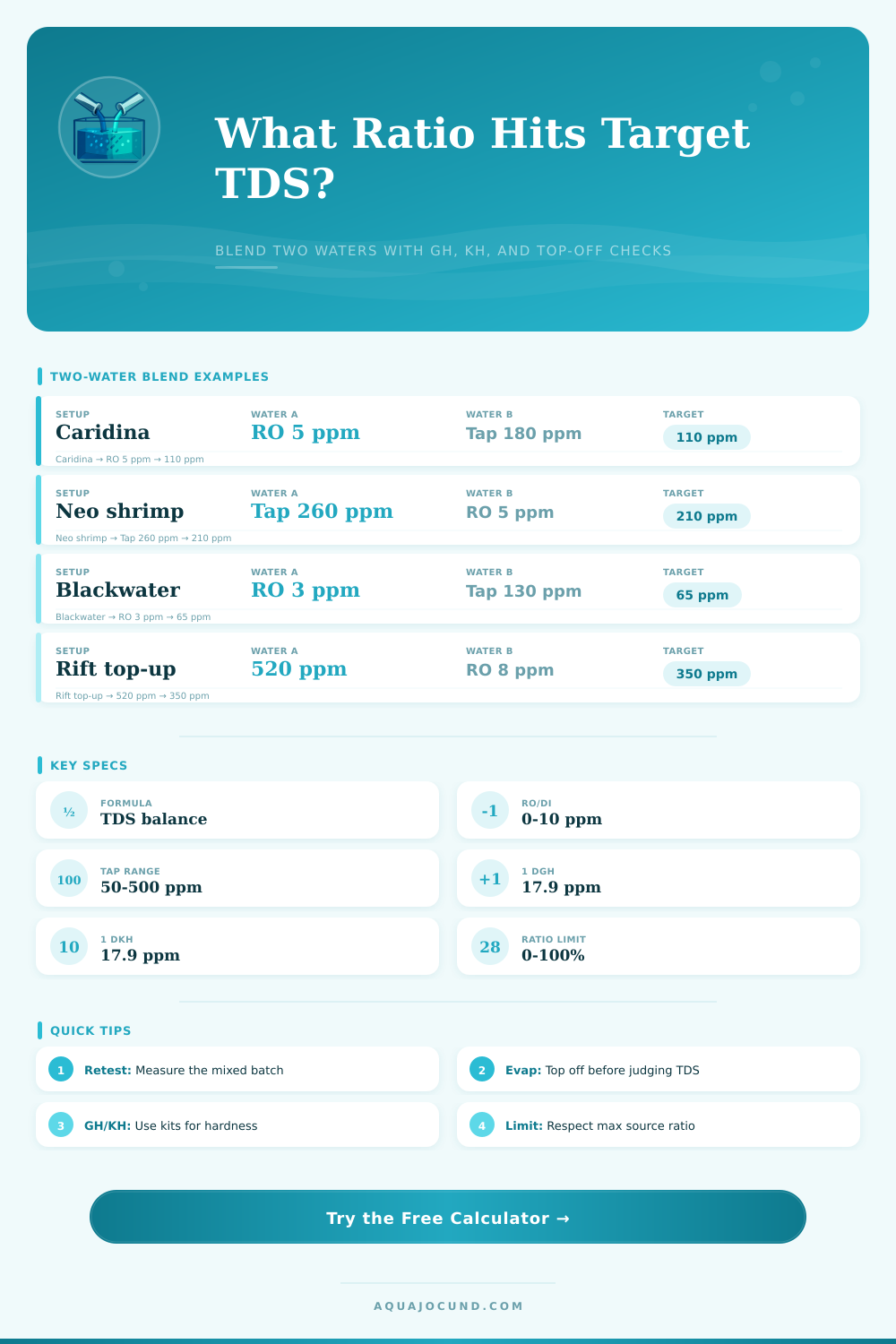
Blend water A and water B to a target aquarium TDS with batch volume, source ratio limits, optional GH/KH tracking, evaporation correction, and remineralizer add-on.
No extra minerals are added after blending.
Mixing Breakdown
| Source Type | Typical TDS | GH/KH Pattern | Blend Use |
|---|---|---|---|
| RO/DI or distilled | 0-10 ppm | Usually near 0 dGH and 0 dKH | Dilutes high-TDS water and gives a blank slate for remineralizing. |
| Tap water | 50-500 ppm | Depends on source and treatment | Convenient mineral source when stable and safe after conditioning. |
| Well water | 150-800+ ppm | Often high GH, high KH, or both | Use as the mineral-rich side only after testing metals and hardness. |
| Rainwater | 1-40 ppm | Usually low hardness | Soft dilution source if collected cleanly and tested each batch. |
| Remineralized RO | 80-520 ppm | Matches the salt recipe | Useful water B when tap water is unstable or unsuitable. |
| Blackwater extract mix | 10-120 ppm | Low KH preferred | Softwater blending where low alkalinity is part of the target. |
| Common Batch | Imperial Size | Metric Size | Typical Blend Job |
|---|---|---|---|
| Nano shrimp jug | 5 gal | 18.9 L | Small RO/tap blends for sensitive shrimp tanks. |
| Water-change bucket | 10 gal | 37.9 L | Repeatable weekly blend with marked containers. |
| 20 long refill | 20 gal | 75.7 L | Planted or community tank water-change preparation. |
| Brute-style barrel | 32 gal | 121.1 L | Larger fish-room batch with pump mixing. |
| 40 breeder service | 40 gal | 151.4 L | Large freshwater change or multiple nano refills. |
| 75 gal service | 75 gal | 283.9 L | Staging tank or bulk hardwater/softwater blend. |
| Target Profile | TDS Range | GH Reference | KH Reference |
|---|---|---|---|
| Caridina shrimp | 90-140 ppm | 4-6 dGH | 0-1 dKH |
| Neocaridina shrimp | 180-250 ppm | 6-8 dGH | 2-4 dKH |
| Planted community | 150-280 ppm | 4-10 dGH | 2-8 dKH |
| Soft blackwater fish | 30-120 ppm | 1-5 dGH | 0-3 dKH |
| Livebearer hardwater | 250-450 ppm | 8-18 dGH | 5-12 dKH |
| Rift lake cichlid | 320-550 ppm | 12-20 dGH | 10-18 dKH |
| Mixing Check | What To Watch | Why It Matters | Calculator Setting |
|---|---|---|---|
| Target outside source range | Target lower than both or higher than both sources | A two-water blend cannot reach it without a mineral add-on or a different source. | Adjust target or add-on TDS. |
| Ratio limit exceeded | One source needs more than the max allowed percent | The math works, but the practical source cap prevents that blend. | Raise max ratio or pick another source. |
| Evaporated batch | TDS reads high after water loss | Evaporation removes water, not minerals, so top-off can shift the final reading. | Use evaporation correction. |
| Hardness mismatch | TDS is right but GH or KH is off | Two waters can match conductivity while missing hardness targets. | Turn on GH/KH tracking. |
Water mixing sounds easy enough but it’s actualy doing some chemistry in a bucket. You’ve got hard tap coming in and soft reverse osmosis going out. Now mix those two together to reach your desired range for your planted tank/shrimp tank. Just plug in what your sources reads on that calculator above and let it do the math. No more grabbing measuring cup and guessing at coefficients while standing over the tub. It’s not complicated, just about having control.
Total Dissolved Solids (TDS) are easy to measure, cheap, and instantly gratifying; all reasons most hobbyists begin their water journey here. Measure the tap. Measure the RO. Aim to land somewhere right in between. While this is fine for ballpark estimates, it falls apart where stability become important. TDS is electrical conductivity estimate. Therefore, it measures anything that conducts electricity. This includes not just trace contaminants but also permanent and temporary hardness. It does not differentiate sodium chloride from calcium carbonate. That’s why there is an option for tracking General Hardness and Carbonate Hardness as well. If you’re keeping a species that has specific requirements for GH and/or KH, then relying exclusively on TDS measurements are dangerous. Enter those hardness values into the calculator and see whether or not the blend matches both your mineral AND conductivity targets. A small thing but it means a lot over time.
Why Mixing Water Needs More Than Just Guessing
The other source of error, which people seldom consider at home (is evaporation). When water evaporates (whether from your tank, or from your mixing container) then minerals is left behind. Those minerals concentrate what’s left in the tank. So TDS will be higher then what you calculated to make initially. If you mixed up something on Saturday and didn’t put a lid on it and used it Monday, you’ve changed your parameters. By asking about how much volume has been lost, evaporation correction addresses this issue. It’ll ask about any top-off water you may add prior to the final pour. That way, if your mix appears to be off, you know you’re not correcting wrong math but rather accounting for physics.
While there are many factors that influence the water being delivered to your fish tank, one that gets more attention than it deserves is source reliability. Treatment plants tweak their chemistries with the seasons, weather patterns shift groundwater tables, etc., so your municipal water can range from 180 ppm in June to 250 ppm in January. If you don’t test your sources right now but instead try to remember what they were yesterday, you’re not keeping up with the blend ratios and those will have drifted off target. That’s why you see the comparison of typical ranges for various water types (well), rain, tap and RO, at the bottom of the page. This reminds you that tap water is variable factor and RO is the constant baseline. Always test them both just prior to mixing. Letting go of old numbers is how stable tanks turns into unstable ones overnight.
The ratio limits also avoids unrealistic outcomes. Because pumps and storage have limitations, some combinations just isn’t feasible at any volume. You can specify max values as a percent of Water A and Water B. For example if the calculation demands 90% RO but your setup can only hold 50%, the calculator will flag that and force you to either recalculate your desired result or alter your sources prior to making changes. This avoids wasting time and water.
Additives like remineralizers also make this harder. When you blend with salts, those minerals adds to your overall TDS & hardness. There are fields on the calculator for including these additions in your total mineral load. Knowing how much salt will increase the parameters before you mix takes out the guesswork. More precise mixing reduce stress on livestock.
When you know what each of the inputs equate to in the real world, the numbers lose their abstraction. They become steps to take. No longer do you guess, now you plan. This switch from reaction to preparation is difference between hobbyist and someone who actualy keeps things alive reliably. The purpose isn’t to reach some random number but rather create an environment where external variables keep settings inside safe bounds.