Oxygen at Given Temperature Calculator
Estimate dissolved oxygen at your water temperature after salinity, altitude, saturation percent, tank volume, aeration class, fish biomass, and safety threshold.
Oxygen snapshot
Results update from temperature, salinity, altitude, saturation percent, tank volume, aeration class, biomass, and safety threshold.
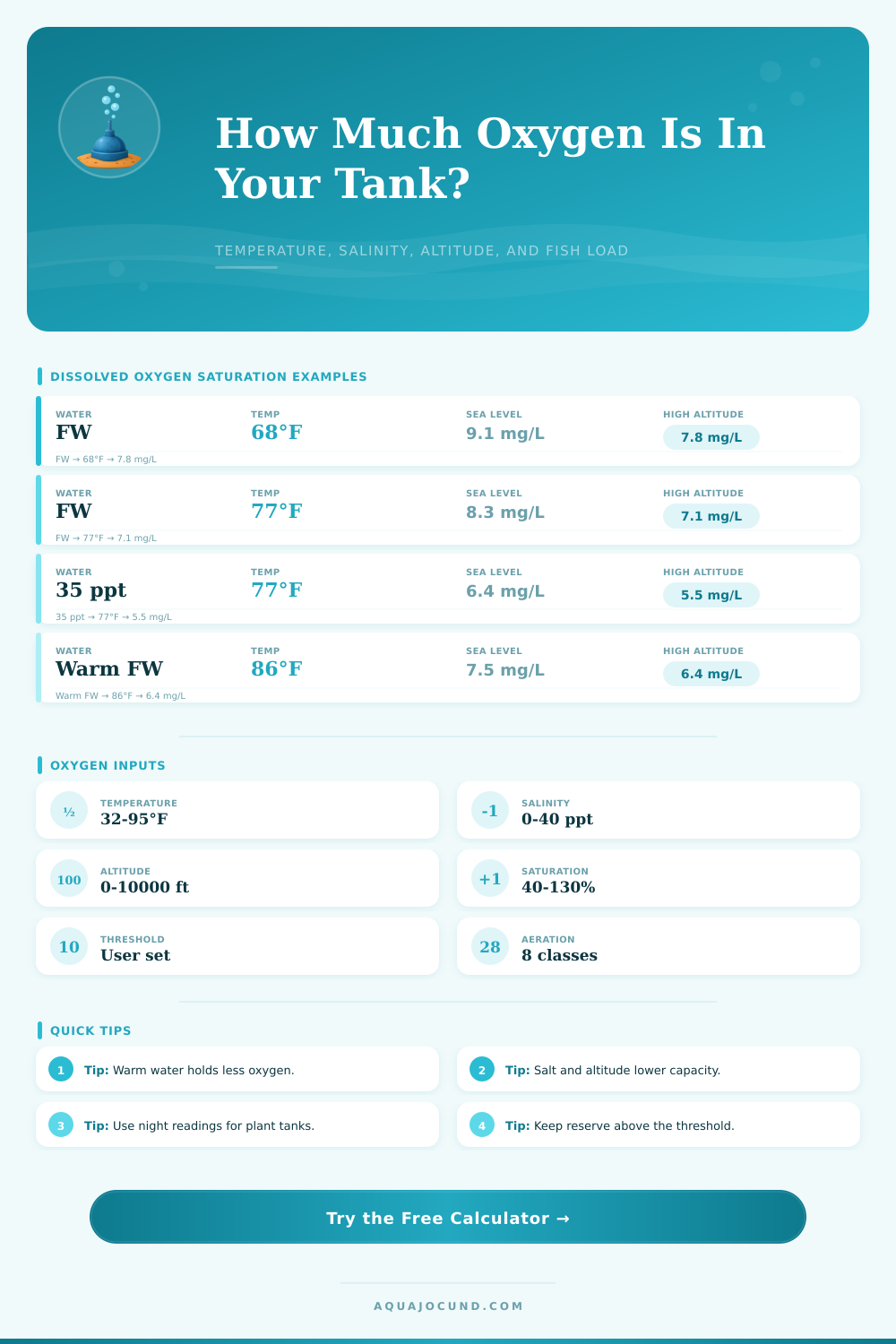
| Condition | 50°F / 10°C | 68°F / 20°C | 77°F / 25°C | 86°F / 30°C |
|---|---|---|---|---|
| Freshwater, sea level | 11.3 mg/L | 9.1 mg/L | 8.3 mg/L | 7.5 mg/L |
| Freshwater, 5000 ft / 1524 m | 9.5 mg/L | 7.7 mg/L | 7.0 mg/L | 6.3 mg/L |
| Brackish 15 ppt, sea level | 10.2 mg/L | 8.2 mg/L | 7.5 mg/L | 6.8 mg/L |
| Seawater 35 ppt, sea level | 8.8 mg/L | 7.0 mg/L | 6.4 mg/L | 5.8 mg/L |
| Seawater 35 ppt, 5000 ft / 1524 m | 7.4 mg/L | 5.9 mg/L | 5.4 mg/L | 4.9 mg/L |
| Aeration class | Planning recovery | Use when | Calculator effect |
|---|---|---|---|
| Still surface | 0.08 mg/L per hour | Temporary bowls, quiet quarantine, lid-heavy tanks | Little support; reserve drains quickly. |
| Light ripple | 0.18 mg/L per hour | Small displays with mild filter movement | Offsets light biomass only. |
| Filter return ripple | 0.28 mg/L per hour | Common freshwater and reef returns | Baseline support for moderate load. |
| Air stone | 0.35 mg/L per hour | Warm tanks, medication, backup oxygen | Adds steady gas exchange. |
| Sponge filter air lift | 0.42 mg/L per hour | Fry, shrimp, quarantine, breeder tanks | Combines filtration and surface turnover. |
| Powerhead surface break | 0.55 mg/L per hour | Large aquariums needing surface agitation | Improves exchange across broad surface area. |
| Overflow or skimmer | 0.75 mg/L per hour | Reef sumps and overflow systems | Strong exchange when water is mixed well. |
| Pond diffuser / shower | 1.10 mg/L per hour | Koi ponds and warm outdoor systems | Highest recovery class in this planner. |
| System | Typical volume | Common temperature | Typical oxygen note |
|---|---|---|---|
| Shrimp cube | 10 gal / 38 L | 72°F / 22°C | Low biomass, but small volume means reserve is limited. |
| Community tank | 55 gal / 208 L | 76-78°F / 24-26°C | Usually comfortable above 6 mg/L with filter ripple. |
| Goldfish tank | 40-75 gal / 151-284 L | 68-74°F / 20-23°C | Higher oxygen demand from body mass and waste load. |
| Warm discus tank | 75 gal / 284 L | 84-86°F / 29-30°C | Warm water has lower solubility, so aeration margin matters. |
| Reef aquarium | 75-120 gal / 284-454 L | 77-80°F / 25-27°C | Salinity lowers oxygen capacity; overflows and skimmers help. |
| Koi pond | 1000 gal / 3785 L | 70-86°F / 21-30°C | Summer heat and feeding can reduce reserve rapidly. |
| Saturation reading | Meaning | Calculator impact | Planning use |
|---|---|---|---|
| 40-60% | Strong oxygen deficit | Current DO may fall near safety threshold | Use for emergency or outage checks. |
| 60-80% | Below equilibrium | Reserve is reduced even if capacity looks adequate | Common in warm, dirty, or covered systems. |
| 80-100% | Normal aerated range | Current DO tracks expected solubility | Good range for most planning entries. |
| 100-115% | Slight supersaturation | Reserve rises above equilibrium | Can occur with intense plants, waterfalls, or chillers. |
| 115%+ | High supersaturation | Calculator shows more oxygen mass than air equilibrium | Verify meter calibration and rapid gas changes. |
Oxygen dissolves in water more readily than the colder the water. I know you’ve heard it before. Hobby magazines say it. Science teachers tells their students in grade school. And there it stops for most.
“If I have a heater set to seventy-seven degrees,” they reason, “then my water has plenty of oxygen.” That’s true but several other factors reduces this number even lower. Fish biomass, surface agitation, altitude, and salinity all contributes. The calculator above account for each. It doesn’t simply display a solubility chart. Instead, it puts those variables into a stress test based off your particular set-up.
Why Your Tank Needs More Than Just Cool Water
First, consider the water. Are you running reef tank? Salinity reduces the oxygen capacity of water dramaticly versus fresh water. The calculator will adjust the saturation baseline for parts per thousand.
Next, location, location, location. At elevations of five thousand feet and above, atmospheric pressure is lower. Even though your tank may have the same temperature as one at sea level, there are fewer oxygen molecule dissolving in the water due to the lower pressure. Your meter shows one hundred percent. That’s not what’s in the water. There’s just less of the life-sustaining gas present in that water than there would of be near the ocean. Keep this in mind if you add new livestock on a hot afternoon.
For aeration class, most people fall flat on their face. Still water without any current behaves like a closed system, oxygen is consumed by fish and bacteria faster then it can re-enter from the atmosphere. Gentle filter return will provides tiny amounts of gas exchange. An air stone or powerhead makes a dramatic difference in oxygen recovery rate.
How much? That’s where the recovery rates per hour are listed on the reference table in milligrams per liter. Why should you care about this? Oxygen demand isn’t static. It increase during feeding times. Plants also use oxygen while they’re not performing photosynthesis (at night).
The other lever is biomass. There’s no amount of water temperature that will prevent ten pounds of koi from stripping a tank bare. Similarly, there’s no volume of a single food item that will leave much of a reserve. For example, a single shrimp cube won’t have much impact on total dissolveds, but it doesn’t leave any margin for error.
These are the inputs into the calculator which calculates an oxygen reserve and how long until reaching a critical threshold. It forces you to consider worst-case scenarios instead of ideal conditions. Put in the warmest temperature your tank ever gets, not the average. That’s how you don’t get surprised.
But don’t get religious about the numbers. Think of them as a guardrail. When you see just twenty-minutes of reserve over your safety level, it’s time to cut back on feeding or add an air stone. Keep something in reserve in case of a summer heatwave, equipment failure, or power outage.
Oxygen stress is a silent problem that can cause damage before you even know it exists. By then, maybe you’ll notice some gasping at the surface. With accurate inputs and planning ahead, the system will be stable and won’t require constant intervention. There are unseen forces at play when managing an aquarium. Dissolved oxygen can’t be seen, yet we know it’s there or we don’t.
The calculator turns invisible scientific ideas into clear measurements, letting us see what is hidden in our tanks. It also reminds us that keeping something alive isn’t necessarily keeping it healthy. Keeping them healthy mean providing your livestock with enough space to breathe as well as other considerations. Less oxygen dissolves in warmer water, yet smarter management makes up for this shortcoming.