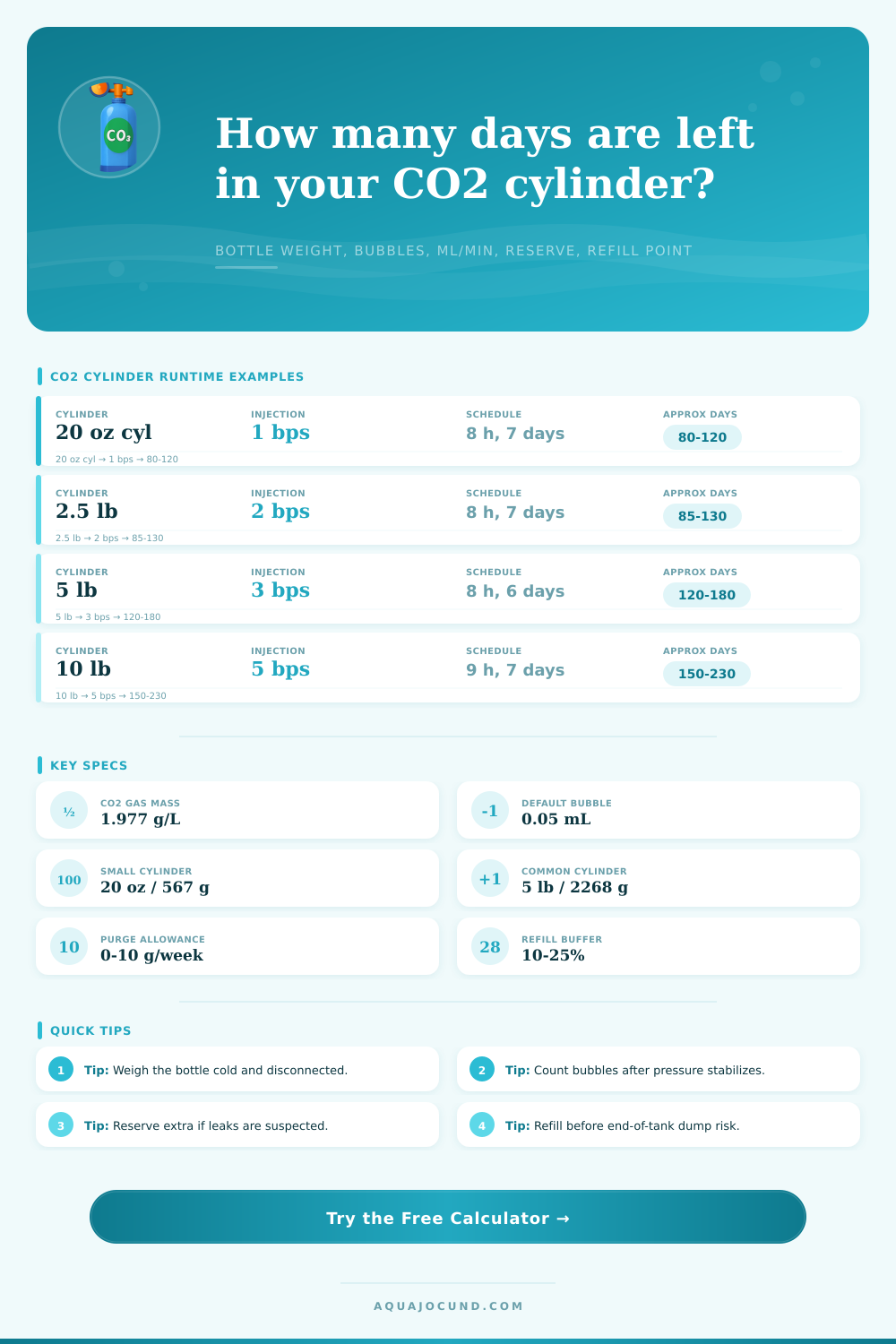
CO2 Cylinder Days Remaining Calculator
Estimate planted aquarium CO2 runtime from cylinder size, remaining bottle weight, bubble rate or mL/min, photoperiod, injection days, leak reserve, regulator purge, refill threshold, and tank demand.
CO2 cylinder runtime snapshot
Results update from bottle weight, usable reserve, injection rate, photoperiod, purge use, and tank demand.
| Cylinder | Nominal CO2 fill | Typical tare range | Use case |
|---|---|---|---|
| 425 g soda cylinder | 0.94 lb / 425 g | 0.75-1.0 kg bottle | Nano and temporary setups |
| 20 oz paintball | 1.25 lb / 567 g | 1.6-2.4 lb bottle | Small planted aquariums |
| 2.5 lb cylinder | 2.5 lb / 1134 g | 4-6 lb bottle | Small cabinet systems |
| 5 lb cylinder | 5 lb / 2268 g | 7-9 lb bottle | Most 20-75 gallon tanks |
| 10 lb cylinder | 10 lb / 4536 g | 12-16 lb bottle | Large tanks or long refill intervals |
| 20 lb cylinder | 20 lb / 9072 g | 24-32 lb bottle | Fish room manifold or very large display |
| Bubble rate | Approx mL/min at 0.05 mL/bubble | 8 h gas use | Notes |
|---|---|---|---|
| 0.5 bps | 1.5 mL/min | 1.4 g/day | Nano or very gentle starting point |
| 1 bps | 3.0 mL/min | 2.8 g/day | Common 10-20 gallon baseline |
| 2 bps | 6.0 mL/min | 5.7 g/day | Typical medium planted tank range |
| 4 bps | 12.0 mL/min | 11.4 g/day | Large or dense planted display |
| 8 bps | 24.0 mL/min | 22.8 g/day | Usually reactor, manifold, or high agitation |
| Tank demand profile | Planning mL/min per 10 gal | Efficiency factor | Best input use |
|---|---|---|---|
| Low light / slow plants | 0.3-0.6 | Lower loss | Use when drop checker barely needs lime green |
| Medium planted tank | 0.7-1.1 | Normal loss | Good baseline for mixed stems and epiphytes |
| High-tech stem plants | 1.0-1.6 | Normal to high loss | Use when light, fertilizer, and plant mass are high |
| Carpet / Dutch style | 1.4-2.1 | High demand | Usually needs stable injection before lights peak |
| Efficient reactor system | 0.8-1.3 | Better dissolution | Use for inline reactor with low visible mist |
| High surface agitation | 1.6-2.6 | Higher off-gassing | Use when overflow, spray bar, or skimmer strips gas |
| Common tank | Volume | Gentle start | High-tech range |
|---|---|---|---|
| 10 gallon nano | 38 L | 0.5-1 bps | 1-2 bps |
| 20 gallon long | 76 L | 1 bps | 2-3 bps |
| 40 breeder | 151 L | 1.5-2 bps | 3-5 bps |
| 55 gallon | 208 L | 2-3 bps | 4-7 bps |
| 75 gallon | 284 L | 3-4 bps | 6-10 bps |
| 125 gallon | 473 L | 5-7 bps | 10+ bps or reactor flow |
You’re reading a 100 pound gauge on your CO2 regulator. Because needle hasn’t moved, you assume you have weeks of supply left. So you assume you still has plenty of gas. Uh oh. That’s when planted aquarium hobbyists starts seeing brown stems and making an emergency trip to the gas supplier.
Here’s what they don’t know: The gauge doesn’t do this very well. As long as there is liquid carbon dioxide in the tank, pressure will be the same whether you have a pint or a gallon. The pressure only drops when cylinder is almost empty. That means there is a blind spot. You thought you were fine, but gas has been gone from the tank for days and your plant have been starved.
Why You Should Weigh Your CO2 Tank Instead of Trusting the Gauge
You enter injection rate and weight of bottle. The calculator does the rest. No more conversions or guesswork with coefficients. Time for some heavy lifting: grab the tank and place it on kitchen scale. What’s the tare weight of the empty cylinder? If you don’t already know, there’s a good chance it will be printed right on the metal. Take away that value and remaining weight is actual amount of gas in the cylinder. Weighing your gear as if it were head of lettuce might feel invasive but it is the sole honest piece of information we get. Pressure tell you nothing about quantity. Quantity tells us everything.
Then you guess at burn rate. How rapidly you’re depleting that mass. Bubblers per second are what most people count. Those are visual aids, but they don’t accurately measure volume. One bubble from a big diffuser have vastly more gas than one from a fine-bubbler stone. If you have a calibrated injection system or rotameter, you can use it to go beyond easy bubble counting to measured milliliters per minute. That level of accuracy become important if you’re operating a high tech set up with lots of stem plant gobbling up reserves in no time flat. It’s also important for those small leaks in the tubing because they will suck down a fifth of your supply without you ever realizing it until your water chemistry starts crashing.
And time, that’s important, too. Gas is consumed only during periods of light, or the photoperiod. For instance, an eight-hour light period mean eight hours per day of consumption. That schedule is built-in to the calculator. It eliminates the dark hours when nothing is being injected. So even though you might think you have plenty of supply left because of the pressure gauge, there may actualy be only a few days before the tank empties.
Finally, establish a reserve limit so you don’t let a cylinder go completely dry. At low volume rates, liquid CO2 can flash-to-gas to quickly and freeze regulators. Ten to 15 percent reserve assures safe operation of equipment while avoiding the last refill cycle.
The demand profile shifts greatly depending off different sized tanks. A small nano tank with slow-growing crypts will barely dent a paintball-sized cylinder. Seventy-five gallons of rapid-growers such as ludwigia and rotala act like a black hole for carbon dioxide in an aquarium. The reference tables laid out on the page provides some rough estimates based off common setups. They provide a sanity check on your inputs. If the math tell you that a five pound tank lasts three years at two bubbles per second, then something isn’t right. Most likely you’re leaking heavily or under-dosing.
That’s the beauty of it…the fact that the supply chain in this hobby is invisible. Where does the gas go? It dissapears. You don’t see it, you only see the results when it is gone. First there are brown leaves. Next growth slow. Then the algae takes over; it feeds off of chaos. With your scale and known burn rate you convert a mystery to a plan. No more guesswork… now you have time to refill on the weekend rather then in the middle of the week.
The point of all of it is control. It is about controlling an invisible resource for the sake of visible life. And yes, it takes discipline and patience to go through the process of weighing the bottle every few weeks. But once you get the hang of the math. Where runtime equals mass, you’ll never worry again. Your gauge might continue reading full but you’ll have the answer in your hands before the plants even notice something wrong.