Air Lift Flow Rate Calculator
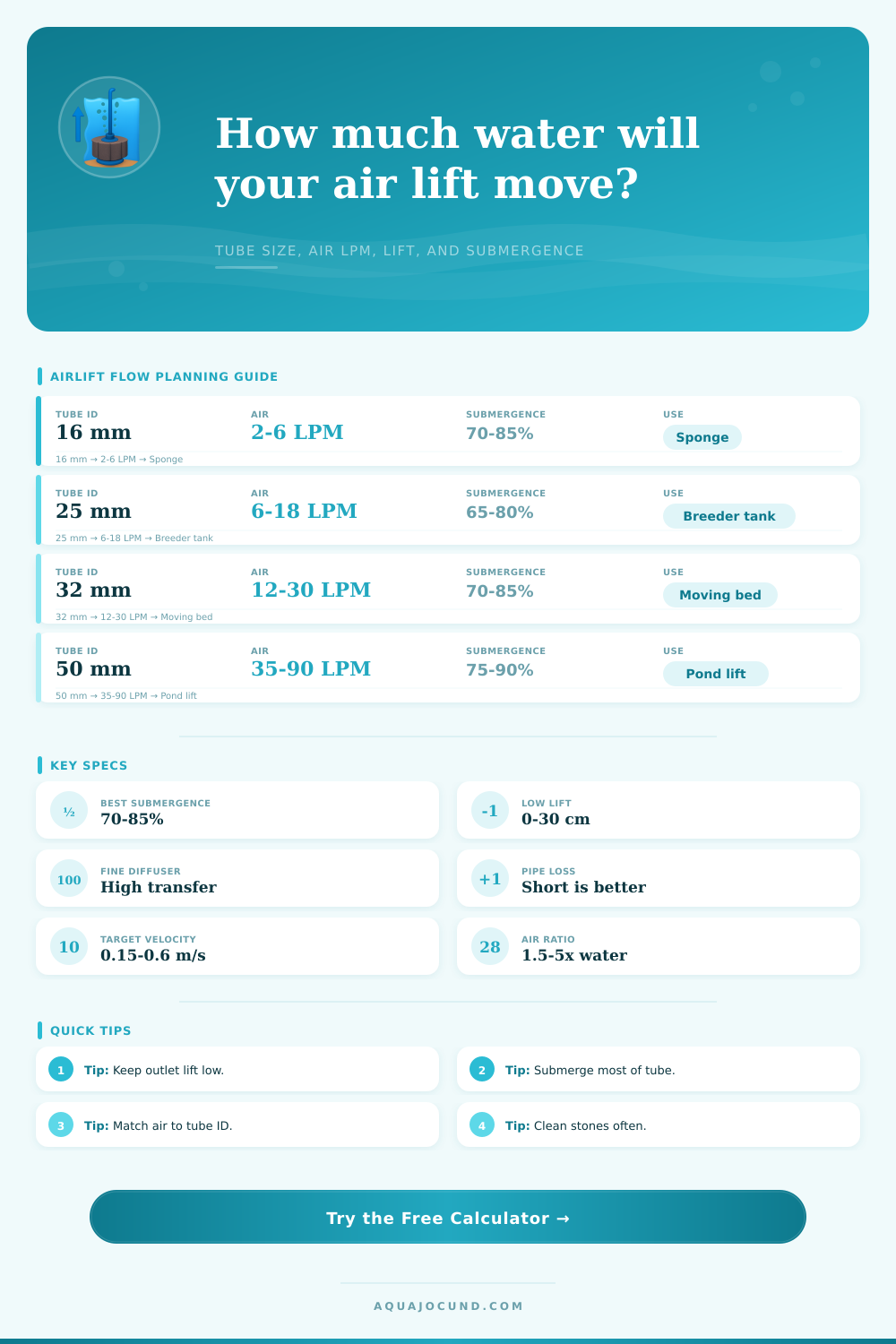
Estimate aquarium airlift water flow from tube diameter, submergence, air LPM, lift height, diffuser depth, pipe length, and efficiency class.
Estimated Airlift Output
| Inside diameter | Practical air range | Typical water flow | Best use |
|---|---|---|---|
| 12-16 mm / 1/2 in | 1.5-6 LPM | 4-18 LPM | Nano sponge, fry tank, shrimp rack |
| 20-25 mm / 3/4-1 in | 5-18 LPM | 15-60 LPM | Breeder tanks, box filters, corner lifts |
| 32 mm / 1.25 in | 12-35 LPM | 35-115 LPM | Matten filters and moving bed chambers |
| 40 mm / 1.5 in | 22-60 LPM | 70-200 LPM | Large tanks and low-head sumps |
| 50 mm / 2 in | 35-95 LPM | 120-330 LPM | Pond lifts and high-volume manifolds |
| Submergence ratio | Expected behavior | Lift height fit | Calculator note |
|---|---|---|---|
| 45-60% | Weak start, pulsing likely | Very low lift only | Increase diffuser depth or lower outlet |
| 60-70% | Usable but sensitive | Small sponge filters | Good for shallow tanks with short risers |
| 70-85% | Strong, steady lift | Most aquarium airlifts | Best planning band for this calculator |
| 85-92% | High output if outlet is low | Deep tanks and ponds | Watch backpressure and splash height |
| Class | Model multiplier | When to use | Maintenance clue |
|---|---|---|---|
| Coarse stone / open airline | 2.1x base | Simple sponge lifts and open tubes | Large bubbles, stable but less efficient |
| Standard air stone | 2.6x base | Common aquarium air pump setups | Replace when bubbles gather on one side |
| Fine pore diffuser | 3.2x base | Quiet lifts and compact risers | Rinse or soak when backpressure rises |
| Tuned low-lift riser | 3.7x base | Optimized outlet, straight pipe, deep diffuser | Best for repeatable rack systems |
| Aged or partly clogged | 1.65x base | Older stones or mineral buildup | Flow falls before bubbles disappear |
| Large pond manifold | 3.4x base | Wide pipe, low lift, high air volume | Balance air across branches |
| Preset | Tube and air | Water depth | Typical target |
|---|---|---|---|
| Nano Sponge | 16 mm, 3 LPM | 25 cm / 10 in | Gentle circulation under 80 LPH |
| Breeder Lift | 25 mm, 10 LPM | 40 cm / 16 in | Moderate 40 breeder turnover |
| Matten Filter | 32 mm, 18 LPM | 45 cm / 18 in | Wide biological filter draw |
| Moving Bed | 40 mm, 35 LPM | 60 cm / 24 in | Media chamber circulation |
| Pond Airlift | 50 mm, 70 LPM | 110 cm / 43 in | Low-head pond transfer |
An airlift is a quiet way to aerate an aquarium and also provide some water movement (good for sumps or breeding tank where a gentle flow is desired). The airlift moves water upward through a tube using rising bubbles, depending on factors like lift height, submergence ratio, tube diameter, and bubble size. It’s not necessarily good for moving large amounts of water since you’re relying on the bubble flow to move it up the tube.
An airlift might not work proper if one variable isn’t right. For instance, a narrow tube with insufficient air might stagnate. There’s even an airlift calculator so you can check your dimensions to see if you have a pump strong enough to do what you want.
How Airlifts Work
Submergence ratio is most important variable. Submergence is defined as the proportion of the total tube length that is submerged in water. Generally speaking, seventy to eighty-five percent is desired for efficient designs. When it is less than sixty percent, friction exceeds the hydraulics, so the water column isn’t heavy enough to provide a constant supply. Water pulse rather than flowing steadily. Low submergence caps maximum lift height even if the volume of air being blown are high.
The size of the tubing matter as well. Most folks think a big tube would move more water. Actualy, a large inner diameter means there is more surface area which creates more resistance. If you don’t add more air to match, it will slow the column rise. If there is too little air or the tube is too small, it might just stagnate. If there is too much air and the tube is too large, it won’t raise the water. It accounts for all of that by using efficiency multipliers based off the type of diffuser. Coarse stone make larger bubbles which transfer less momentum then fine pore diffusers.
How far up from the water surface is the outflow? That’s the lift height. Every cm of tubing that isn’t underwater will resist the force pushing it upwards. Keeping this distance minimal help maintain pressure. Increase the lift by raising the outlet? You’ll need either more air or more submergence to offset it. The calculator factors in lift height so you can enter your design and get an idea of what a higher outflow means before building it.
Another factor to performance is diffuser maintenance. Over time mineral deposits accumulates in fine pores of your diffusers. What was once a high efficiency diffuser becomes a low efficiency diffuser (you won’t notice). The output decreases because instead of small bubbles, larger bubbles are produced. Because of reduced surface contact the larger bubbles float up faster with less water. Reduced contact with water result in less momentum transfer. Keep it clean and get your efficiency back where it should of been.
For breeding systems, this is important for longer term steadiness as constant flow ensure an even distribution of temperature while avoiding any dead spots. When reviewing results, pay close attention to the air-to-water ratio. Healthy airlifts will push several liters of water per liter of air consumed. Anything closer to one to one is an indication that something’s not right; perhaps submergence isn’t sufficient, or maybe the tube is too wide for the amount of airflow it can handle. Use this idea to adjust your physical setup instead of purchasing a larger pump. Oftentimes adjusting diffuser depth just a few centimeters makes much more difference than doubling the air volume.
Airlifts transfer energy from compressed gas into moving liquids. They are gentle on fish and quiet. They can be engineered rather than guessed at. This is done by understanding how bubble size, diameter, and submergence interact. Know the real flow rate for shrimp tank or mat filters so that no costly mistakes occur. You want steady movement while wasting as little as possible to balance an ecosystem where every bubble matters.