Biomedia Volume Needed Calculator
Estimate biological filter media volume from fish biomass, daily feed, ammonia load, working surface area, maturity, oxygen delivery, flow, and safety factor.
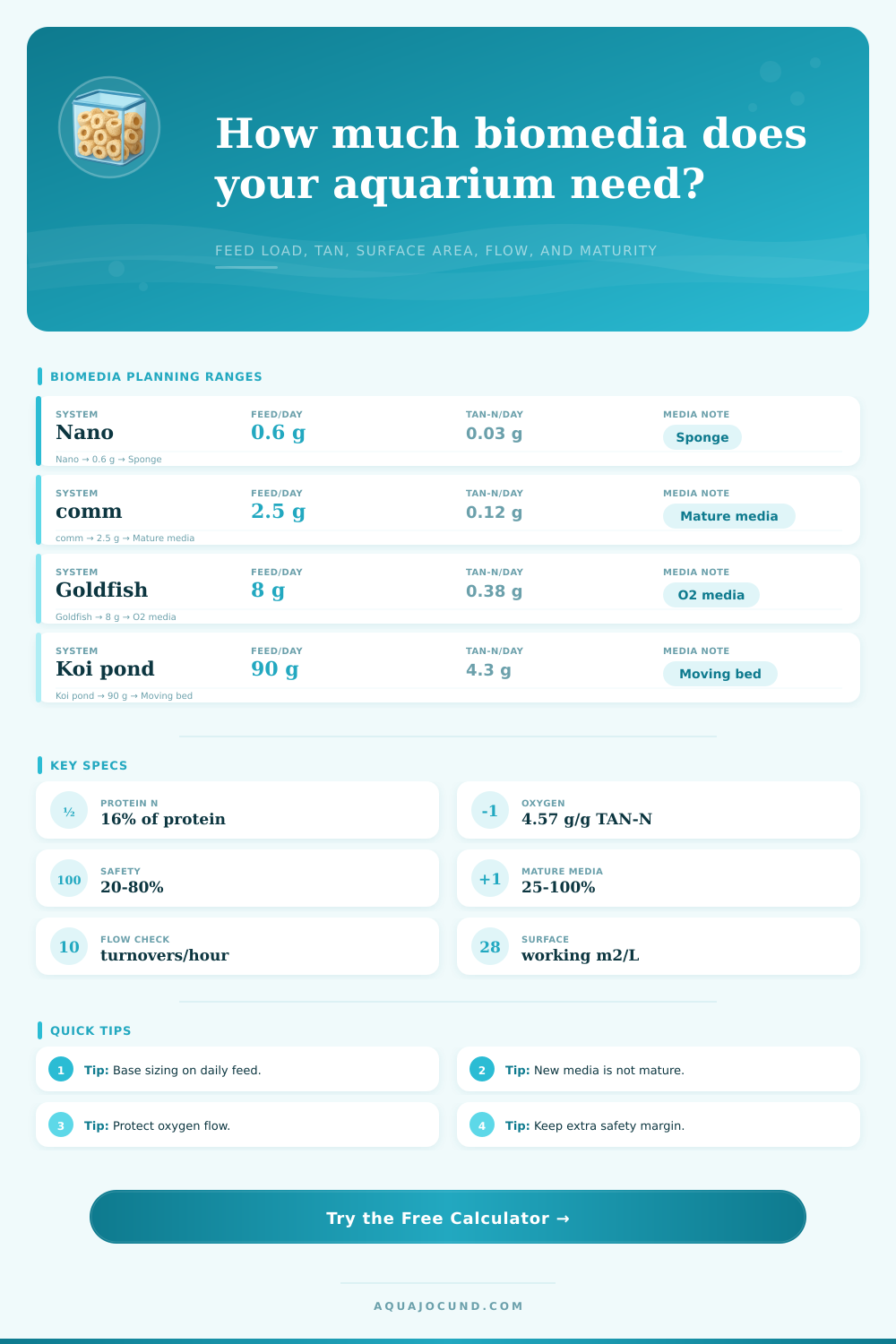
Biomedia sizing snapshot
Results update from feed load, media surface area, oxygen, flow, maturity, and safety factor.
| Biomedia type | Working surface area | Typical use | Flow sensitivity | Calculator note |
|---|---|---|---|---|
| Coarse sponge | 0.15 m²/L | Small filters, prefilters, fry tanks | Clogs if fine waste is not rinsed | Good mature area but lower protected surface. |
| Ceramic rings | 0.35 m²/L | Canisters, sumps, HOB baskets | Needs even flow through the basket | Balanced default for many aquariums. |
| Sintered glass | 0.90 m²/L | Compact canisters and media bags | Can lose performance if pores clog | High area, lower efficiency if dirty. |
| Moving bed carrier | 0.50 m²/L | Air-driven MBBR chambers | Needs strong tumbling and oxygen | Very reliable when kept moving. |
| Matten foam wall | 0.20 m²/L | Shrimp, fry, planted, low-tech tanks | Works best with slow broad flow | Large visible volume, gentle hydraulics. |
| Lava rock basket | 0.25 m²/L | Ponds and utility sumps | Uneven pieces can channel | Use extra safety factor. |
| Bioballs | 0.18 m²/L | Wet/dry trickle towers | Strong aeration, lower submerged area | Often oxygen-rich but bulky. |
| Shower media | 0.65 m²/L | Koi showers, high oxygen towers | Needs distributed spray flow | High oxygen, high splash capacity. |
| Common system | Water volume | Typical feed/day | Estimated TAN-N/day | Planning media range |
|---|---|---|---|---|
| 10 gallon nano | 10 gal / 38 L | 0.4-0.8 g | 0.02-0.04 g | 0.5-1.5 L mature sponge or rings |
| 20 gallon planted | 20 gal / 76 L | 1-2 g | 0.04-0.09 g | 1-3 L mature media |
| 55 gallon community | 55 gal / 208 L | 3-6 g | 0.14-0.28 g | 3-8 L depending on media |
| 75 gallon cichlid | 75 gal / 284 L | 7-14 g | 0.34-0.67 g | 7-18 L with strong flow |
| 120 gallon growout | 120 gal / 454 L | 18-35 g | 0.86-1.68 g | 18-45 L mature media |
| 1000 gallon koi pond | 1000 gal / 3785 L | 70-120 g | 3.4-5.8 g | 50-140 L moving or shower media |
| Input factor | Low value effect | High value effect | Best calculator use |
|---|---|---|---|
| Mature media % | New media needs more volume | Established biofilm lowers required volume | Use 25-50% for partially seeded media. |
| Installed efficiency | Channeling or clogging reduces capacity | Even flow uses more surface | Use 60-80% unless flow is proven even. |
| Feed protein | Less nitrogen per gram of feed | More ammonia load per gram | Enter the protein on the label. |
| Safety factor | Smaller media chamber | More room for growth and dirty media | Use 40%+ for messy fish or ponds. |
| Temperature | Cold water slows nitrification | Warm water improves activity until oxygen limits | Use real seasonal low for ponds. |
| Flow target | Turnover guide | Oxygen note | When to increase |
|---|---|---|---|
| Planted low waste | 2-4x system volume per hour | Plants help daytime oxygen but filters still need flow | Increase for heavy feeding or night oxygen dips. |
| Community freshwater | 4-6x per hour | Steady flow prevents stagnant media pockets | Increase when ammonia or nitrite lingers. |
| Goldfish and cichlids | 6-8x per hour | Waste load and oxygen demand rise quickly | Increase for large fish and dense stocking. |
| Reef display bio section | 3-6x per hour through media | Skimmer and overflow aeration often help | Increase if media is deep or bagged tightly. |
| Koi pond biofilter | 0.75-1.5x per hour | Air stones or showers carry much of the oxygen load | Increase in warm weather and peak feeding. |
A common rule of thumb is that most aquarists begin with simple idea of buying a filter rated for the number of gallons they own. This assumes that “gallons” equate to some sort of capacity. But gallons of water don’t generate ammonia. Food left over from feeding and fish waste do. If you fail to consider actual biological load, then you will have purchased a good-looking filter that won’t hold up under pressure.
Sizing by biomedia volume changes thing because it forces you to consider what you are really running through your filter. In other words, the actual biological load. So why does this matter? Well, it’s important to realize that not everything you feed will produce same amount of waste. An algae-based flake doesn’t create nearly as much ammonia than a high-protein pellet. So when you input your protein content and the amount fed daily, the calculator do the math for you (i.e., no guessing at nitrogen coefficients).
Why You Should Not Rely on Tank Size for Your Filter
For example, if your community fish is eating 38% protein, the calculator converts this to total ammonia nitrogen output from that food. From there it computes surface area needed by those bacteria to turn that ammonia into nitrate. You end up with amount of media necessary to maintain safe and clear water.
Most hobbyists fall into trap of assuming all new filter media is ready for duty out-of-the-box. They aren’t. While they has lots of pore space, there’s no colony on them. The maturity input specifically covers this issue. When starting a new tank with the maturity set to say twenty-five percent, it tell the calculator that most of what you just put into the tank have zero colony and therefore most of its volume is sterile space.
To accommodate same number of fish, you’ll require much more media than you would in an existing tank. This protects against error many hobbyists make by assuming too little capacity at startup and then crashing their cycle in those crucial initial few weeks.
There’s also an oxygen-related, silent bottleneck in biological filtration. Aerobic nitrifying bacteria eats oxygen, fast. They burn about 4.5 grams of oxygen per each gram of ammonia nitrogen consumed. Metabolic rates increase with warmer water and so does dissolved oxygen depletion. You end up with a deadly zone where your bacterial population could suffocate despite seemingly adequate flowrate. The tool compares your estimated oxygen demand with actual amount delivered to you (the oxygen delivery ratio). Too little means you’ll have to increase aeration to sustain what you have or add more media to distribute the work.
Lastly, there’s flow dynamics, something many folks don’t think about. The amount of surface area on a canister filter can be in the thousands of square meters, yet what good is all that surface area if water doesn’t touch it? That’s where channeling comes into play. By using a basket, water will find its way around much of the media because it takes path of least resistance. Enter the installed efficiency factor. It recognize that no filter operates perfectly in regards to hydraulics.
Moving bed carriers tumble, keeping them relatively clean. Sponges trap debris very fast. All filters works differently depending on how much water flows through them and how much surface area they have. Understanding this allows you to use media that works best with your pump’s pressure capabilities. This ensures the media operates consistantly over time.
The variable of temperature adds another wrinkle to the equation. Bacterial metabolism is slowed by cold water, meaning they takes longer to convert or you need more bacteria to reach the same result. This is important if you’re discontinuing food intake during the fall while bacterial action continues until winter sleep sets in. Your filter should of be large enough to handle low season temperature, rather than simply the warm days of summer. That way there’s some cushioning for cloudy water events or die-off periods.
The bottom line is this: Biological filtration is precise and it require patience. Remember, you are growing an engine that sustains life in your aquarium. It’s a living engine. If you guess, you will fail. If you calculate, you have confidence.
Build a system based off oxygen requirements and feed loads instead of arbitrary tank dimensions and you’ll end up with something that works. The goal isn’t just clear water, but a stable environment where bacteria thrive alongside your fish, that’s the name of the game. Understanding those variables makes them less vague and more like roadmap to long term success.