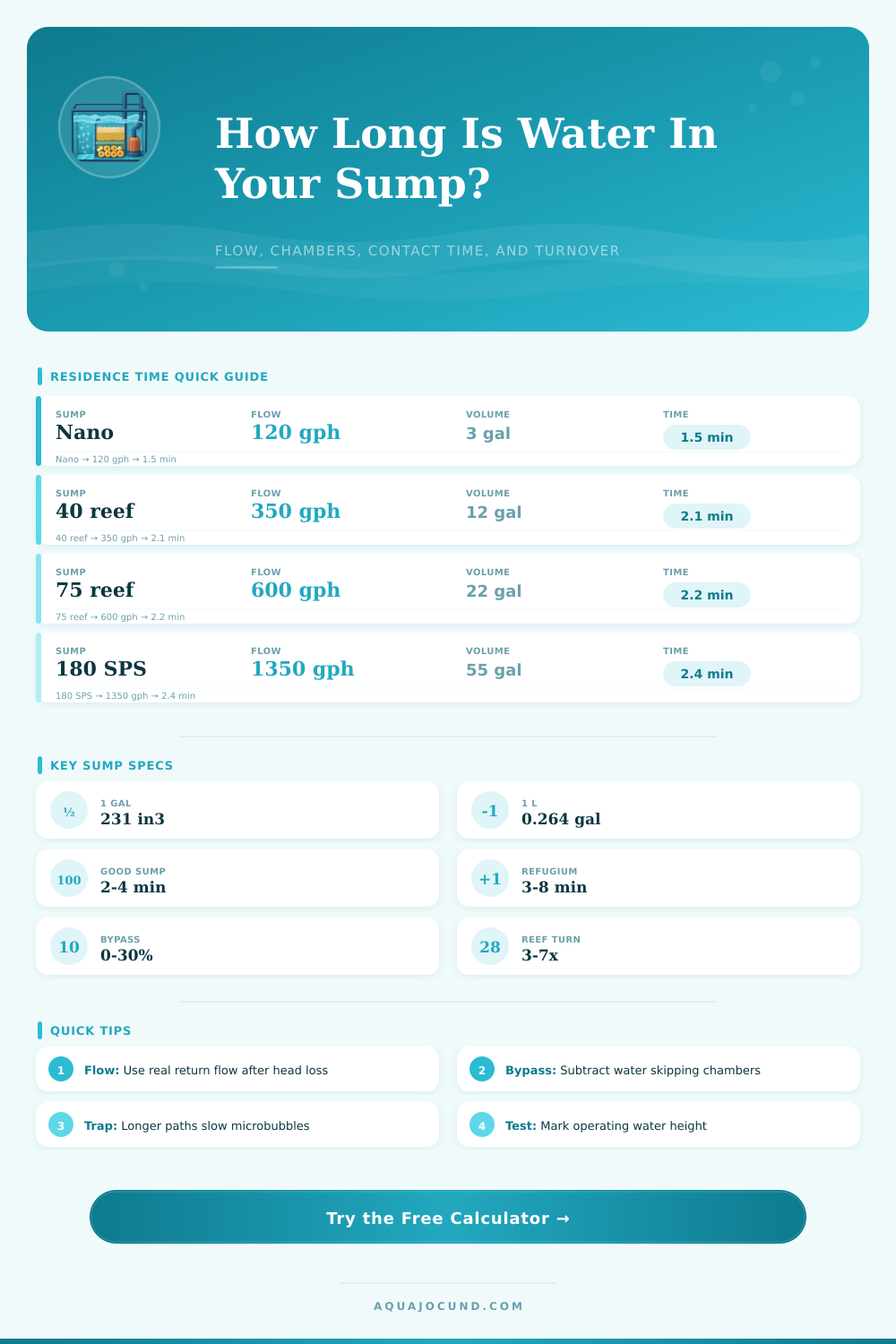
🌊 Sump Residence Time Calculator
Estimate aquarium sump operating volume, chamber contact time, effective return flow, bypass impact, refugium and skimmer dwell time, bubble trap pace, and display turnover.
| Profile | Whole sump target | Skimmer contact | Refugium contact | Typical sump turnover |
|---|---|---|---|---|
| Balanced reef | 2 to 4 minutes | 1 to 3 minutes | 3 to 6 minutes | 3x to 6x display volume per hour |
| Skimmer-heavy export | 1.5 to 3 minutes | 1.5 to 4 minutes | 2 to 5 minutes | 4x to 8x display volume per hour |
| Macro refugium first | 3 to 6 minutes | 1 to 2 minutes | 5 to 12 minutes | 2x to 5x display volume per hour |
| Compact high-flow sump | 1 to 2.5 minutes | 0.7 to 2 minutes | 1.5 to 4 minutes | 5x to 10x display volume per hour |
| Low-flow display sump | 4 to 8 minutes | 2 to 5 minutes | 8 to 18 minutes | 1x to 3x display volume per hour |
| Frag system sump | 1.5 to 3.5 minutes | 1 to 3 minutes | 2 to 6 minutes | 5x to 12x display volume per hour |
| System | Example sump footprint | Operating volume | Flow range | Expected residence |
|---|---|---|---|---|
| Nano rear sump | 12 x 3 x 10 in / 30 x 8 x 25 cm | 1.6 gal / 6 L | 80 to 180 gph / 303 to 681 L/h | 0.5 to 1.2 minutes |
| 20 long DIY sump | 30 x 12 x 8 in / 76 x 30 x 20 cm | 12.5 gal / 47 L | 180 to 350 gph / 681 to 1325 L/h | 2.1 to 4.2 minutes |
| 40 breeder reef sump | 36 x 18 x 9 in / 91 x 46 x 23 cm | 25.2 gal / 95 L | 350 to 700 gph / 1325 to 2650 L/h | 2.2 to 4.3 minutes |
| 75 gallon reef sump | 40 x 18 x 10 in / 102 x 46 x 25 cm | 31.2 gal / 118 L | 450 to 750 gph / 1703 to 2839 L/h | 2.5 to 4.2 minutes |
| 120 peninsula sump | 48 x 20 x 11 in / 122 x 51 x 28 cm | 45.7 gal / 173 L | 700 to 1200 gph / 2650 to 4542 L/h | 2.3 to 3.9 minutes |
| 180 SPS sump | 60 x 24 x 12 in / 152 x 61 x 30 cm | 74.8 gal / 283 L | 1100 to 1800 gph / 4164 to 6814 L/h | 2.5 to 4.1 minutes |
| Section | Residence formula | Flow to use | Useful target | Watch point |
|---|---|---|---|---|
| Whole sump | Operating volume / effective gph x 60 | Return flow minus bypass | 2 to 4 minutes for many reef sumps | Very short time can carry bubbles forward |
| Skimmer chamber | Skimmer volume / skimmer-path gph x 60 | Flow actually entering that section | 1 to 4 minutes depending on layout | Too much flow can make water level unstable |
| Refugium chamber | Refugium volume / refugium-path gph x 60 | Slower branch or through-flow share | 3 to 12 minutes for macro contact | Detritus can settle if flow is too slow |
| Bubble trap | Path length / linear velocity | Effective flow through baffles | Low velocity and clean baffle spacing | Salt creep and clogged sponge change velocity |
| Aquarium style | Sump turnover guide | Return flow basis | Residence effect | Adjustment note |
|---|---|---|---|---|
| Soft coral reef | 3x to 5x display per hour | After head loss | Longer sump time | Use powerheads for in-tank flow |
| Mixed reef | 4x to 7x display per hour | Measured at return outlet | Balanced contact and export | Bypass manifolds reduce treatment time |
| SPS dominant | 5x to 10x display per hour | Real pump output, not box rating | Shorter sump time | Bubble control matters more at high flow |
| Refugium focused | 2x to 5x display per hour | Branch flow if separate | Longer macro contact | Keep refugium debris from becoming stagnant |
| Predator system | 4x to 8x display per hour | Post-filter return flow | Moderate to short time | Skimmer section stability matters |
I know you’ve wondered at times if your filtration is actualy filtering or just moving water around. If you care about GPH (gallons per hour) but don’t care about how long water stays in contact with filter media, this might annoy you. Your filter may have high numbers on paper. However, your residence time dictate if the macroalgae or skimmer foam cleans the water enough to get rid of contaminants.
Enter the data you measured and dimensions of your sump and the calculator will do the math for you. You won’t need to guess if you have bypass plumbing diminishing system’s effectiveness.
How to Calculate Your Tank’s Water Flow and Contact Time
The first number most hobbyists measure is water return rate. So they put in a pump that pumps six hundred gallons per hour, then they think their system is good. But once the water has gone through those valves and elbows, actual output can be as low as four hundred gallons. Why does it matter? Each one of those gallons that doesn’t go through the treatment chambers never gets filtered. This new tool lets you remove this missed flow from your calculations.
What if 30% of the water goes straight back out to the pump, not even coming into contact with the skimmer? Your turnover rates will be great but you’ll be exporting nothing in terms of nutrients.
The other issue is that sumps aren’t typically a simple rectangular box. Even two sumps with same depth and length will have different volumes depending on their width. Simply entering your width for each area in the input variables takes this variable into account.
Skimmers need enough room so that they create a steady foam column that relies on contact time over flow velocity. Water flowing through them in 10 seconds don’t release organics into atmosphere. Increasing the amount of contact time will allow chemical processes to keep up with water flow. Refugiums actualy need longer since macroalgae growth is slow and nutrients must be exposed for extended periods.
The more complicated part is bubble traps are designed to restrict flow. By design, water flow reduces as it hits a baffle, slows down, releases air bubbles, and moves on. How many baffles there are changes the route of travel but doesn’t increase the volume much. More baffles mean more twists and turns which means more friction slowing linear velocity. That way the bubbles don’t go back into the display tank where they can scatter light and confuse fish. Also, it extends how long water stays in that last chamber before leaving sump.
Different fish species will require different turnover rates as well; some soft corals like slow movement and longer residence time, while SPS (small polyp stony) corals loves fast water movement and rapid exchange. The multipliers below are suggestions based off style of system and type of aquatic life. There is no one right amount for all setups.
Fast turnover is okay for a predator tank because there are no delicate tissues to stress. On the other hand, a frag rack needs fast exchange to prevent waste buildup. However, it will also benefit from enough skimmer dwell time. So there’s the catch. More pump = more turnover but less residence time if you don’t compensate with more volume (sump) or less bypass flow. In other words, you can’t max two at once without changing the physical setup. A lot of people want to max the number rather than max contact time. It’s about knowing the metric you’re measuring.
Rather than taking the word of the pump label, use a stopwatch and bucket to measure your real return flow. Then take precise measurements of the sump. Include odd sump shapes and baffle locations that can impact flow. Plug those numbers into your flow calculator to see how they match up to target range(s) based on your coral mix.
If your skimmer has <1min of contact time, increase volume or decrease flow in this area. To slow down refugium flow, see if you’re bypassing water from the refugium altogether. The good news is that these adjustments can be made with patience, since they impact the whole system. A smaller bypass valve could make your skimmer more effective but will make your refugium less effective. A baffle could help eliminate bubbles while increasing head loss on the pump. It’s not just plumbing but engineering time.
Give water enough time in each area for it to come out cleaner than when it entered. When you get that beat, you have a living ecosystem, not a moving river called a tank.