Flow Per Gallon Calculator
Estimate real tank circulation from return flow, powerheads, flow loss, livestock style, aquascape obstruction, and target multiplier.
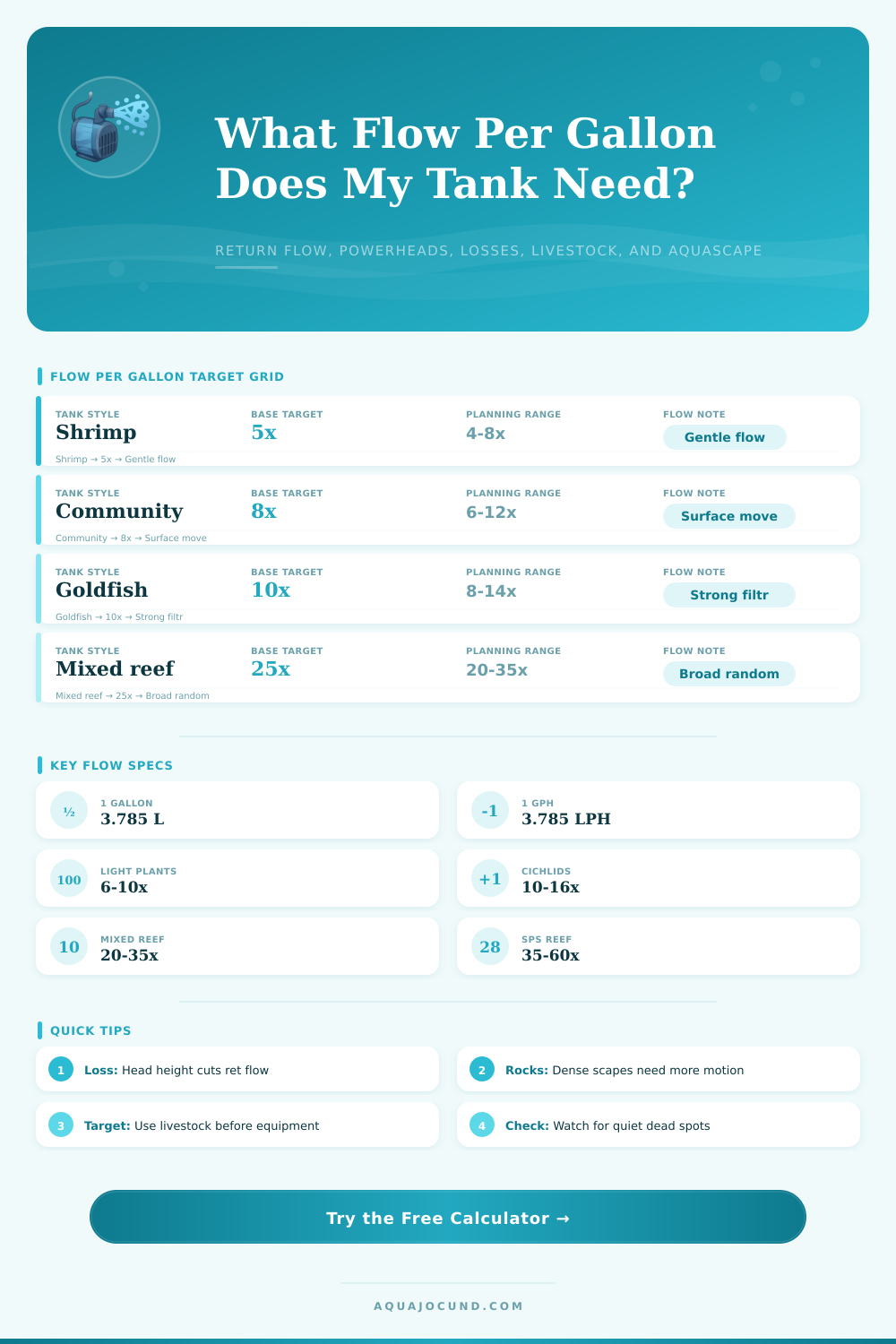
| Livestock style | Base target | Useful range | Best flow pattern |
|---|---|---|---|
| Shrimp, fry, or betta | 5x per hour | 4-8x | Gentle surface exchange and sponge-safe flow |
| Low-tech planted | 7x per hour | 5-10x | Slow cross-tank movement without uprooting plants |
| Community fish | 8x per hour | 6-12x | Even turnover with visible but calm surface ripple |
| Goldfish or messy fish | 10x per hour | 8-14x | Strong filtration path plus calm resting zones |
| Cichlid or river fish | 14x per hour | 10-18x | Directional lanes and rockwork sweep |
| Soft coral reef | 18x per hour | 15-25x | Broad indirect motion, not laminar blasting |
| Mixed reef | 28x per hour | 20-35x | Alternating pumps with open gaps behind rock |
| SPS dominant reef | 45x per hour | 35-60x | Random turbulent flow across coral faces |
| Obstruction setting | Useful flow factor | Target lift | Typical reason |
|---|---|---|---|
| Open swimming layout | 1.00 | 1.00x | Few barriers, long open water lanes |
| Moderate plants or rock | 0.94 | 1.05x | Common community, planted, or reef structure |
| Dense plants or stacked rock | 0.88 | 1.15x | Flow slows behind stems, caves, and rock shelves |
| Reef wall or peninsula scape | 0.82 | 1.25x | Hardscape creates shadow zones and back-wall pockets |
| Tank | Volume | Community target | Mixed reef target |
|---|---|---|---|
| 10 gallon nano | 10 gal / 38 L | 80 GPH / 303 LPH | 280 GPH / 1060 LPH |
| 20 long | 20 gal / 76 L | 160 GPH / 606 LPH | 560 GPH / 2120 LPH |
| 40 breeder | 40 gal / 151 L | 320 GPH / 1211 LPH | 1120 GPH / 4239 LPH |
| 75 gallon | 75 gal / 284 L | 600 GPH / 2271 LPH | 2100 GPH / 7949 LPH |
| 125 gallon | 125 gal / 473 L | 1000 GPH / 3785 LPH | 3500 GPH / 13249 LPH |
| 180 gallon | 180 gal / 681 L | 1440 GPH / 5451 LPH | 5040 GPH / 19078 LPH |
| Source | Calculator input | Adjustment used | Practical note |
|---|---|---|---|
| Return pump | Return flow | Flow loss factor | Head height, elbows, socks, and valves reduce delivered flow |
| Powerhead or wavemaker | Flow each x count | Useful flow percent and obstruction | Pulse modes and rock shadowing reduce tank-wide sweep |
| Canister or hang-on filter | Filter or closed-loop flow | Flow loss factor | Media loading usually lowers advertised clean-pump rating |
| Target circulation | Tank volume x target x buffer | Livestock, scape, multiplier | The target is a planning value, not a single universal rule |
Whether it’s too little or just way too loud, pumps is where most of us go wrong in our fish tanks. You want healthy livestock and clean water. Achieving such goals frequentally requires guesswork regarding your flow rate. A calculator does the math for you, so you can focus on the biology of your fish tank.
Turnover basically means that all the water in the tank should pass over the filter or circulate through it (via circulation pumps) X amount of time an hour. But turnover isn’t simply raw gallons per hour. Turnover is what actualy happens to water once it’s been slowed by gravity, friction, and hardscape. That’s where rated flow vs. Effective flow make the biggest difference.
How to Choose the Right Pump for Your Fish Tank
Know the size of your tank, accurately. Knowing that you have a 20g long doesn’t mean you have a 20g of water in there when you factor out gravel, driftwood, ceramic castles, and those fish livig inside. Yes, we subtracted your headroom because those items takes up space in your total water volume. This one can cascade throughout the system and throw everything off by as much as ten percent.
The next thing to do is review the return pump rating. Pumps are tested by manufacturers under best case scenarios (wide open pipes with no head height). Your pump has to pushes water up to a siphon break, push that water through filter socks, elbows and perhaps valves too. All of these restriction steals pressure. To compensate for this friction, the tool applies loss factor. Even a brand new pump can’t overcome lost flow caused by running a long hose from floor to a high stand. It’s not broken. It’s fighting gravity.
This is a directional powerhead. Directional devices like powerheads makes things more complicated. For example, a return loop doesn’t produce the same result than a wavemaker. A return loop increases rate of filter turnover. A wavemaker produces movement, mixing, or agitation at the surface. They serve different purposes, which is why the calculator separates them. Each is necessary for a clean tank, but neither can substitute for the other. You’ll have both.
That’s the target multiplier based off the type of animals kept. Stillness suits shrimp tanks, whereas gently rippled water are fine for bettas. Goldfish are giant messes. They require powerful current flow to suspend their waste for removal, as well as strong filtration. At the opposite end of the spectrum, we have reef aquaria. These can pushes towards forty-five turnovers because small polyp stony corals requires a random, turbulent flow to clean up waste and feed. This isn’t just some number out of thin air. These numbers reflect how the corals feed and how much waste they produce. You’ll see this represented on the page on the right as a reference table. A SPS reef aims for forty-five times turnover, for example, whereas a general community tank may aim for eight.
Obstruction matters: While a naked bottom tank will have straight-line flow, a heavily planted tank with thick stems and/or stacked rock will form pockets of stilled water behind each layer. Because you want those quiet spots to be swept periodically, the target gets bumped up for a densely landscaped layout. If your flow is interrupted by initial piece of drift wood, it isn’t doing anything.
Last, buffer in some wiggle room. Things get dirty. Filters clog. Pumps grows old and their flow decreases with time. If you plan to have 10% more than what you think you need, then odds are high that you’ll stay at or near your goal for months if not years until maintenance saps the performance. Little thing, big deal.
Run the numbers. What’s the difference between your current effective flow and your adjusted target? A positive number means you’ve got breathing space. Negative means you’re going to need additional power or improved placement. Debris piles up in the corners; that’s a telltale sign of low flow regardless of what the gauge reads. A good circulation will feel like a gentle breath on the water’s surface. You should of seen it with your eyes, but you’ll know it by its feel.