Combined Powerhead Flow Calculator
Estimate usable tank circulation from multiple pump ratings, controller settings, pulse duty, placement overlap, return flow, and livestock targets.
Flow Breakdown
Opposed Crossflow
Best default for rectangular reefs. Lower overlap and better coral-surface exchange.
Gyre Loop
Strong perimeter movement with good detritus transport, especially in long tanks.
Same-Side Push
Simple mounting, but parallel streams can stack flow and leave back-corner shadows.
Random Reef
Useful for variable coral motion. Average flow is usually lower than peak rating.
| Livestock goal | Planning range | Ideal check point | Calculator note |
|---|---|---|---|
| Seahorse / gentle display | 3x-8x | 5x | Use guarded, broad flow and avoid direct blasts. |
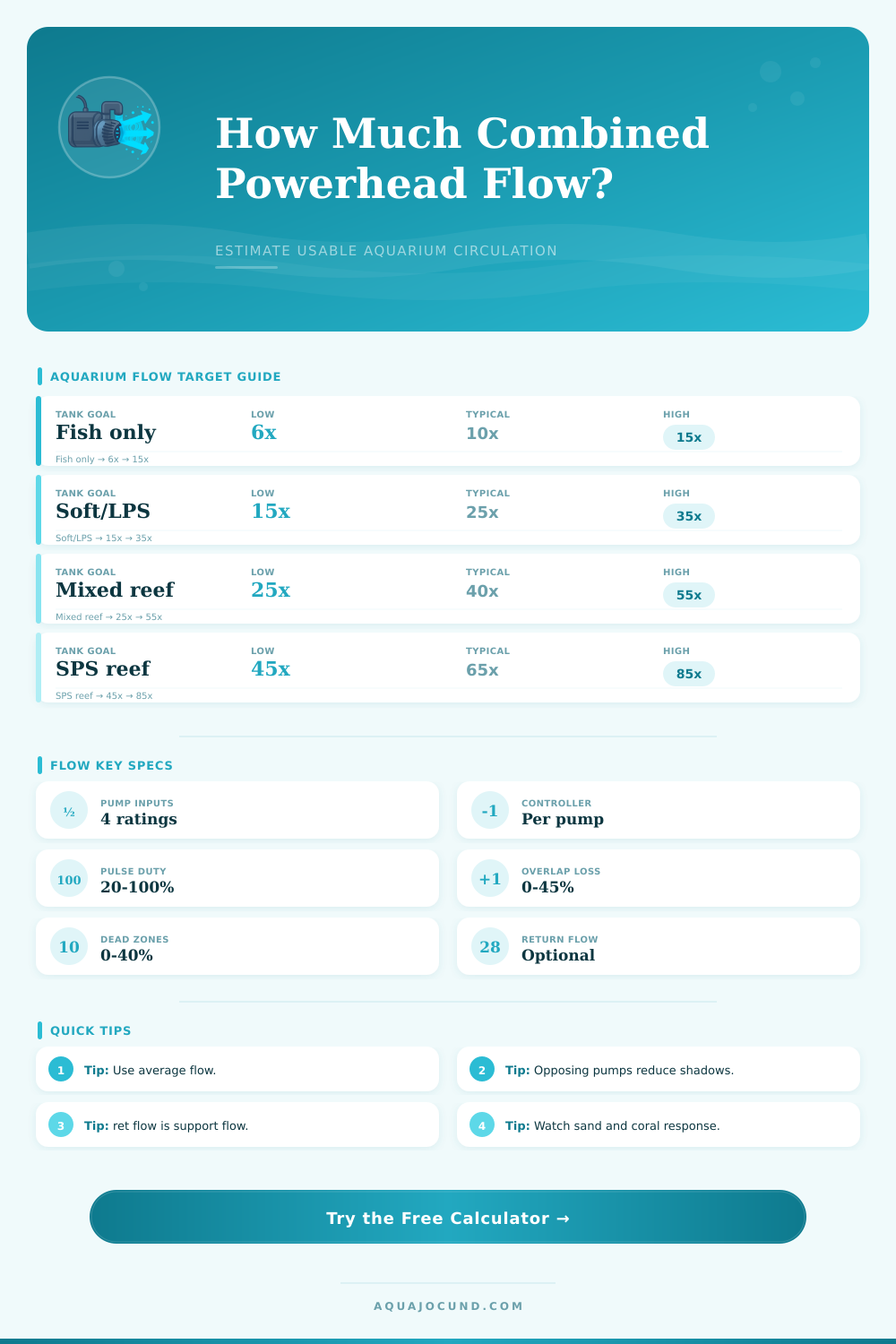
| Fish only / FOWLR | 6x-15x | 10x | Enough to suspend waste without stressing fish. |
| Soft coral and LPS | 15x-35x | 25x | Broad, intermittent movement is usually better than a narrow jet. |
| Mixed reef | 25x-55x | 40x | Use zones: calmer LPS shelves and stronger SPS ledges. |
| SPS dominant reef | 45x-85x | 65x | Needs strong random flow with good surface exchange. |
| Frag tank / shallow tray | 30x-70x | 50x | Shallow water spreads quickly but racks create shadows. |
| Tank | Dimensions | Nominal volume | Mixed reef target |
|---|---|---|---|
| 20 long | 30 in x 12 in x 12 in / 76 x 30 x 30 cm | 20 gal / 76 L | 800 gph / 3028 lph usable |
| 40 breeder | 36 in x 18 in x 16 in / 91 x 46 x 41 cm | 40 gal / 151 L | 1600 gph / 6057 lph usable |
| 75 reef | 48 in x 18 in x 21 in / 122 x 46 x 53 cm | 75 gal / 284 L | 3000 gph / 11356 lph usable |
| 120 reef | 48 in x 24 in x 24 in / 122 x 61 x 61 cm | 120 gal / 454 L | 4800 gph / 18170 lph usable |
| 180 reef | 72 in x 24 in x 24 in / 183 x 61 x 61 cm | 180 gal / 681 L | 7200 gph / 27255 lph usable |
| Setting | How calculator applies it | Typical range | Use when |
|---|---|---|---|
| Controller percentage | Multiplies each pump rating individually | 30%-100% | Pumps are intentionally throttled |
| Pulse/random duty | Uses average output, not peak output | 45%-90% | Wave, reef crest, random, lagoon, or night modes |
| Placement overlap | Subtracts flow that collides or stacks in the same path | 8%-35% | Streams cross, parallel, or share one end |
| Dead-zone factor | Subtracts circulation blocked by aquascape and geometry | 5%-30% | Rock arches, caves, overflow boxes, or tall tanks |
| Return usefulness | Adds only the useful circulation share of the return line | 40%-80% | Return nozzles are aimed for display movement |
| Flow style | Useful factor | Coverage tendency | Best calculator use |
|---|---|---|---|
| Wide propeller stream | 0.92 | Broad cone | General reef and fish display movement |
| Gyre / crossflow sheet | 0.97 | Long horizontal sheet | Long tanks, peninsula tanks, detritus lanes |
| Narrow jet stream | 0.82 | High center velocity | Freshwater river zones or behind-rock flushing |
| Oscillating output | 0.94 | Sweeping path | Broad coverage where mounts can rotate safely |
| Random reef mode | 0.90 | Variable intensity | Coral motion with less constant laminar push |
| Pulse / standing wave | 0.88 | Surge movement | Surface exchange and coral polyp movement |
| Guarded low-suction pump | 0.78 | Gentle local spread | Seahorse, anemone guard, nursery, or fry systems |
If you’ve shopped for pumps or looked at pump boxes, you’ve likely noticed large numbers listed as flow rates. These numbers imply your tank will be spinning so hard it might power a small boat. That’s not what happens in most tanks most of the time. Most new reefers gets caught off guard by the disconnect between what pumps is rated to do in ideal conditions and what their tank realy feels like inside the glass. They over-buy on raw power, drop volume way back and then complain about how anemic their flow seem. So they return and buy another set of pumps. And another. Rinse repeat. Math and understanding how water behave in a closed environment will save you from this frustrating pattern.
This calculator shows you how much is being removed when you take items out. It begins with net (not gross) tank volume. This is because all of your sand and rockwork displaces water. The size of your glass doesn’t matter if you’re using it as a box. That’s not your tank. Enter the net volume of water after you build out your aquascape.
How to Choose the Right Flow for Your Tank
Next, enter your powerheads one at a time and any setting on their controllers. Why? Because two pumps on 70% duty cycle don’t produce 70% of the combined peak rating when they’re either pointing into a wall or otherwise fighting each other. Finally, the calculator take into account placement overlap; the friction cost of multiple streams intersecting in the same area. The thing most folks miss is that overlap factor. They think it adds up linearly, but hydrodynamics isn’t that simple.
Two pumps faces each other. That cancels some amount of momentum in the middle. Two running parallel on the same side? It creates a high-velocity lane with the rest of corners completely stagnant. The tool estimates this by using various coefficients for those patterns and determining what part of that raw output contribute to useful circulation.
Also, consider dead zones caused by overflow boxes or rock arches. Any complex hardscape cause water to drop into pockets where flow goes down to practically zero, unless you are deliberately trying to break up those layers, and even then…water doesn’t like turning tight corners.
Determining your goal is realy about your livestock. What do you have? That answer will vary greatly. Ten turns per hour, the amount of water in the tank replaced every hour, for fish only is generally sufficient (but not to much). Broad, intermittent movement is good for soft coral, but constant blasting isn’t great. Very small polyp stony corals requires strong, irregular flow to help with nutrient exchange and to keep them free of mucus buildup. This chart on the page makes it all clear. Essentially, if you have a SPS reef, you’ll likely want close to twice as much turnover as you would a mixed community. But remember, you aren’t moving water just to move water. You’re mimicking certain natural conditions that supports the biology of your livestock.
The return pump adds more complexity. Its usefulness depends strictly on nozzle angle and placement. An ill-aimed return will give you filtration but no circulation. For this reason, the calculator gives you the ability to specify an efficiency percentage for the return pump. After all, not all pumped water benefit your tank equally. You should of also plan for pump aging (add a ten to fifteen percent buffer). Head loss increase over time, impellers wear out, and baskets fills with debris. When the initial excitement wears off and maintenance settles into a routine, this planning margin keeps your flow from dropping below critical levels six months down the road.
The most important aspect isn’t max flow or speed. Instead it’s how consistently good flow covers all corners. Extreme blasts on one end won’t cut it. You want moderate flow that reaches all parts of the tank. Set up the flow so you hit your biological needs but still have some margin for change as your aquascape matures. It is a balance you don’t see. A quiet balance within the flow is what makes a healthy reef feel alive and keeps your livestock secure in its surroundings. That tranquility amid motion is what distinguishes a struggling reef from a thriving one.