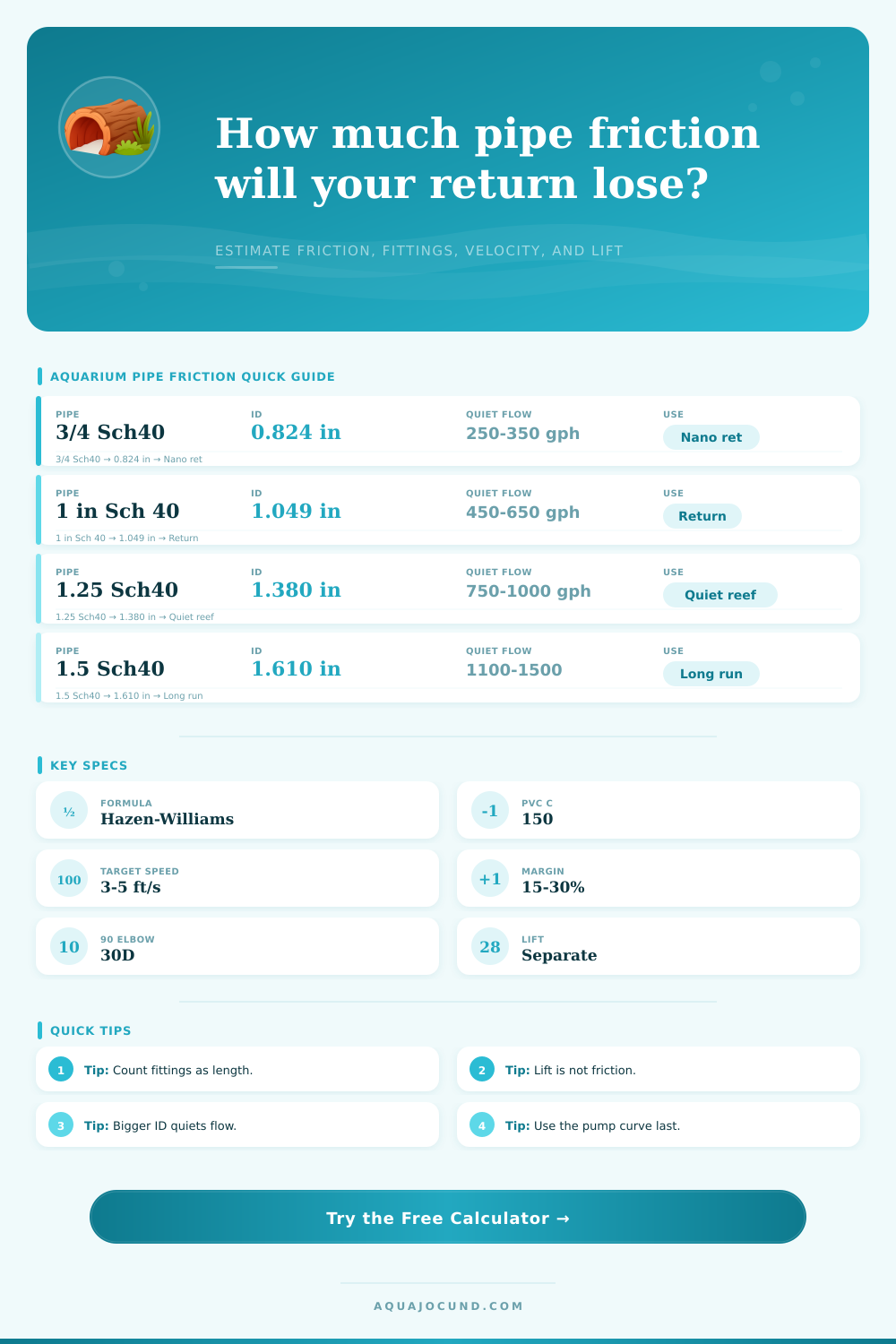
💧 Pipe Friction Loss Calculator
Estimate aquarium return-line friction from flow, real pipe ID, straight run, fittings, roughness, vertical lift, velocity target, and safety margin.
| Pipe / Schedule | Actual ID | Quiet Flow Range | Typical Aquarium Use |
|---|---|---|---|
| 1/2 in Schedule 40 | 0.622 in / 15.8 mm | 80-180 gph | Small utility loop |
| 3/4 in Schedule 40 | 0.824 in / 20.9 mm | 200-350 gph | Nano or planted return |
| 1 in Schedule 40 | 1.049 in / 26.6 mm | 450-650 gph | Common cabinet return |
| 1.25 in Schedule 40 | 1.380 in / 35.1 mm | 750-1000 gph | Quiet reef return |
| 1.5 in Schedule 40 | 1.610 in / 40.9 mm | 1100-1500 gph | Large display or manifold |
| 2 in Schedule 40 | 2.067 in / 52.5 mm | 1800-2600 gph | Fish room or long run |
| Roughness Source | Hazen C | Friction Effect | Planning Note |
|---|---|---|---|
| New PVC / CPVC | 150 | Lowest common loss | Good default for new hard plumbing |
| Flexible PVC / SpaFlex | 140 | Low to moderate | Gentle bends can offset rougher wall |
| Vinyl tubing with barbs | 135 | Moderate | Useful for short runs, watch restrictions |
| ABS or older drain pipe | 130 | Moderate | Often better for drains than pressure return |
| Biofilm aquarium pipe | 120 | Higher | Good conservative value after months of use |
| Rough or scaled line | 105 | High | Clean, replace, or oversize the pipe |
| Fitting | Gentle Style | Standard Style | Compact / Barbed |
|---|---|---|---|
| 90° elbow | 20D | 30D | 45D |
| 45° elbow | 10D | 16D | 24D |
| Open ball valve | 3D | 5D | 12D |
| Union / coupler | 2D | 3D | 5D |
| Tee through branch | 30D | 60D | 90D |
| Scenario | Flow | Pipe Choice | Friction Strategy |
|---|---|---|---|
| Small AIO return | 120-250 gph | 1/2 to 3/4 in | Short run, few elbows |
| 75g reef cabinet | 500-800 gph | 1 in | Use sweep bends where possible |
| 120g SPS return | 900-1200 gph | 1.25 to 1.5 in | Keep velocity near target |
| Basement fish room | 1000-1800 gph | 1.5 to 2 in | Oversize pipe before oversizing pump |
| Rack manifold | 700-1300 gph | 1.25 to 1.5 in | Count tees and valves honestly |
The tank might be rated at a thousand gallons an hour but the return line pushes only half that amount of water. The problem isn’t that some water leaks out the sides, it’s because the water is fighting against the pipe itself. Plastic costs you friction loss and if you ignore it then a quiet reef tank can turn into a loud one. This page’s calculator does the math for you so you don’t have to guess what elbow cut your flow down.
First off, friction isn’t the same as static lift. Friction is how much resistance water encounters as it flows through fittings and scrapes along the walls of your pipe(s). Static lift are a force. Gravity pulls downward on each foot of vertical distance between the sump and display. That’s constant. When choosing a pump, you have to factor in both of these things, but they does not respond equally to pressure. Treating them this way will lead you to either 1) purchase a pump with insufficient power to push water upward, or 2) buy one that is too large for the application.
Understanding Friction Loss in Reef Tanks
This assumes you are using the Hazen-Williams formula for pipe size, where diameter is the main variable. This is logical, since this equation raises the internal diameter almost to the fifth power. So even a slight bump up in pipe size will drop friction quite a bit (more than simply eliminating one elbow). Moving from 1/2″ tube to 3/4″ pvc can make a big difference in resistance. Not only does it push more water, but the larger diameter interior slows the water’s speed, creating less turbulence and noise. The flow is quieter and more efficient.
Most hobbyists lose the battle at fittings. A fitting isn’t just a bend. A 90 degree elbow are a turn that forces the water to shift direction suddenly, which causes drag and eddies. This tool replaces the fittings with an equivalent length of straight pipe depending on the type of sweep selected. Barbed fittings in a compact form create a bottleneck. A long sweep is smooth. Fill up a run with compact elbows and the increase in flow resistance goes way up. Count ’em truthfuly. The calculator will tell you exactly how much head pressure those turns consume.
Roughness of material does matter. Not as much as most believe. New PVC is slick. Older pipe encrusted with biofilm or calcium isn’t. They assume clean new plastic has a C-Value of one hundred and fifty. Older piping and even flexible vinyl tubing have a lower C-value. That reduces the C value. Lower C value equals more friction. It is not a big deal to enter this into the input screen, however it helps avoid overestimating how well you will do in the real world.
To keep it quiet and safe, aim for a velocity target of three to five feet per second in the display return. Faster is cavitation, that gravel-in-the-pump-head sound. It’s bad for seals, not good on the ears. If you go slower, you may experience air entrapment or insufficient flushing of the line. The calculator compares your velocity to your target and lets you know whether your intended pipe size will match your desired flow rate.
You cannot afford to leave safety margins out of the equation. Safety margins is insurance. Over time, pipes will become rough. Pumps deteriorates. You might install something that adds a valve later on. You may then fail to account for it as part of your loss. A fifteen to thirty percent margin on your design head provides you with breathing room so that when you build a system next year the pump you purchase today won’t be overwhelmed.
For rapid sanity checks, check out the reference tables on that page. It lists some common pipe sizes and their corresponding typical flows. This can help you determine whether or not you’ll be ok with an inch of pvc in your seventy-five gallon reef tank or if you’re going to have to move up to an inch and a quarter. Cost, noise, and pump strain is balanced.
The numbers are intimidating. But they don’t have to be. Physics is simply at work when we’re talking about friction loss. A bit of knowledge goes a long way. You should of known how wider pipes minimize resistance and how gentle bends assist. Also, remember that drag is not related to lift. The rest is simple math. The tool does all the work. You just have to learn what questions to ask.
Use as few elbows as possible. Use bigger pipe. Soon enough, you’ll stop hearing it. Your pump will last longer. And your fish won’t have to live in the wake of a storm.