💧 Plumbing Water Hold-Up Volume Calculator
Estimate aquarium water sitting in return lines, drain pipes, manifolds, hoses, reactors, overflow boxes, and the amount that can drain back into the sump.
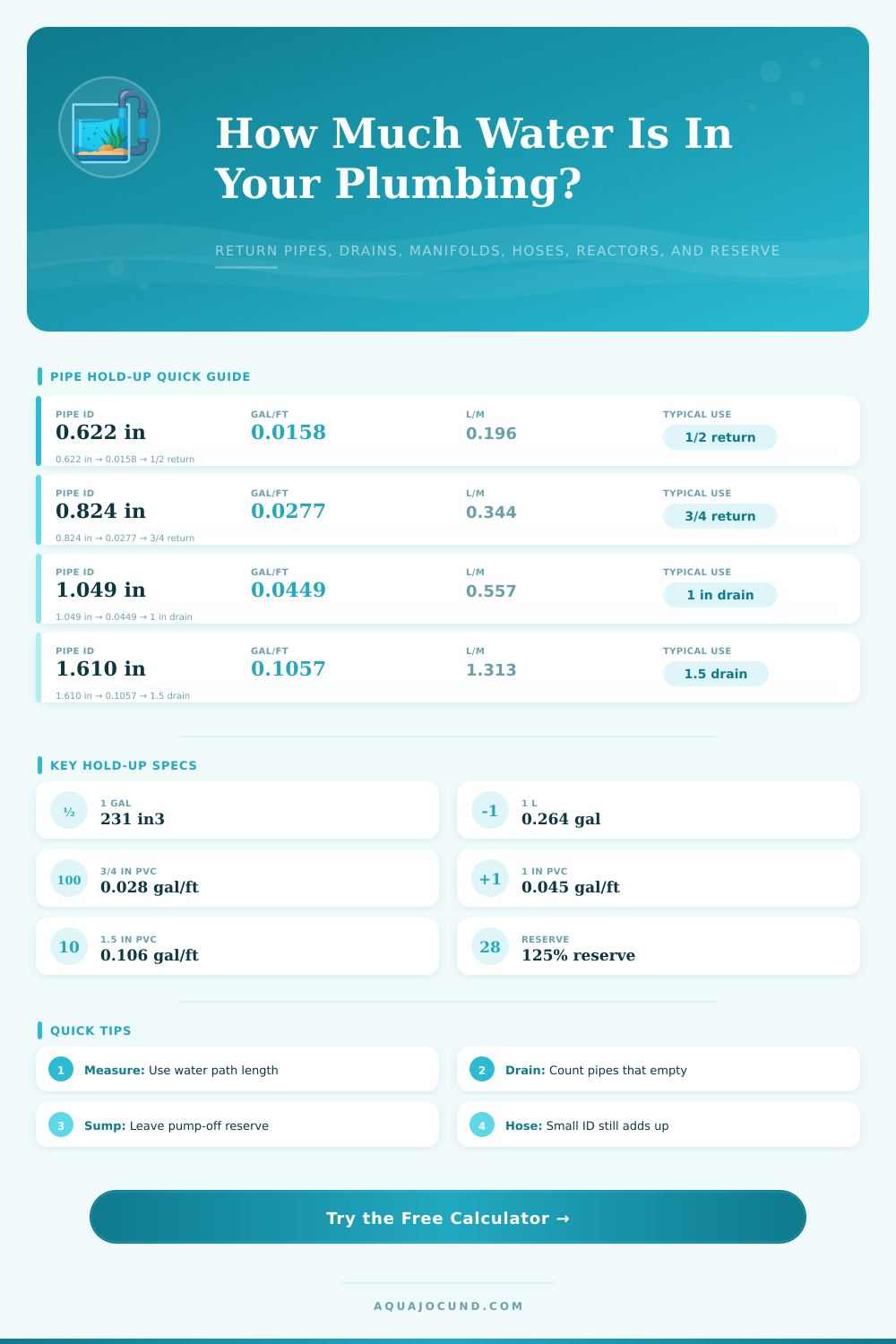
| Nominal pipe or hose | Inside diameter | Hold-up per foot | Hold-up per meter |
|---|---|---|---|
| 3/8 in flexible tube | 0.375 in / 9.5 mm | 0.0057 gal/ft | 0.071 L/m |
| 1/2 in flexible hose | 0.500 in / 12.7 mm | 0.0102 gal/ft | 0.127 L/m |
| 3/4 in Sch 40 PVC | 0.824 in / 20.9 mm | 0.0277 gal/ft | 0.344 L/m |
| 1 in Sch 40 PVC | 1.049 in / 26.6 mm | 0.0449 gal/ft | 0.557 L/m |
| 1 1/4 in Sch 40 PVC | 1.380 in / 35.1 mm | 0.0778 gal/ft | 0.967 L/m |
| 1 1/2 in Sch 40 PVC | 1.610 in / 40.9 mm | 0.1057 gal/ft | 1.313 L/m |
| 2 in Sch 40 PVC | 2.067 in / 52.5 mm | 0.1744 gal/ft | 2.166 L/m |
| System | Typical pipe runs | Connected vessels | Typical hold-up |
|---|---|---|---|
| All-in-one nano | Short rear chamber tubing | Media chamber only | 0.2-0.8 gal / 0.8-3 L |
| 40 breeder sump | 3/4 in return, 1 in drain | Small reactor optional | 1.5-3.5 gal / 6-13 L |
| 75 reef | 3/4 in return, dual 1 in drains | Overflow plus 1-2 reactors | 3-7 gal / 11-26 L |
| 120 manifold | 1 in return, 1 1/2 in drain, branches | UV, carbon, refugium loop | 6-12 gal / 23-45 L |
| Remote sump | Long horizontal supply and drain | Large skimmer and reactors | 10-25 gal / 38-95 L |
| Component | Use this calculator field | How to measure | Drain-back behavior |
|---|---|---|---|
| Return line | Return pipe length, ID, count | Measure the water path from pump to outlet | Often drains partly through siphon until air breaks |
| Main drain | Drain pipe length, ID, count | Measure overflow to sump inlet | Usually drains strongly during pump-off |
| Manifold branches | Branch average length and count | Average each branch that stays water-filled | May drain if outlets are above sump waterline |
| Reactors and canisters | Average vessel volume and count | Use stated internal water volume or a fill test | Often remains trapped unless valves open |
| Overflow box | Overflow box water volume | Length x width x operating depth, or measured volume | Drains to the teeth or standpipe level |
| Reserve ratio | Status | What it means | Practical check |
|---|---|---|---|
| Less than 100% | Short | Drain-back estimate exceeds empty sump room | Lower running sump level before testing |
| 100-124% | Tight | Reserve covers the model with little extra room | Mark max-fill line and verify pump-off |
| 125-174% | Good | Reserve includes a useful allowance | Retest after return nozzle changes |
| 175% or more | Comfortable | Reserve has broad capacity for normal variation | Still keep siphon breaks clean |
Gravity brings that water down to your sump when the pump turn off. And there you sit… watching your display tank’s water go down. It’s silent, yet potentially disastrous if you failed to account for the volume. Most of us thinks about filtration media and flow rates. We forget about the invisible volume hiding within our plumbing. This volume make the difference between stability and catastrophe if power goes out.
Total plumbing hold-up is the amount of water present anywhere within your system at any time, whether it’s in your reactors, hoses, manifold, drain pipes or return lines. It seems insignificant until you realize just how fast it will add up. For example, an additional ¼ inch in pipe size may not seem significant on paper but multiply that by every foot of tubing throughout your system.
The Hidden Water in Your Pipes
Use this as a handy way to plug in your own numbers and let the calculator do the math for you. You’ll get a breakdown of how many gallons are being held up in each piece of plumbing equipment and where most of that water tend to hide.
A common misconception is that all water flows out when the pump is on and therefore there’s nothing coming into the drain pipes. That’s wrong. Any pipe below the water level or above the drain outlet remain full of water, even while the system is running. And when power goes out, that water column drains back down. Unless you have plenty of empty space in your sump to collect it, the water will overflow onto the floor.
How much? The amount of water held per foot of pipe depend on its diameter, as shown in the reference table. This is a very straightforward relationship that catches most builders off guard, especially those who think they have left themselves with more than enough margin for safety. Before relying on any number the calculator spits out you must understand how much reserve you really have. During normal operating conditions what is the difference between edge of your overflow and your current high water? That’s your reserve. And it doesn’t matter if it’s inches or just fractions of an inch, it’s not a lot of wiggle room.
You can also plug into the calculator your best guess as to what percentage of the tank will drain back. Some return lines keeps enough siphon to hold half the water trapped when you shut down. This calculator helps account for that fact so you won’t falsely believe you’re safe.
Little things like small hoses is often seen as insignificant, but a few feet of quarter-inch hose don’t hold much on their own. Add an inlet line, and outlet line, and three or four reactors and now those little volume are competing for room in your sump. The volume of reactors count towards the total hold up volume. Even though they might never drain back during a shut down, reactors is big reservoirs all by themselves. You must manually drain them otherwise. This can help you determine whether to bypass certain loops or add check valves to manage which way water flow.
Residence time output show how long it takes for a given drop of water to pass through your plumbing system until it recycles back into the tank. Slower turnover (higher residence time) can impact your chemical dosing and filtration efficiency. Movement matters as well; don’t let capacity drive everything at the expense of flow.
Test your assumptions against actual measurements because generic rules of thumb aren’t going to cut it here. The amount of pipe needed is measured exactly. You’re measuring all the way through where the water actualy goes. That means both horizontal runs and vertical drops. Don’t just think, “oh, I’ll go from the tank to the sump.” You need to account for every extension and every bend. Each one adds volume, which add up to the total amount your system can carry.
Armed with that, the tool will show you exactly how much more your system can hide in plain sight. What was once a scary unknown becomes something you can easily manage. The thing with water is that it’s heavy and it carries momentum; that means it doesn’t always do what you think it should, especially when it changes directions in an instant. That sense of calm comes from knowing where that water lives when it decides not to cooperate. It allows you to tinker with the plumbing layout, modify your sump levels, or create additional reserve space.
Someday. Eventually, the pump will shut down once more, and you’ll want to be prepared. When power goes out, you know how to design a system that survives the silence because you know what hides within your pipes.