Aquarium Bottom Panel Load Calculator
Estimate bottom panel pressure from footprint, water depth, substrate, rock, support style, foam pad, material, point load, and safety margin.
| Material | Typical density | Bottom-panel note | Calculator factor |
|---|---|---|---|
| Annealed glass | 156 lb/ft³ / 2500 kg/m³ | Common for custom glass tanks; sensitive to edge flaws and point contact. | 1.00x |
| Tempered glass | 156 lb/ft³ / 2500 kg/m³ | Stronger in bending but not drillable after tempering; check manufacturer design. | 1.35x |
| Low-iron glass | 156 lb/ft³ / 2500 kg/m³ | Similar weight to standard glass; use the same load estimate for bottom weight. | 1.00x |
| Laminated glass | 160 lb/ft³ / 2560 kg/m³ | Interlayer changes failure behavior; use maker data for final structural sizing. | 1.10x |
| Cast acrylic | 74 lb/ft³ / 1185 kg/m³ | Lighter than glass and more flexible; flat support is very important. | 0.85x |
| Cell-cast acrylic | 74 lb/ft³ / 1185 kg/m³ | Preferred acrylic sheet type for many aquarium builds; avoid point supports. | 0.82x |
| Load source | Typical dry density | 1 in depth load | Bottom-panel use |
|---|---|---|---|
| Fine sand | 95 lb/ft³ | 7.9 lb/sq ft | Heavy, even blanket load after leveling. |
| Aquarium gravel | 100 lb/ft³ | 8.3 lb/sq ft | Similar to sand, but larger grains can create small contact points. |
| Aquasoil | 55 lb/ft³ | 4.6 lb/sq ft | Lighter planted substrate; waterlogged weight varies by product. |
| Crushed coral | 85 lb/ft³ | 7.1 lb/sq ft | Moderate to heavy; spread before rock placement. |
| Planted soil mix | 65 lb/ft³ | 5.4 lb/sq ft | Often capped with sand, so include both layers if needed. |
| Rockwork | Direct weight input | Contact-area controlled | Use point load factor for sharp bases or stacked aquascapes. |
| Tank | Footprint | Typical water depth | Interior bottom load | Uniform pressure |
|---|---|---|---|---|
| 10 gallon | 20 x 10 in / 51 x 25 cm | 11 in / 28 cm | 80 to 115 lb | 0.40 to 0.58 psi |
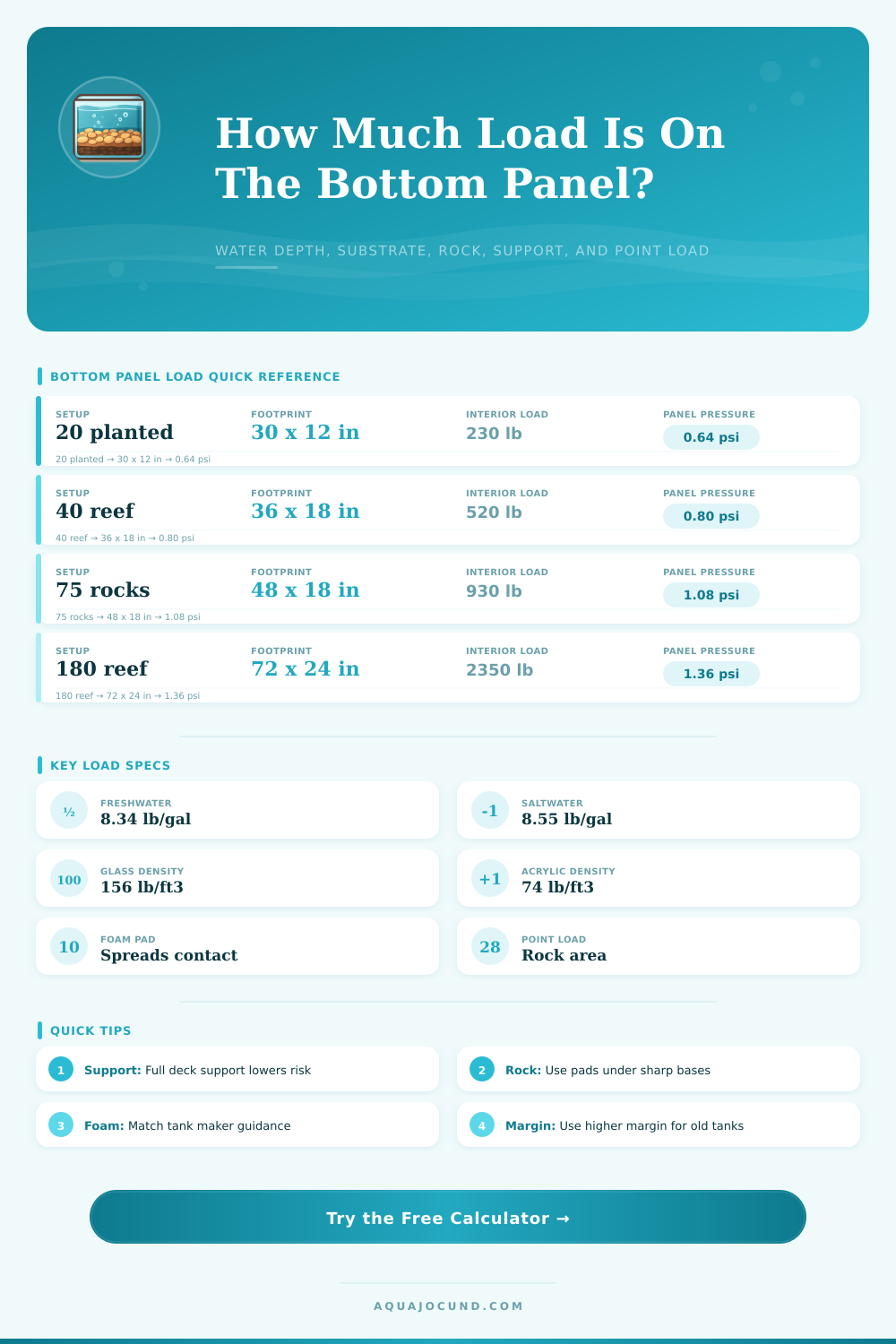
| 20 long | 30 x 12 in / 76 x 30 cm | 11 in / 28 cm | 190 to 260 lb | 0.53 to 0.72 psi |
| 40 breeder | 36 x 18 in / 91 x 46 cm | 15 in / 38 cm | 430 to 600 lb | 0.66 to 0.93 psi |
| 75 gallon | 48 x 18 in / 122 x 46 cm | 20 in / 51 cm | 800 to 1050 lb | 0.93 to 1.22 psi |
| 125 gallon | 72 x 18 in / 183 x 46 cm | 21 in / 53 cm | 1350 to 1750 lb | 1.04 to 1.35 psi |
| 180 gallon | 72 x 24 in / 183 x 61 cm | 24 in / 61 cm | 2100 to 2700 lb | 1.22 to 1.56 psi |
| Support condition | Risk factor | Best use | Watch item |
|---|---|---|---|
| Full flat deck | 1.00x | Flat-bottom glass, acrylic, plywood-deck stands | Deck must be flat and clean. |
| Deck plus rim | 1.05x | Framed tanks with added flat bearing | Do not force a rimmed tank onto foam against maker guidance. |
| Perimeter rim only | 1.18x | Factory-framed glass aquariums | Rim must bear continuously. |
| Cross slats or rails | 1.35x | Small tanks or designs made for rail support | Open spans increase bottom bending. |
| Corner or sparse support | 1.70x | Not recommended for filled aquariums | High twisting and edge stress risk. |
| Medium foam pad | 0.92x contact modifier | Rimless and acrylic tanks when approved | Too-soft foam can create uneven bearing. |
Cracking Glass A cracked glass bottom isn’t something delicate; no sir. It only takes a couple seconds of catastrophic failure because someone forgot that water is heavy and stands aren’t always perfect. What’s the load on the floor? That’s important when selecting a place to house an existing tank or building your own aquarium stand. But what about the actual load on the glass itself? Many people forget to consider that weight until it’s too late.
To combine all those loads, use the calculator above. It will estimate the combined loads based off water depth, substrate types, and rock placement. It will also consider how you support the panes using your chosen stand. In short, this calculator turns the abstract world of physics into a single pressure reading so you can see if your setup is safe before you ever fill the tank with something like two hundred pounds of saltwater.
How to Keep Your Aquarium Glass Safe
The most obvious factor here is weight of water itself. That’s around 8.34 lbs/gallon in fresh water. Salt water will weigh a little more as well because there are some dissolved minerals present. So that initial load is what rests atop the bottom panel all the time. But then add in substrate. Sand is lighter than gravel, and planted soils can hold varying amounts of water, altering their effective weight. These change the effective weights of those materials. The tool automaticly takes into account these different densities. But you have to understand how your own tank is set up. For instance, if you’re running a reef tank with a lot of live rock and deep sand beds, the weight increases rapidly. Now it’s not just volume, it’s also about density distributed over aquarium floor.
The most threatening factor in rock placement are point loads. For example, a large piece of dryland stone may be resting on just a few square inches of glass where its base or edges is not even or otherwise sharp. That translates into thousands of pounds of possible force concentrated in a tiny spot. That creates local stress much higher then the overall average load on the glass. The calculator allows you to specify the smallest area of hard contact to model this worst-case scenario. In other words, it helps you see what your hardscape is really doing to the glass given the thickness you’ve chosen. If the result seems too high, try spreading out the base of the rock or add a foam pad to drasticly reduce the risk. By doing so you increase the bearing surface.
Just as important to long life is the support structure. Weight distribution is key here. For most custom glass tanks a full flat deck evenly distributes weight across the bottom panel. Framed aquariums should of have rim support, but not all do. If your support structure has cross slats or only corner supports, it creates bending pressure that weakens the glass over time. Unless the aquarium was specifically made for that style of support, it’s not good. The tool’s reference tables detail exactly how each style of support impact the stress calculation. Knowing why a flat surface matters helps avoid thinking you can use just about any decent looking table. Anything wobbly exerts occasional stress on edges and seams which is typically where older tanks fail prematurely.
Your safety margin is also influenced by material selection. Glass has the advantage of being strong and stiff but is also brittle which means it will fail abruptly once its limits has been reached. Acrylic, on the other hand, is more flexible and bends better under weight without breaking. However, acrylic need continuous support so it does not bow out. The calculator takes this into account in order to give you a true pressure reading based on the materials you use. For second-hand panels whose history of use is unknown (or older tanks) it’s wise to go with a higher safety margin which gives you a bit of wiggle room against any unseen micro-fractures that might have formed over time.
To conclude, Ultimately, it all comes down to risk management. It’s easy to manage until it becomes an issue. And then you have a mess on your hands. So how do you manage the risk? You calculate the load on your bottom panels and know when they’re at or near their limit so you can take corrective action if necessary. With a little bit of math, we’re able to end the guessing game and figure out the amount of stress being placed on a piece of glass. We don’t know when it’s going to break, but we can estimate it.
Distribute the load: So what do you do with those pounds? Distribute them! The goal is to distribute weight in a way that keeps the panel relaxed. If the glass is relaxed. The tank will be safe as long as there are enough supports that match the design and each and every pound are accounted for. Knowing everything that’s inside my tank allows me to feel confident that it won’t fall apart.