Aquarium Bracing Percentage Calculator
Estimate eurobrace coverage, center brace area, clear top opening, overflow cutout loss, light shadow, and safety coverage from your tank dimensions.
| Material / Trim | Typical Thickness | Relative Stiffness | Shadow Factor | Common Use |
|---|---|---|---|---|
| Glass strip | 6-12 mm | 1.00-1.35x | 0.95-1.00x | Eurobrace and center brace |
| Acrylic strip | 0.375-0.75 in | 0.65x | 0.80x | Acrylic tanks and retrofits |
| Polycarbonate strip | 0.25-0.5 in | 0.75x | 0.78x | Clear covers and light duty braces |
| Aluminum frame | 1-2 in rail | 1.50x | 1.15x | Commercial top rims |
| Stainless frame | 1-2 in rail | 1.70x | 1.18x | Large custom systems |
| PVC trim | 0.75-1.5 in rail | 0.55x | 1.20x | Cosmetic trim, not primary bracing |
| Tank Class | Water Height | Typical Bracing Target | Common Layout | Access Note |
|---|---|---|---|---|
| Shallow frag | 8-14 in / 20-36 cm | 12-22% | Narrow eurobrace or rim | Prioritize open top |
| Breeder / low display | 14-18 in / 36-46 cm | 20-30% | 2 in eurobrace | Large central service opening |
| Standard display | 18-24 in / 46-61 cm | 26-36% | Eurobrace plus center | Split openings around brace |
| Tall display | 24-30 in / 61-76 cm | 32-44% | Wider strips plus center | Plan tool reach before gluing |
| Large public tank | 30+ in / 76+ cm | Engineer specified | Custom frame | Do not rely on percentage only |
| Tank | Dimensions | Top Area | Typical Brace Width | Typical Braced Area |
|---|---|---|---|---|
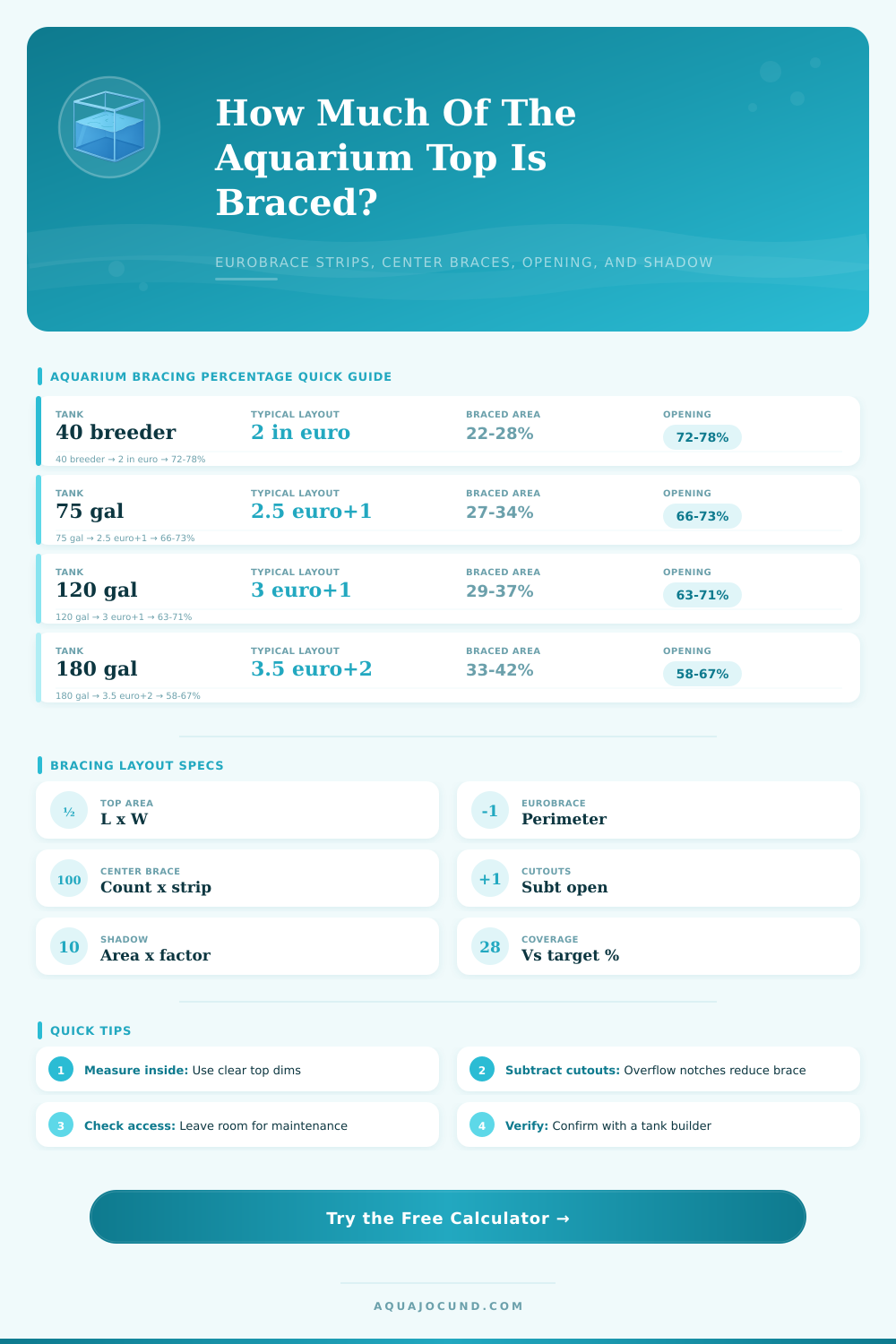
| 40 breeder | 36 x 18 in / 91 x 46 cm | 648 sq in | 2.0 in / 5.1 cm | 22-28% |
| 75 gallon | 48 x 18 in / 122 x 46 cm | 864 sq in | 2.5 in / 6.4 cm | 27-34% |
| 90 gallon | 48 x 18 in / 122 x 46 cm | 864 sq in | 3.0 in / 7.6 cm | 30-38% |
| 120 gallon | 48 x 24 in / 122 x 61 cm | 1152 sq in | 3.0 in / 7.6 cm | 29-37% |
| 180 gallon | 72 x 24 in / 183 x 61 cm | 1728 sq in | 3.5 in / 8.9 cm | 33-42% |
| 220 gallon | 72 x 24 in / 183 x 61 cm | 1728 sq in | 4.0 in / 10.2 cm | 38-48% |
| Opening Type | Typical Area | How It Affects Bracing | Calculator Input |
|---|---|---|---|
| Corner overflow notch | 8-16 sq in / 52-103 sq cm | Subtract from nearby eurobrace | Overflow cutout area |
| Back overflow box | 16-36 sq in / 103-232 sq cm | Usually removes back strip area | Overflow cutout area |
| Coast-to-coast slot | 30-90 sq in / 194-581 sq cm | Can strongly reduce rear brace | Custom cutout area |
| Access opening | Varies by aquascape | Compared with clear center opening | Access length and width |
| Light fixture clearance | Fixture footprint dependent | Estimated by shadow factor | Fixture spread / shadow factor |
Sand shades. You spend weeks selecting them and weeks planning out the hardscape. You select your livestock so they’ll live happily ever after. Then you head off to buy the tank. And you get sucked into a spreadsheet comparing center strip counts and eurobrace widths. This is an interesting intersection of structural physics and aesthetic dreaming.
A tanks top is more than just an open hole. It is a way for people to get in. It is a key point for bracing. It is also a place where light can come in. Most of us think only of what’s visible from within the tank. We overlook its roof as the thing holding everything together. That’s where the math comes in, and it can save you some serious money down the road.
Why You Need to Plan Tank Braces Carefully
If you understand what all those numbers represent, then you won’t make an expensive mistake regarding your bracing and structural physics. Bracing is a see-through vs. It is a tough trade-off. In order to ensure the long front pane doesn’t buckle under the weight of hundreds of gallon, you require sufficient material. But you also desire that unobstructed view.
Because the span isn’t very long (typically), a 40 breeder tank usually requires only perimeter bracing. Extend that span to seventy-two inches, however, and everything changes. That means torque. Torque pushes outward against bottom corners. And without wider eurobraces or a center brace, that glass will flex until cracks appears.
That’s why the safety calculations is driven by height and width. Water pressure is directly proportional to depth. So a small frag tank won’t require much bracing at all. But a tall display requires much greater surface area for support.
Next, the tool calculates net coverage, based off your overall top area minus the area covered by any cut outs for overflows or access openings. That’s another place folks screw it up. You may believe you have 30% bracing covering the surface area. But then you make a big ol’ notch for a back overflow box. Now the rest of it has to work harder with less material.
Then there’s material selection. Glass strips is clear, hard, and rigid. That makes them popular in reef tanks where light penetration is important. Acrylic is lighter and less rigid. It will flex more and change how it distributes stress. Frames made of aluminum are very rigid and don’t block light, but they do cast sharp shadows. The reference table on the page spells it out well enough to allow you to compare the relative stiffness.
When you’re making your own custom rimless tank, you can’t go with your gut. You should of known that a half-inch acrylic bar is different than a ten-millimeter piece of glass. Until it’s too late: light shadow Your corals require photons and a wide brace isn’t just blocking the view, it’s also blocking those photons.
The calculator looks at a spread coefficient depending on the type of lighting fixture use. For example, even with high-intensity LEDs, even a narrow strip can create an appreciable void in coverage which impacts where you place your more sensitive frags (and thus what your aquascape look like). It’s a little thing that derails so many pretty tanks.
The last practical limitation is accessibility. In order to prune and change water, you’re going to need to get your hand in there at some point or another. An eight inch gap between the edge of the stand and the center strip do not help with getting a set of long tweezers back out again…good luck!
Enter your desired amount of access into the tool so as not to lose function for form; sure, it might be super strong, but what good is it when you can’t keep up with maintaining the ecosystem within? Do it now, save your head later. Adjusting a digital width now is easier than cutting through cured silicone later. Bracing correctly will keep that tank together and let you focus on the living world in it.