📐 Aquarium Glass Pane Area Calculator
Estimate each glass panel, edge overlap allowance, eurobrace strips, overflow cutouts, waste allowance, thickness weight, and total order area.
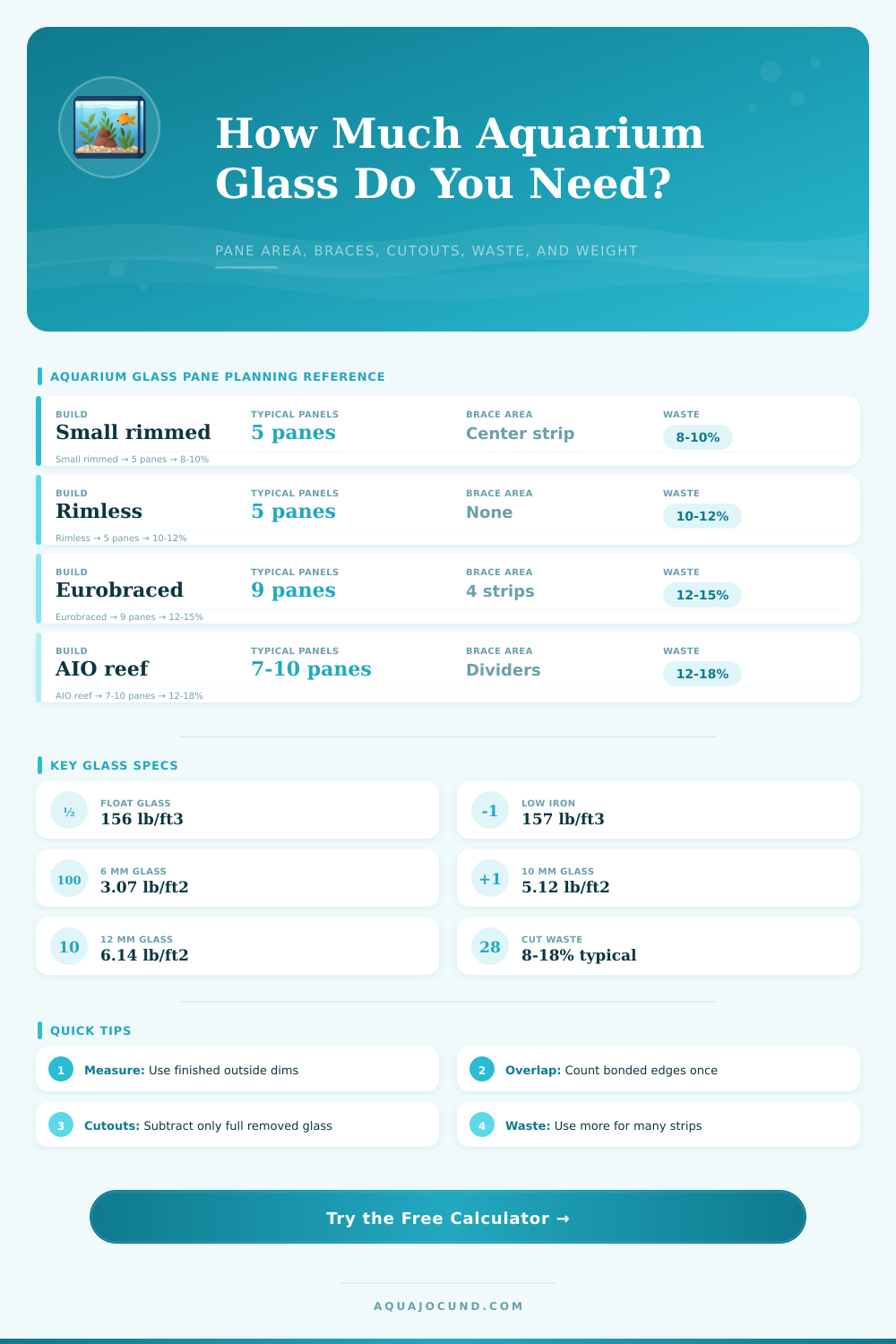
| Layout | Pane Pieces | Area Impact | Best Use |
|---|---|---|---|
| Standard 5 panes | Front, back, 2 sides, bottom | Baseline glass area | Most framed rectangular aquariums |
| Center brace | 5 panes + 1 strip | Adds one short strip | Longer tanks with top support |
| Eurobrace | 5 panes + 4 perimeter strips | Adds long narrow strips | Open-top tanks needing rim support |
| AIO divider | 5 panes + divider baffles | Adds custom flat panes | Rear-chamber reef tanks |
| Overflow box | 5 panes + box panes, minus slots | Cutouts subtract removed area | Drilled reef and sump systems |
| Tank | Outside Dimensions | Approx 5-Pane Area | Typical Thickness |
|---|---|---|---|
| 10 gallon | 20 in × 10 in × 12 in / 51 × 25 × 30 cm | 6.4 ft² / 0.59 m² | 3-5 mm |
| 20 long | 30 in × 12 in × 12 in / 76 × 30 × 30 cm | 10.0 ft² / 0.93 m² | 5-6 mm |
| 40 breeder | 36 in × 18 in × 16 in / 91 × 46 × 41 cm | 17.3 ft² / 1.61 m² | 6-8 mm |
| 75 gallon | 48 in × 18 in × 21 in / 122 × 46 × 53 cm | 27.0 ft² / 2.51 m² | 8-10 mm |
| 120 gallon | 48 in × 24 in × 24 in / 122 × 61 × 61 cm | 32.0 ft² / 2.97 m² | 10-12 mm |
| 180 gallon | 72 in × 24 in × 24 in / 183 × 61 × 61 cm | 44.0 ft² / 4.09 m² | 12-15 mm |
| Item | Common Range | Calculator Treatment | Planning Note |
|---|---|---|---|
| Edge overlap allowance | 1/16-1/4 in per edge | Adds perimeter allowance to each pane | Use the finished pane dimensions from your builder. |
| Eurobrace strip width | 2-4 in / 5-10 cm | Counts strips separately | Wider strips raise area and weight quickly. |
| Overflow cutouts | Slots, weirs, teeth, bulkhead openings | Subtracts rectangular removed area | Do not subtract drilled holes unless full glass is removed. |
| Cutting waste | 8-18% | Applies after cutout subtraction | Use more waste for many narrow pieces. |
| Material | Density Used | 6 mm Weight | 12 mm Weight |
|---|---|---|---|
| Soda-lime float glass | 156 lb/ft³ / 2500 kg/m³ | 3.07 lb/ft² | 6.14 lb/ft² |
| Low-iron aquarium glass | 157 lb/ft³ / 2515 kg/m³ | 3.09 lb/ft² | 6.18 lb/ft² |
| Tempered float glass | 156 lb/ft³ / 2500 kg/m³ | 3.07 lb/ft² | 6.14 lb/ft² |
| Laminated safety glass | 163 lb/ft³ / 2610 kg/m³ | 3.21 lb/ft² | 6.42 lb/ft² |
| Borosilicate glass | 139 lb/ft³ / 2230 kg/m³ | 2.74 lb/ft² | 5.47 lb/ft² |
If you’re building an aquarium, measuring is essential. Glass is heavy, and water gets even heavier. Knowing how much you want makes it important to order exactly what you need without having excess scrap or missing a brace.
Calculating area for panes isn’t simply length multiplied by width. Surface area needed will depend on style of construction. For example, a typical rimmed tank consist of 5 panes. Easy enough. However, planning for a eurobraced or rimless tank is where things gets tricky fast. Those small thin strip reinforcements adds up in both weight and surface area.
Why Measuring Is Important
Once you know what shape your tank is, the math get complex but the calculator up top takes care of it for you. The calculator handles adding edge allowances for grinding or subtracting cutouts for overflows so you don’t have to do it manually. Understanding what changes the answer is more important than just knowing the answer itself.
For instance, there is the overlap allowance. By most builder standards, you add a little bit (fraction of an inch) to each edge to give yourself some wiggle room to make sure you have a good bond line and maybe also account for how much material will be lost when cut. Sounds minor but multiply this by number of edges on a tank and you may very well find that those tiny inches add another full sheet of glass to your purchase order. That’s what differentiates a stress free build different than a rushed trip back to your supplier.
Another common place people go off course is in waste allowance. You might think “I’ll just cut out a rectangle real clean so there won’t be any waste.” No. That won’t help much since pushing the glass too far can causes shattering. On a basic tank with no divider baffles, etc., most people plan 10 to 12 percent as the waste factor. But if you are making complex cuts, such as carving notches into overflow weirs or cutting dividers into an all-in-one reef system, you should of increase that waste factor. The more complicated the cut, the less confident you may be and the more waste factor you should set here. Newbies to glass work should slide the dial towards a higher waste factor. Rather than running short of a key piece three days from when you intended to begin assembly, it’s better to have some extra shards floating around.
Weight is a big deal when building your own tanks. The water weight is easy, it’s about eight pounds per gallon. However, many people fail to see that glass itself is also fairly heavy. Glass that is ten millimeters thick weighs more than five pounds per square foot. That means when you multiply the weight of the glass by the area of a 120-gallon tank‘s front panel and its corresponding brace strips, you’re looking at a lot of weight!
It doesn’t matter how much you like calculus; this is no theoretical problem. A poorly designed cabinet will result in cracked glass (at best) if it cannot hold the weight of both the water and all that heavy structural glass. Understanding how much everything weigh allows you to check whether your cabinet can hold the weight without flexing and potentially breaking.
Finally, keep in mind that your decision to use low-iron glass or standard float glass will affect the math here by a bit. Low-iron glass is a bit denser than regular glass so it weighs just a tiny bit more per square foot. If you’re realy up against the edge of what your stand can hold, that marginal weight gain is something to consider. That said, most people considers this negligible and opt for low-iron due to how much better it looks. To each their own…but know the numbers.
And lastly, keep in mind these quantities are estimates for order purposes only. Your local glass shop will cut the glass differently based off how they cut pieces from a standard sheet to get the most use out of it. So go into this armed with the calculator as a good starting point and talk to them about it. You’ll come in with your expected panels/areas and sound like you know what you’re doing. Suppliers respects prepared customers because it also moves their process along quickly.
Glass has its quirks, but glass is predictable if you know what to expect from it. Expect weight, account for waste, check your brace sizes twice and be prepared when it cracks. If the numbers add up then all that’s left is some patience and some silicon. Put the tank together and the water will finish the job for you.