Saltwater Weight Calculator
Estimate reef or brackish water weight from salinity, specific gravity, temperature, sump volume, displacement, and mixing batch size.
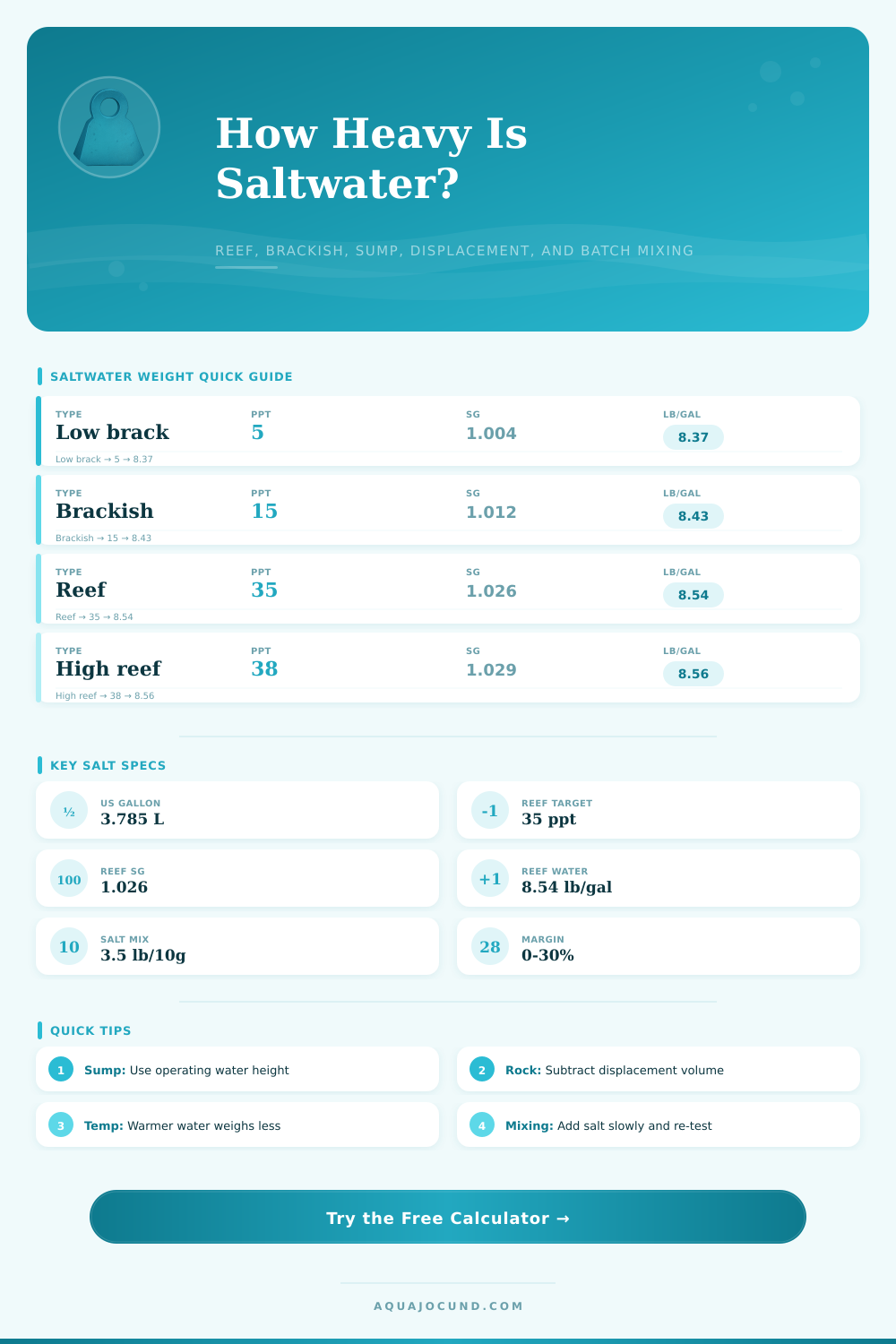
| Water style | Salinity | Approx SG at 25°C | Density kg/L | Weight lb/gal |
|---|---|---|---|---|
| Freshwater reference | 0 ppt | 1.000 | 0.997 | 8.32 |
| Low brackish | 5 ppt | 1.004 | 1.001 | 8.35 |
| Moderate brackish | 15 ppt | 1.012 | 1.008 | 8.41 |
| Fish-only marine | 31 ppt | 1.023 | 1.020 | 8.51 |
| Standard reef | 35 ppt | 1.026 | 1.024 | 8.54 |
| High salinity reef | 38 ppt | 1.029 | 1.026 | 8.56 |
| Batch volume | 35 ppt salt mix estimate | Mixed water weight | Common use |
|---|---|---|---|
| 5 gal / 19 L | 1.75 lb / 0.79 kg | 42.7 lb / 19.4 kg | Nano top-up mix |
| 10 gal / 38 L | 3.5 lb / 1.6 kg | 85.4 lb / 38.7 kg | Small water change |
| 20 gal / 76 L | 7.0 lb / 3.2 kg | 170.8 lb / 77.5 kg | Medium reef change |
| 32 gal / 121 L | 11.2 lb / 5.1 kg | 273.3 lb / 124.0 kg | Mixing barrel |
| 44 gal / 167 L | 15.4 lb / 7.0 kg | 375.8 lb / 170.5 kg | Brute can batch |
| System | Display dimensions | Typical net water | 35 ppt water weight | With 10% safety |
|---|---|---|---|---|
| 10 gal nano | 20 x 10 x 12 in / 51 x 25 x 30 cm | 9 gal / 34 L | 77 lb / 35 kg | 85 lb / 38 kg |
| 20 long reef | 30 x 12 x 12 in / 76 x 30 x 30 cm | 18 gal / 68 L | 154 lb / 70 kg | 169 lb / 77 kg |
| 40 breeder | 36 x 18 x 16 in / 91 x 46 x 41 cm | 35 gal / 132 L | 299 lb / 136 kg | 329 lb / 149 kg |
| 75 gal with sump | 48 x 18 x 21 in / 122 x 46 x 53 cm | 87 gal / 329 L | 743 lb / 337 kg | 817 lb / 371 kg |
| 125 gal display | 72 x 18 x 21 in / 183 x 46 x 53 cm | 137 gal / 519 L | 1170 lb / 531 kg | 1287 lb / 584 kg |
| Temperature | 35 ppt density | Weight per gallon | Planning note |
|---|---|---|---|
| 68°F / 20°C | 1.025 kg/L | 8.56 lb/gal | Cool mixing station |
| 75°F / 24°C | 1.024 kg/L | 8.54 lb/gal | Common reef room |
| 77°F / 25°C | 1.024 kg/L | 8.54 lb/gal | Standard comparison |
| 80°F / 27°C | 1.023 kg/L | 8.53 lb/gal | Warm reef system |
| 84°F / 29°C | 1.022 kg/L | 8.52 lb/gal | Use for hot rooms |
Because live rock and water will add considerable weight, don’t rely on glass measurements. Many people has had their stands fail because they ignores the weight of an aquarium. Adding salt increases weight of the water. The above calculator will calculate the actual weight of your tank and tell you whether your floor can handle an upgraded setup or not.
The primary factor here are salinity. Freshwater weighs about eight point three pounds per gallon, but if you add enough salt to match ocean conditions, that number climb to roughly eight point five. While the disparity might not seem significant when scaled up to volume of a 75g tank, it adds quite a bit of weight. For example, a 75g reef tank will weigh almost fifteen pounds more then an equivalent freshwater tank. That’s a good-sized kid standing on your stand.
How to Calculate Your Tank Weight
To account for this, the calculator provide preset options like “reef,” or lets you type in a specific gravity number yourself. Depending on what you choose, it recalculates density accordingly.
The same is true for weight, but not as much. As a general rule, warmer water will be less dense due to expansion. Therefore, if your tank were filled with water that was at sixty-eight degrees, it would weigh more than water in a tank that’s at eighty-four degrees. The tool use your heater setting to make the estimate accurate. Most of us maintain our tanks somewhere around seventy-five to seventy-eight degrees so the variation is negligible. Unless, of course, you’re dealing with a big-ass two-hundred-gallon peninsula… then the difference counts.
Secondly, remember that there are items in your aquarium that displace water. These include plumbing, sand, and live rock. These item all use up some of the aquarium’s volume. Failing to consider this volume will result in an overestimation of amount of water in the aquarium. There is a place in the calculator where you can subtract out any of those items from the aquarium’s total capacity. You can even add the volume of the sump to the equation, that reservoir adds to the strain on the cabinet joints. Consider it as part of the total.
A bucket of premixed salt water weighs something… It’s good to know before you go lifting it. Based off your desired salinity, this thing estimates how much that particular batch would weigh. It will also tell you how much dry salt mix to add (roughly three and a half pounds per ten gallons for the typical 35 ppt). You don’t want to run out mid-mixing session in the garage.
The last part of the plan is adding a safety factor. Stands comes in all shapes and sizes. They also vary in build quality, and you should of keep in mind that floor joists has their own limits. Calculating your water weight plus another ten or fifteen percent adds a buffer against uncertainty. The additional weight from hoses, equipment and even overflow are covered by that buffer. It’s the difference between standing up straight and standing like a wobbler.
If you want a plan, use actual data. Don’t estimate. It doesn’t require engineering expertise. Simply determine the volume of your system and go from there. With that information, you can move forward with confidence.