Aquarium Water Weight Calculator
Estimate display water, sump water, water-change batch weight, density, displacement, and safety-factor planning load.
Water weight snapshot
Display water, sump water, batch water, and density update when inputs change.
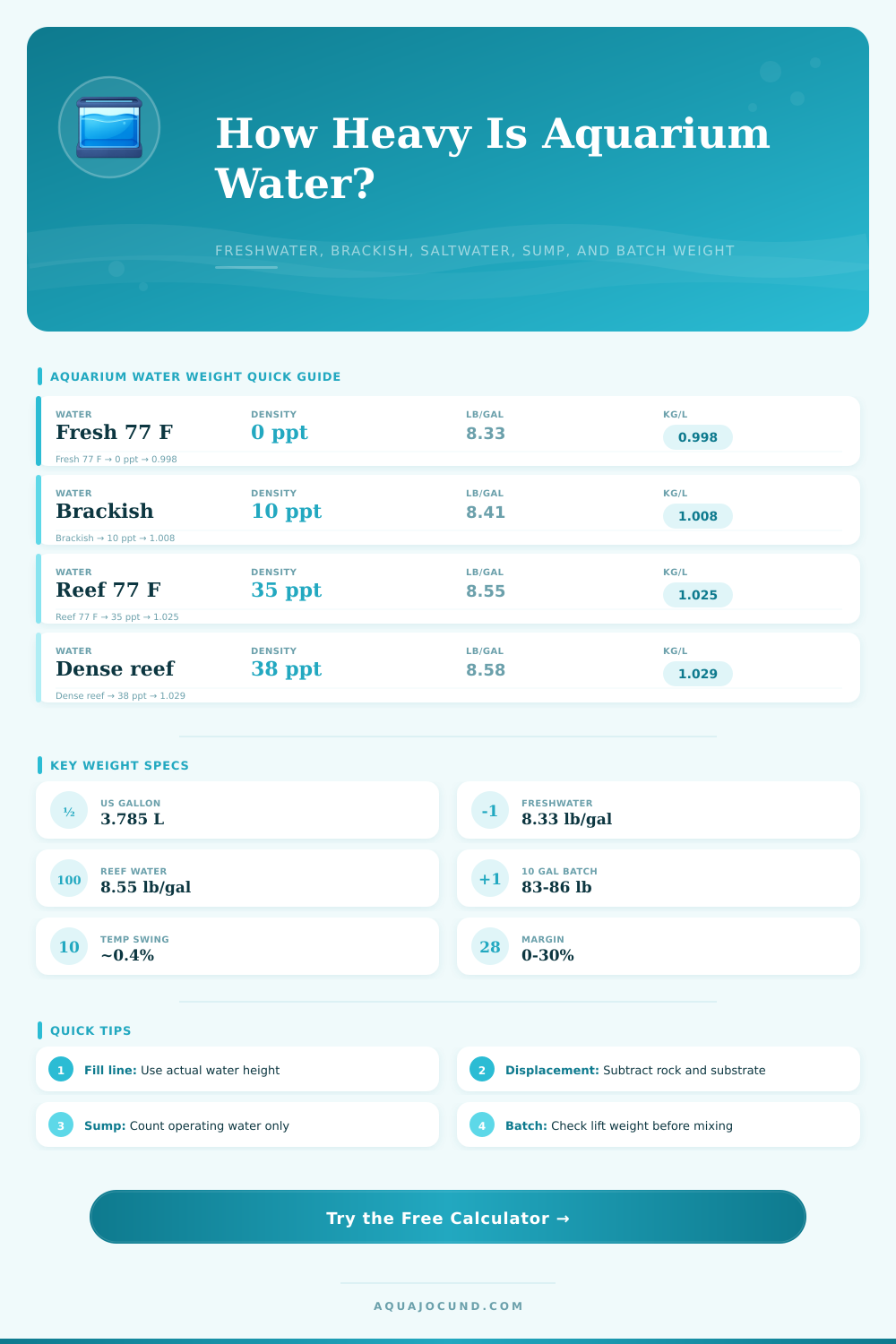
| Water type | Typical salinity | Density near 77°F | Weight per US gal | Weight per L |
|---|---|---|---|---|
| Freshwater | 0 ppt | 0.997 kg/L | 8.32 lb | 0.997 kg |
| Low brackish | 5 ppt | 1.002 kg/L | 8.36 lb | 1.002 kg |
| Brackish | 10 ppt | 1.007 kg/L | 8.40 lb | 1.007 kg |
| Marine | 30 ppt | 1.021 kg/L | 8.52 lb | 1.021 kg |
| Reef | 35 ppt | 1.025 kg/L | 8.55 lb | 1.025 kg |
| Common tank | Inside size used | Full volume | Fresh water weight | Reef water weight |
|---|---|---|---|---|
| 10 gallon | 20 in × 10 in × 12 in | 10.4 gal | 86 lb | 89 lb |
| 20 long | 30 in × 12 in × 12 in | 18.7 gal | 156 lb | 160 lb |
| 40 breeder | 36 in × 18 in × 16 in | 44.9 gal | 374 lb | 384 lb |
| 75 gallon | 48 in × 18 in × 21 in | 78.5 gal | 654 lb | 671 lb |
| 125 gallon | 72 in × 18 in × 22 in | 123.4 gal | 1028 lb | 1055 lb |
| Displacement source | Typical entered range | Effect on water weight | Best input method |
|---|---|---|---|
| Thin substrate only | 3-8% | Small reduction | Use actual fill test if known |
| Rock aquascape | 8-18% | Moderate reduction | Estimate after hardscape is placed |
| Dense reef rock | 15-30% | Large reduction | Compare display fill gallons to geometry |
| Bare bottom | 0-5% | Nearly full water load | Enter zero unless equipment is bulky |
| Batch size | Freshwater weight | Reef saltwater weight | Lift planning note |
|---|---|---|---|
| 5 gal | 42 lb | 43 lb | Small bucket, still heavy when full |
| 10 gal | 83 lb | 86 lb | Use a container with a stable base |
| 20 gal | 167 lb | 171 lb | Better for a dolly, cart, or fixed station |
| 44 gal | 367 lb | 376 lb | Stationary mixing bin weight matters |
Aquarium keepers tend to spend more time thinking about lighting, fish compatibility, etc., while neglecting something very important, water is heavy. For example, freshwater weighs approximately 8.3 pounds per gallon, which doesn’t sound like too much…but then think about it, a typical 75g tank contains over 450 pounds just in water! And that’s not even counting the rocks, substrate, glass, stand, etc. So you’re already at 600+ pounds for your tank structure. Depending on the condition of your floor joists (and the strength of your stand), that could be a structural issue, not just an ugly one.
The calculator up top will do the math for you when you input your measurements, eliminating guesswork as to what your floor can realy support.
Why Aquarium Weight Is Important
First error: People assume the tank volume equals the water weight. That’s not true. You don’t fill your tanks to the top, there must be room for freeboard (to avoid spillage), wave action, and overflow weirs. In a big tank, the two inches of empty space could mean a few gallons of water, greatly decreasing the actual load on the tank. Understanding this will allow you to get an accurate number by using the real amount of water in the tank rather than the total height of the tank in glass. This can be crucial when making the decision of whether to strengthen your stand before lifting the tank or whether existing one is up to the task. It will also explain to you how a 20 gallon long is so heavy you need two guys and a plan to move it, but you’re able to move your ten gallon nano by yourself.
But here’s where salinity enters the equation, and (as previously stated) not to the extent that you’d expect. Because of the dissolved minerals, saltwater is heavier than fresh. At a “normal” salinity of 35 parts per thousand, it weighs roughly 8.5 pounds per gallon. This means a 125 gallon tank of saltwater holds almost 30 pounds more water then a freshwater tank of equal volume. Over hundreds of gallons that’s no biggie, but it does have an impact on long term structure design. The table below on the page breaks down how density varies based off salinity and temperature. As temperature increases, water gets a bit lighter and expands, whereas as temperature decreases it gets a bit heavier as it contracts. While these changes are small from day-to-day, they is important when considering specific input requirements instead of ballpark guesses.
The other hidden variable is displacement, water will never take up the same amount of room as substrate and rock. If your aquarium has a lot of hardscape (either in a complex reef build or a heavily aquascaped freshwater tank), you may be displacing 10 to 20 percent of total volume with rock. This means you’re not weighing empty air. You should subtract that displacement from the total volume, as it is still helpful to know what portion of the water are actualy pushing down on your structure. That can help you plan water changes and may be important if you are worried about plumbing stress or leakage.
Knowing the net liquid weight adjusted for displacement would of been helpful. For instance, a 20 gallon bucket of fresh water weighs almost 168 lbs., so carrying that over the edge of a counter takes more than just muscle, but rather leverage and care. Knowing how heavy each batch of water is before doing this can prevent broken fixtures and injuries.
A second twist occurs with sumps since the sump holds additional volume that rests on its own cabinet or the same stand. The weight of an external sump is different than that of one built into primary stand so making sure you count the operating volume of the sump helps avoid underestimating the total weight of the system.
To further hedge their bets, some builders go with a slim calculation and disregard any safety factor. This is a mistake, since you can always account for this by including 15-30 percent buffer volume to allow for changes in glass thickness, gear weight, and unforeseen extras such as filters or heaters which will sit atop the frame. Better safe than sorry!
The truth of the matter is that aquarium construction is as much a science (physics) as it is one of life (biology), and it’s the basic strength of your tank’s foundation that makes the tank beautiful. The weight of the water really matter and knowing what it truly is will allow you to make better choices, avoid expensive errors, and keep your tank water off the floor. Measure twice, calculate wisely, and remember that gravity doesn’t care if your aquascape is beautifull.