🌊 Peninsula Tank Volume Calculator
Estimate peninsula display and system water from waterline, viewing-end freeboard, overflow box displacement, dual-side aquascape zones, rock, substrate, sump link, and turnover target.
Calculation Breakdown
| Overflow style | Typical dimensions | Calculator assumption | Volume effect |
|---|---|---|---|
| End external weir box | 18-30 in wide, 3-5 in projection | Mostly outside display, small weir loss | Low display displacement |
| End internal overflow box | 12-24 in wide, 4-6 in projection | Box footprint subtracts water space | Moderate to high |
| Slim ghost overflow | 12-24 in wide, 1.5-3 in projection | Thin box with high solid share | Low to moderate |
| Coast-to-coast end box | Full width, 3-5 in projection | Full end weir chamber | High but efficient skim |
| No display box | Drilled external or no sump | Zero display overflow displacement | None |
| Peninsula format | Inside dimensions | Gross at running waterline | Typical net after scape |
|---|---|---|---|
| Nano peninsula | 24 x 16 x 15 in / 61 x 41 x 38 cm | 22-24 gal / 83-91 L | 17-21 gal / 64-79 L |
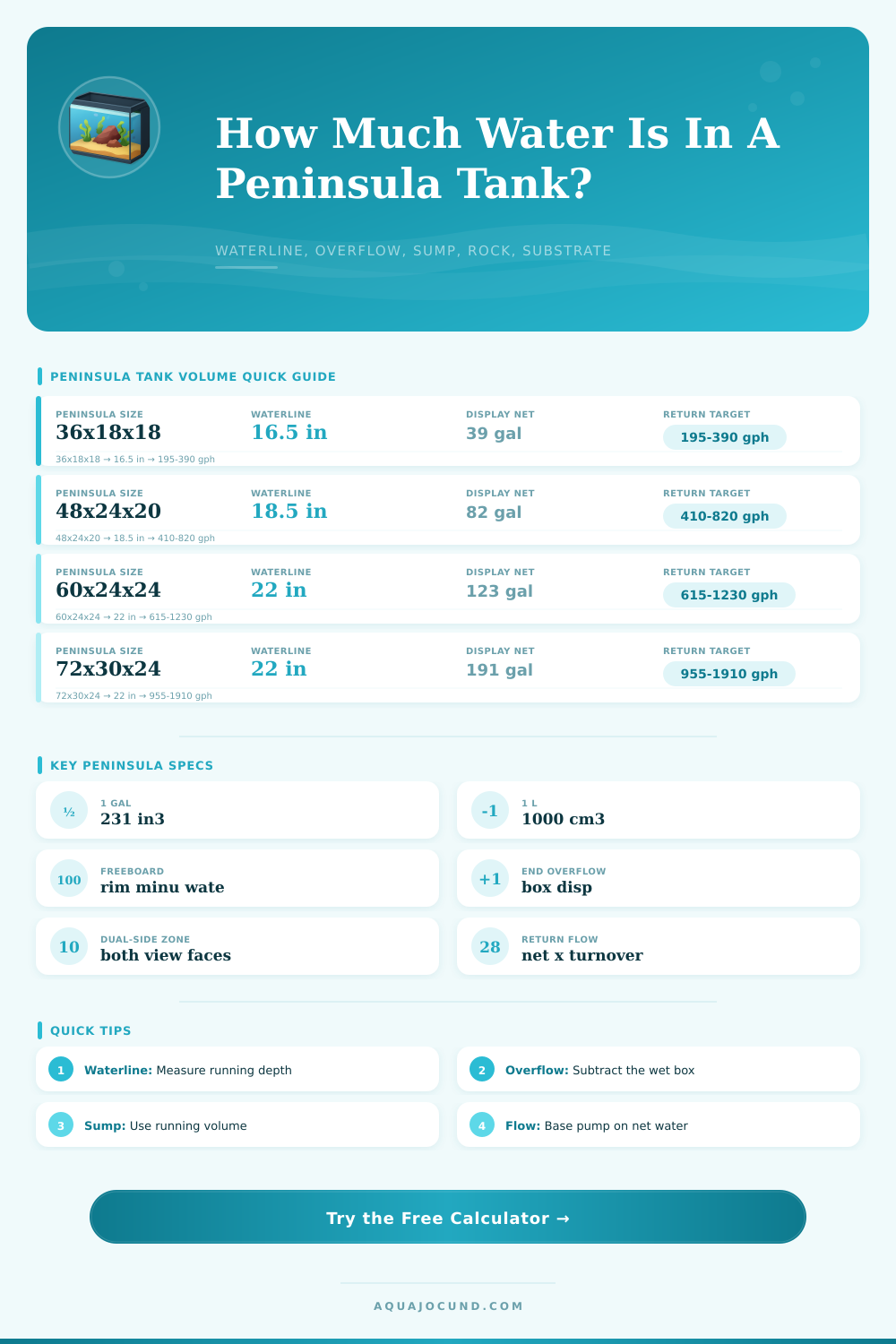
| 36 in room divider | 36 x 18 x 18 in / 91 x 46 x 46 cm | 44-47 gal / 167-178 L | 35-42 gal / 132-159 L |
| 48 in mixed reef | 48 x 24 x 20 in / 122 x 61 x 51 cm | 91-95 gal / 344-360 L | 72-85 gal / 273-322 L |
| 60 in peninsula | 60 x 24 x 24 in / 152 x 61 x 61 cm | 137-143 gal / 519-541 L | 110-126 gal / 416-477 L |
| 72 in large reef | 72 x 30 x 24 in / 183 x 76 x 61 cm | 200-206 gal / 757-780 L | 168-190 gal / 636-719 L |
| Layout | Zone footprint | Best use | Volume impact |
|---|---|---|---|
| Center island | 35-45% | Balanced viewing from both long sides | Moderate rock displacement |
| Two island bommies | 40-55% | Reef coral zones with swim lane breaks | Moderate to high |
| Offset spine | 30-45% | One service side and one show side | Moderate |
| Dual-side canyon | 45-60% | Open sightline down the peninsula length | High footprint use |
| Minimal channel | 15-30% | High flow, fish room, or open scape | Low |
| Reference | Value | Use in calculator | Note |
|---|---|---|---|
| US gallon | 231 in³ | Display volume from dimensions | US liquid gallon |
| Metric liter | 1000 cm³ | Metric volume output | Direct cube conversion |
| Freshwater weight | 8.34 lb/gal | Water load estimate | Approximate at room temperature |
| Reef saltwater weight | 8.55 lb/gal | Reef system water load | Approximate at 35 ppt |
| Return turnover | 3-10x/hr | Pump target from net water | Not total in-tank circulation |
At some point during the construction of your peninsula tank, you reach a moment at which the math cease to be theoretical… As if it were an idea, and becomes a fact of physics. You stare at the long, open-topped piece of glass, and you’re about to fill it with water but you don’t know what’s going to happen to the floor and your furnitures because of all that weight you’ve got sitting there.
You notice that the tank doesn’t appear as large as it really is, and that visual trick is precisely why we underestimate how much our aquascape displaces. That causes us to either under-power our pump, so it can’t moves water deep into the corners, or over-power our pump, which tears off the tender polyps of delicate corals.
Why Calculating Tank Volume Matters
Once you enter your dimensions into the calculator above, it does the hard work for you and spares you the need to guess how many invisible inches of rock and sand hide beneath the surface. The most common newbie error is to figure out how many gallons of water fit inside the glass and call it good. It’s not. Even if a 48-inch long tank is listed as holding ninety gallons, that amount can drop sharply when you subtract the rockwork inside, the substrate layer covering the bottom, and the overflow box in the end.
The gap between what looks like you have on paper versus what you actualy do have is the gap between gross and net volume. If you calculate your return pump from the gross volume, you’ll probably find yourself over-pumping your tank. This generates turbulence instead of smooth flow, which is stressful to any livestock that likes a gentle current. Netting down the water number correctly is the starting point for everything else.
And then there’s solid displacement. It is easy to overlook this, but dry stone displaces a full gallon for every gallon of space it occupies, whereas live rock are porous and holds water inside its structure. This is where the tool asks about the types of rock and their porosity, so yes it can sound granular but boy oh boy does it make all the difference when calculating how to distribute weight throughout a cabinet.
A cabinet wasn’t made to hold two hundred pounds worth of concentrated stone in the middle. This causes uneven settling and structural stress. If you don’t take into account the volume those rocks steal away from your water column, you will load up one side heavily and cause unevenness. These are little things but they are big things.
Volume calculations are also subject to the viewing experience. If you have a peninsula tank with three primary viewing faces, then your aquascape must look good from several angles AND allow water flow into all corners. There are preset layouts in the calculator to help you visualize how much of the footprint you can use without choking off flow. Different style layouts (e.g., offset spine vs center island) is also available as presets.
Ideally, you want open swim lanes on each long side so the fish aren’t pressed up against the back glass, yet enough rock and wood for biological surface area and cover. It’s an art form backed by arithmetic to find that balance. Interestingly enough, the ultimate number depends a lot on the overflow setup as well. Less bulkhead and plastic boxes mean less “taking away” from the interior area.
A good example of this would be comparing an external weir box against an internal overflow chamber. Because an external weir box does not take up as much internal space, you have more tank water and less plastic boxes and bulkheads taking up space. So if you’re making a decision between say a standard end box versus a ghost overflow, make sure to see what kind of footprint those pieces take up inside your tank. As the table on the page indicates, projecting a couple of inches can mean the difference of several gallons of water.
Sound like nothing? You should of tried sizing a skimmer or dosing chemicals with inaccurate numbers. Last, think about the turnover rate. While you want sufficient flow to maintain stable water parameters and move detritus, you don’t want excessive flow that causes dead zones behind your rockwork.
Based off your net volume, the calculator estimates the return target (typically 4-6 returns/hour for most reef systems). That’s only the return loop. Powerheads and internal wave makers is additional items that should be added based on what your livestock needs, not simply on the total number of liters or gallons in the tank. Get the numbers first then allow the math to dictate what hardware you need, instead of letting the hardware drive the numbers.
In the end, constructing a peninsula tank is as much about honoring the available real estate as it is acquiring high-priced hardware. Do your homework, measure, and consider each grain of sand and each rock. Believe the net volume instead of the gross guess. You’ll thank your floor joists, and your fish will be swimming around happily in moving water. What makes these tanks so beautiful is how they look, but what makes them work is all under the surface.