💧 Cube Tank Volume Calculator
Calculate cube aquarium water volume from equal-side dimensions, internal glass adjustment, fill height, freeboard, rim clearance, displacement, and optional sump water.
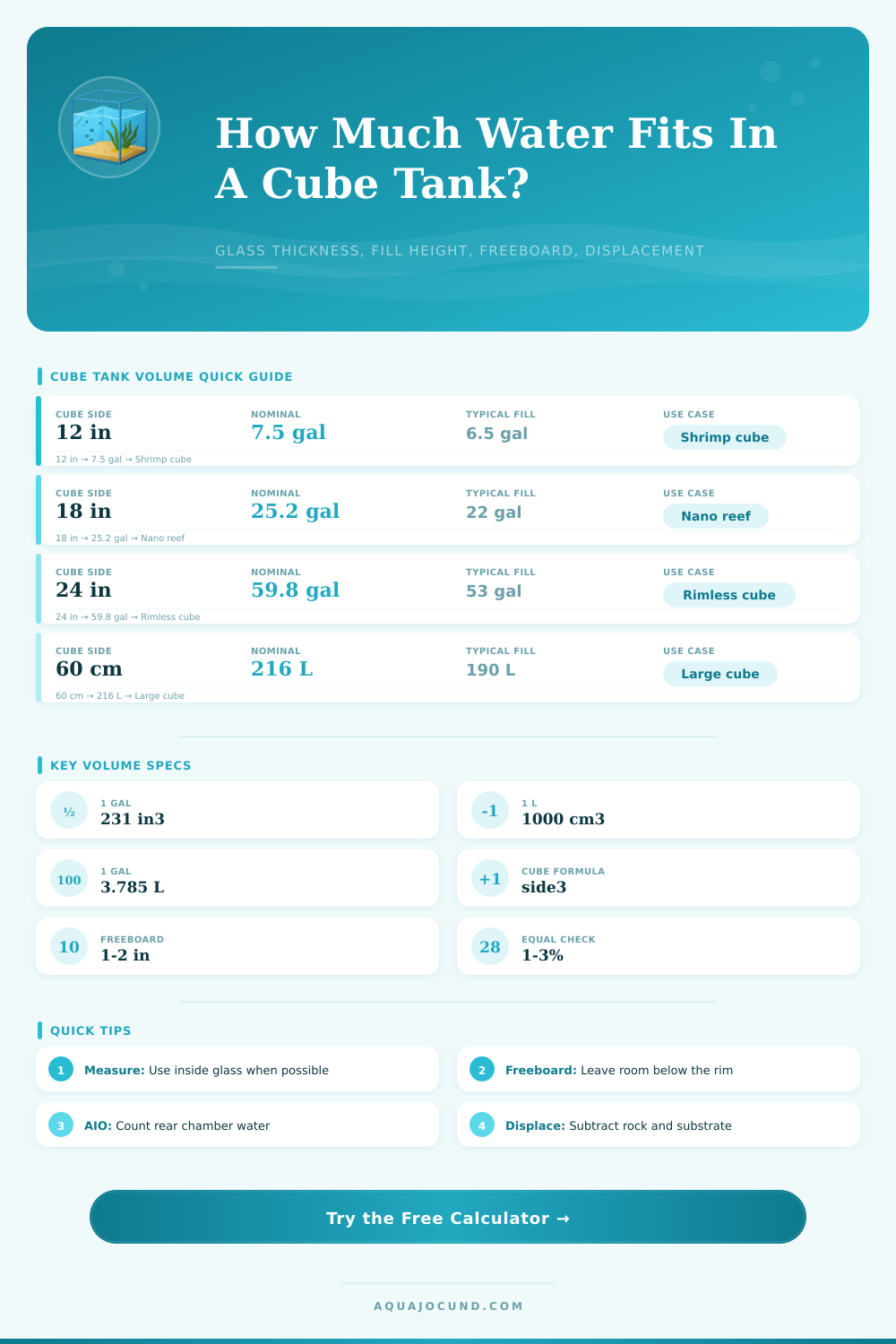
| Cube size | Outside dimensions | Nominal full volume | Typical working volume |
|---|---|---|---|
| 12 in shrimp cube | 12 x 12 x 12 in / 30 x 30 x 30 cm | 7.5 gal / 28 L | 6.0-6.8 gal after glass and freeboard |
| 16 in nano cube | 16 x 16 x 16 in / 41 x 41 x 41 cm | 17.7 gal / 67 L | 14-16 gal with AIO chamber or hardscape |
| 18 in cube | 18 x 18 x 18 in / 46 x 46 x 46 cm | 25.2 gal / 95 L | 20-23 gal for reef or planted layouts |
| 24 in cube | 24 x 24 x 24 in / 61 x 61 x 61 cm | 59.8 gal / 226 L | 50-55 gal with 1-2 in freeboard |
| 60 cm cube | 23.6 x 23.6 x 23.6 in / 60 x 60 x 60 cm | 57.1 gal / 216 L | 185-200 L depending on fill height |
| Glass thickness | Approx metric | Internal side loss | Best use in calculator |
|---|---|---|---|
| 1/8 in | 3 mm | 0.25 in from length and depth | Small cubes and covers, not large rimless tanks. |
| 1/4 in | 6 mm | 0.50 in from length and depth | Common nano and mid-size cube estimate. |
| 3/8 in | 10 mm | 0.75 in from length and depth | Often used on larger rimless cube aquariums. |
| 1/2 in | 12 mm | 1.00 in from length and depth | Large cubes, tall cubes, and reinforced builds. |
| Displacement profile | Default deduction | Typical cube contents | Manual input note |
|---|---|---|---|
| Bare cube | 0% | Heater, sponge filter, minimal decor | Enter only measured objects if needed. |
| Shrimp cube substrate | 5% | Soil cap, botanicals, small hardscape | Add known rock or wood displacement separately. |
| Planted aquascape | 7% | Substrate slope, wood, plant mass | Good default when the scape is moderate. |
| Reef rock cube | 10% | Porous reef rock and equipment | Use manual volume for large solid structures. |
| Heavy stone cube | 14% | Iwagumi or dense stone layout | Measure by bucket displacement for precision. |
| Cube format | Volume behavior | Freeboard habit | Calculator setting |
|---|---|---|---|
| True cube | Side x side x side gives the nominal shape | Usually 0.75-1.5 in below top | All three sides should pass the equal-side check. |
| Shallow cube | Height is shorter than footprint sides | Small freeboard change removes less water | Use three measured sides and accept a non-cube warning. |
| Tall cube | Extra height adds volume but raises pressure | Leave more top reserve for motion | Use actual fill height instead of full glass height. |
| AIO cube | Rear chamber water may count as system water | Return pump sets operating water level | Use AIO displacement or add rear water as sump volume. |
What does this mean? To most aquarists, the size of a tank as listed in the ad means just that… The absolute size of that tank. If it says “eighteen inches,” you believe that you have precisely twenty-five gallons to work with (whether for fish, plants, or corals). The truth is always different than what you think.
Although cube tanks look straightforward because they seem to be the same size on all sides, this symmetry mask multiple layers of lost volume. These losses will affect your dosing calculation, stocking level, and budget. Newbies often make their initial costly blunders by believing the stated volume listed on box matches actual working water within the glass.
Why Your Tank Is Smaller Than You Think
This difference is primarily due to the glass. The size parameter given when purchasing a cube tank are virtually always for exterior dimensions. In other words, they’re talking about physical footprint including thickness of bottom pane and of each wall (four sides). Because those is glass panes, a typical quarter inch thickness subtracts an entire half inch from your interior length and width (the right and left walls). It also subtracts that same amount from total height (the bottom pane). It compounds quickly into a geometric penalty.
For those running bigger rimless tanks with thick glass (three-eighths inch or more), the volume of usable water inside are greatly reduced relative to outside box volume. Once again, the math will be done for you if you plug in your actual glass thickness into calculator above. There is no need to do it yourself each and every time you want think about changing setups.
But there’s more than just amount of structure material. How much do you really want to keep? Is it full? Does anyone fill their tank to the very top? Even if it were a cube, I don’t think people would of doing that. So what about space above the water line. The empty part between the top of the glass and the water line? That’s called freeboard. Having an inch or two of freeboard will prevent overflows and allow you to raise or lower the water with peace of mind.
The final piece of the volume puzzle is the most neglected. Displacement. Decorative stone, driftwood, substrate, live rock, all of this stuff push water aside as you add it. Porous rock alone can take up to ten percent of your tank volume in a reef tank. Seven percent if you’ve got a sloping substrate and some hardscape in a planted tank. Those aren’t small percentages when you’re dosing something or trying to maintain precise nitrate levels.
Also, the cube shape make positioning equipment harder. Most new cubes is designed as all-in-one aquariums with the pump(s) and filter(s) situated in a rear sump compartment. While this makes for a nice looking setup, it takes away more volume from the main display area. That water in the rear compartment is not visible where your fish swim… so do you consider that rear water as being part of your system when dosing? Or just whatever is in your display? You can set up the tool to count both ways (on/off). This helps provide a better idea of exactly how much volume you’re working with in practice. Remember, the sump water are part of the chemical balance of the tank too, even though you don’t see it.
With that knowledge comes a different way of thinking about stocking. An eighteen-inch cube that’s rated for twenty-five gallons may not have as much space as you think if you’re going to displace some substrate and rock. What looks like an adequate sized 18″ cube for tetra keeping could easily become too small when considering how much space your rocks and substrate take up. Under the weight of your hardscape, the perceived space dissapears.
Factoring for displacement, glass thickness, and freeboard needs will give you a far closer estimate of what you really have to work with, which goes beyond the nominal rating on the side of the box. When it’s time to plan your detailed aquascape or calculate bioload capacity, this precision make a big difference. Knowing how much water will fit in the box isn’t the whole story; it’s also knowing how much of that is useable after the real world starts to set its limits.
Why hope the math pans out later? Start with the accurate information and let the tank thrive. That slight shift in expectation naturaly results in a far healthier aquarium over time.