Aquarium Freeboard Volume Calculator
Estimate the open-air reserve above your running waterline after wave allowance, overflow teeth, displacement, sump return backflow, and emergency margin.
Usually tolerates a smaller visible gap, but lids, feeding rings, and HOB returns still need splash room.
Needs extra open-air height because waves, cleaning magnets, and hand movement can spill over a sharp top edge.
The teeth or weir height often becomes the practical spill point before the physical tank rim is reached.
Low walls and strong pumps require larger wave allowance and a stronger emergency reserve target.
| Operating style | Running air gap | Wave allowance | Emergency reserve |
|---|---|---|---|
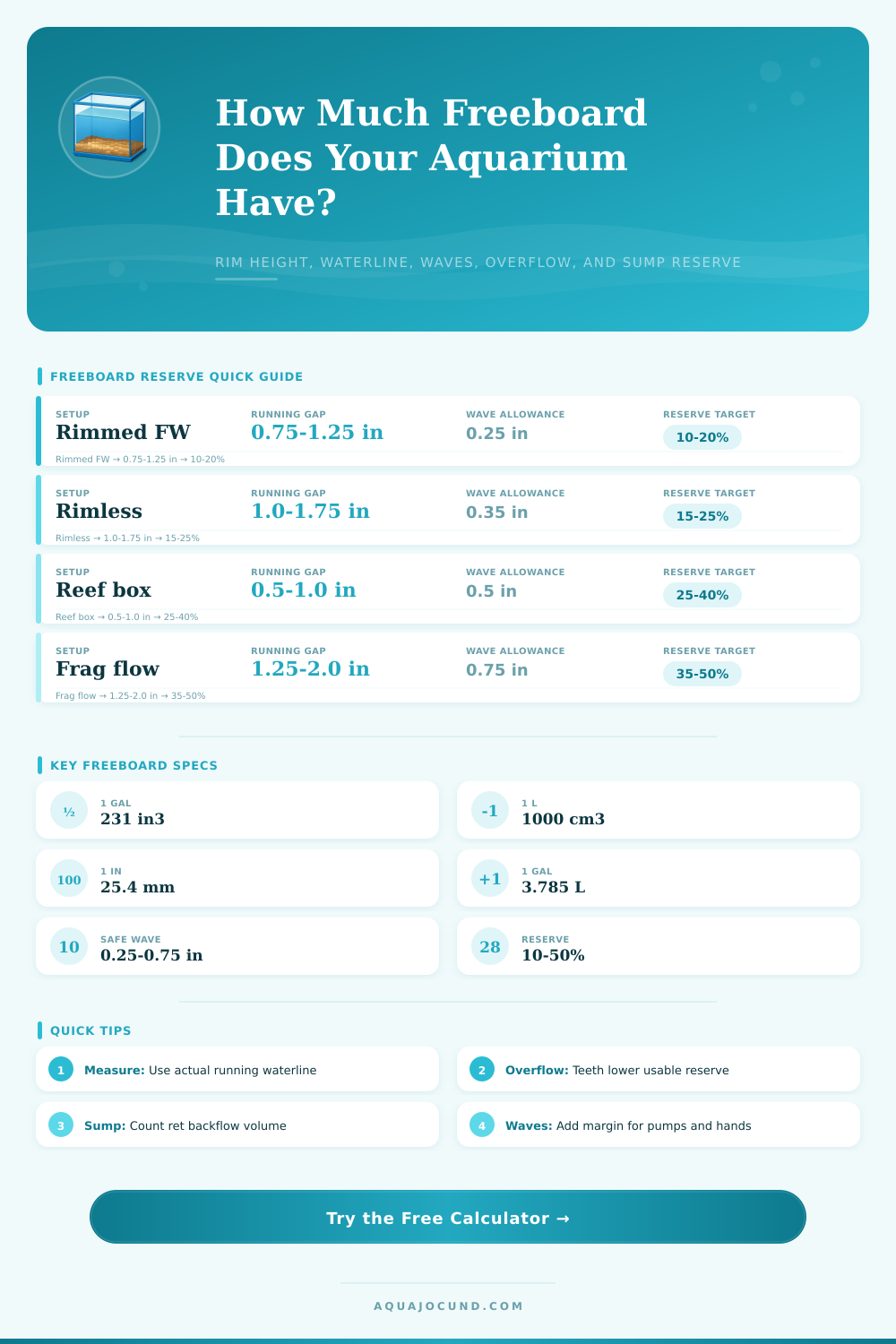
| Rimmed freshwater display | 0.75-1.25 in / 19-32 mm | 0.20-0.35 in | 10-20% |
| Rimless planted display | 1.00-1.75 in / 25-44 mm | 0.30-0.50 in | 15-25% |
| All-in-one rear chamber | 0.75-1.50 in / 19-38 mm | 0.25-0.45 in | 20-30% |
| Reef with overflow teeth | 0.50-1.25 in / 13-32 mm | 0.40-0.70 in | 25-40% |
| Frag tank or surge mode | 1.25-2.50 in / 32-64 mm | 0.60-1.00 in | 35-50% |
| Tank | Footprint | Per 1 in gap | Per 25 mm gap |
|---|---|---|---|
| 20 long | 30 x 12 in / 76 x 30 cm | 1.56 gal | 5.75 L |
| 40 breeder | 36 x 18 in / 91 x 46 cm | 2.81 gal | 10.35 L |
| 75 gallon | 48 x 18 in / 122 x 46 cm | 3.74 gal | 13.79 L |
| 120 gallon | 48 x 24 in / 122 x 61 cm | 4.99 gal | 18.39 L |
| 180 gallon | 72 x 24 in / 183 x 61 cm | 7.48 gal | 27.58 L |
| Item | How to enter it | Typical range | Why it matters |
|---|---|---|---|
| Return plumbing backflow | Sump return/backflow volume | 0.5-8 gal / 2-30 L | Water drains when the pump stops. |
| Overflow teeth depth | Distance from rim to weir opening | 0.25-1.50 in / 6-38 mm | The weir can become the first spill path. |
| Floating baskets or boxes | Displacement above waterline | 0.1-2 gal / 0.4-8 L | Objects reduce air-gap storage. |
| Wave pumps and cleaning | Wave and hand allowance | 0.25-1.00 in / 6-25 mm | Dynamic water height is above static waterline. |
I can’t tell you how many times I’ve filled up a tank, made sure everything looked good from the front, and turned around for five seconds. Turn back around and my carpet’s soaking wet. Static water doesn’t act like dynamic water. Add some flow, filtration, and living creature to an aquarium, and that “flat” surface of the water is never actualy flat.
Freeboard isn’t just empty space above your tank glass. It’s an insurance policy against gravity doing its thing at the most inconvenient time. How close the water gets to the rim of your tank, that freeboard margin, are what separates flooding your basement from saving your floor with a power surge.
Why You Need Space at the Top of Your Tank
To the average hobbyist, freeboard is a visual choice regarding how much glass they want showing. In engineering terms, however, it’s a volume issue. How much water is moved, what kind of surface area we are dealing with, and what size waves will hit my equipment?
Enter your measurements into the calculator above. It performs all necessary calculations for you, so you don’t have to guess if a one-inch gap will be enough when cleaning magnet slides under the water or when there is a sudden surge from your return pump. Before something happens, you should of known exactly how many cubic inches you’re working with.
What exactly does all that mean? What eats up that real estate? It’s a half inch, which seems minor on paper, until you consider you’re talking about three square feet of surface area. All of a sudden, a few inches back and forth equal gallons of water being shoved around and rising up.
No matter how high you make the glass walls, unless your overflow teeth is at least even with the rim, they’ll be weakest link. To address this, the calculator has you specify how far down from the rim your overflow (or weir) open so it calculates the reserve volume based off the actual plumbing and not just the tank height.
Another way you quietly lose your freeboard is displacement. Anything in the tank above water line, such as heater guards, baskets or other items like pieces of wood (e.g., driftwood)… Take space away from your air gap. While seemingly small, these items is frequently overlooked unless you happen to notice them when doing an evaporation cycle or water change and the water level has rose. With this tool, you can simply subtract this volume and get a more accurat representation of how much you have left for emergency use.
Next is the sump return factor. Most people gets this wrong. In a power failure, gravity will drain the return loop back into display tank. So if you’ve got a full eight inches of pipe filled with water and no flow to evacuate, then that amount show up in your display all at once. This is why the calculator wants to know what the backflow volume is: so you can determine whether or not your freeboard has enough room to soak up that shock without going over edge. It forces you to deal with real world physicality of your plumbing set-up.
When it comes to rimless, you have to give them even more respect… Because they don’t have that lip to stop the splash until it’s too late and your couch is wet. Now if you’re talking about a freshwater tank with maybe 3/4″ of water, it’ll probably be fine… But what about a reef tank with some serious wave making? You better have plenty of head room if you want to avoid losing corals when something breaks down or requires cleaning!
That is why I created the reference table on the page, which compares the operating style of different set ups and demonstrates just how much more reserve space you need for a frag tank vs. A planted display is relatively calm. It is not arbitrary, but due to amount of kinetic energy inside the system.
At the end of the day, freeboard calculations is about avoiding risk, not style. Pump failure and evaporation rates is beyond your control. But they are things you can plan for. Treat that space as usable volume… Not dead space. This will transform a disaster scenario into a non-event. Your goal should be to have enough empty space so that water never reaches your floor again.