Aquarium Net Volume After Substrate Calculator
Estimate true water volume after substrate depth, slope, grain porosity, hardscape displacement, waterline gap, sump volume, and safety margin.
Net Volume Results
| Material | Typical porosity | Bulk density | Solid displacement from 1 gal bed |
|---|---|---|---|
| Fine aquarium sand | 35-40% | 90-100 lb/ft³ | 0.60-0.65 gal |
| Pool filter sand | 34-38% | 95-105 lb/ft³ | 0.62-0.66 gal |
| Rounded gravel | 40-45% | 82-95 lb/ft³ | 0.55-0.60 gal |
| Active aquasoil | 50-60% | 42-55 lb/ft³ | 0.40-0.50 gal |
| Crushed coral/aragonite | 42-48% | 65-78 lb/ft³ | 0.52-0.58 gal |
| Bare bottom | 0% | 0 lb/ft³ | 0 gal |
| Tank | Inside dimensions | Nominal volume | 2 in sand solid displacement |
|---|---|---|---|
| 10 gallon | 20 x 10 x 12 in / 51 x 25 x 30 cm | 10 gal / 38 L | 0.9 gal / 3.3 L |
| 20 long | 30 x 12 x 12 in / 76 x 30 x 30 cm | 20 gal / 76 L | 1.9 gal / 7.3 L |
| 40 breeder | 36 x 18 x 16 in / 91 x 46 x 41 cm | 40 gal / 151 L | 3.5 gal / 13.4 L |
| 75 gallon | 48 x 18 x 21 in / 122 x 46 x 53 cm | 75 gal / 284 L | 4.7 gal / 17.8 L |
| 125 gallon | 72 x 18 x 21 in / 183 x 46 x 53 cm | 125 gal / 473 L | 7.7 gal / 29.2 L |
| Adjustment | How it changes net volume | Use this when | Typical range |
|---|---|---|---|
| Waterline below rim | Subtracts display volume above fill line | Open top, rimmed tank, wave room | 0.5-2 in / 1-5 cm |
| Hardscape displacement | Subtracts rock/wood volume | Large stones, reef rock, driftwood | 1-15 gal / 4-57 L |
| Sump running volume | Adds active system water | Reef, planted sump, overflow system | 5-40 gal / 19-151 L |
| Safety margin | Reduces recommended dosing volume | Medication, fertilizer, remineralizer | 5-15% |
| Step | Formula | Meaning | Unit basis |
|---|---|---|---|
| Gross display | Base area x filled height | Water before substrate and decor | cm³ to L |
| Substrate bed | Base area x average depth | Physical bed volume with pore spaces | cm³ to L |
| Solid displacement | Bed volume x (1 - porosity) | Water displaced by grains | L or gal |
| Net system | Gross - substrate - hardscape + sump | Best estimate for active water | L and gal |
So you have a twenty gallon tank. You get some nice looking rock to make it look good, throw in some black sand up to three inches deep and now what? Time to pick up your liquid fish food. You read the dosage on the bottle and figure out how many drops to put in for a twenty gallon tank.
Something doesn’t feel right. Maybe the water change drastically. Or maybe it does absolutly nothing. Why? Because when you bought the tank, it said twenty gallons. That’s the total internal capacity of the tank. It is not how much water it holds once you decorate and set it up. A surprising number of aquarists don’t know the difference (or didn’t check math). The fact is most aquarists lose ten to fifteen percent of their volume before they even notice.
Why You Need to Know Your Real Water Volume
And why should that matter? Because if you’re going to dose anything, it should be based off the amount of liquid you want in there, not just how much space are available between the glass walls. Because we don’t want you pulling out your slide rule (the calculator above does all the geometry), we begin with volume of your tank minus the volume occupied by the substrate bed.
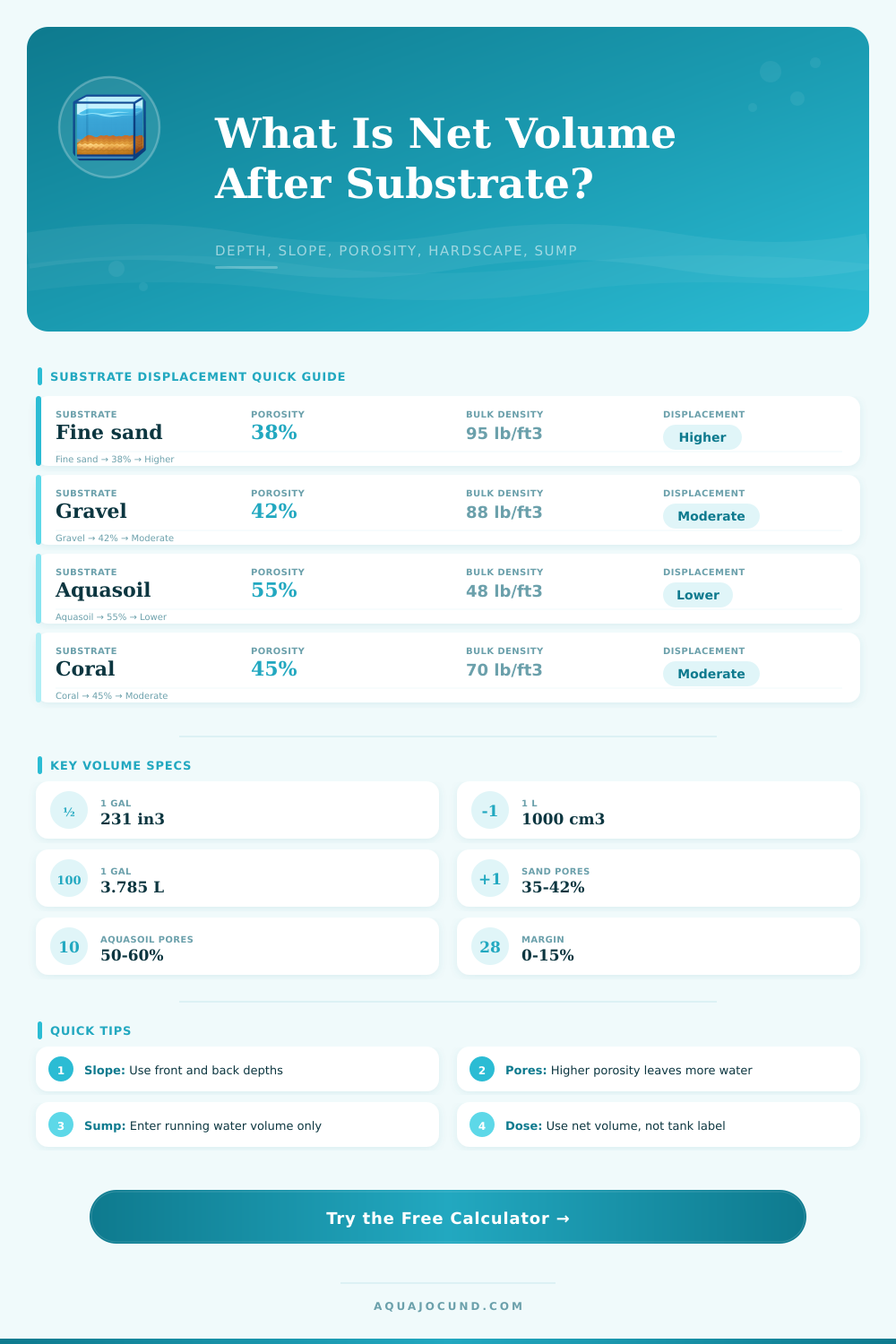
However, it doesn’t simply assume your gravel or sand acts like a solid block. That’s where people goes wrong. Substrate isn’t solid. It’s porous. Grains takes up space, but they also create voids and the spaces between them is filled with water. Fine sand in particular has a lot more empty space inside it than you may realize, almost forty percent is actualy available space for water to fill! So the calculator take that into account, assuming the correct amount of water displacement depending on what kind of substrate you’re using (lighter aquasoil vs denser pool sand vs angular gravel). The reference table on the page explain the difference well. For instance, if you’re using something really heavy, such as a clay-based soil that packs down very tight, it accounts for how that soil compacts over time so your guess would of still be a good one even after initial settling.
Yes, there is a slope, especially if you’re designing a planted aquascape. Aquascaping typically has a sloped substrate (shallow in the front; deep in the rear). That means that a flat assumption overestimate how many gallons of substrate you have because it assumes the substrate is all the same depth. Entering two depths allow the calculator to average between the deepest and shallowest parts of your aquascape, approximating its actual shape (a triangle or a wedge). This little change make sure you don’t underestimate your tank’s volume by a whole gallon or more.
Now we get to the hardscaping. Each rock and each log of wood displaces some amount of water. It doesn’t matter where they go, even if they’re below the surface, they take up room that water can’t. Unless you account for this, your dosing calculations will always be on high side, causing excess nutrients and algae problems in sensitive tank. And don’t neglect that sump if yours has one either. Total water volume circulating through media and filters include any additional volume stored in the reservoir while it’s running. Include this back in the calculation and you have a more accurate representation of how much volume your system can handle.
Furthermore, the dose calculator factor a safety margin when adding chemicals. I call this “not dosing yourself an overdose.” There’s no such thing as an ‘error’ here. It’s simply a buffer or safety zone that accounts for the difference between being precise with our meds and additives versus doing something routine like tank maintenance. If you go right up to the max volume, you’ll never overdosed but boy will you know it if you don’t dose enough. Just add some more.
When you think in terms of net volume, it alters your mindset regarding setting up tanks. Instead of focusing on the sticker price and label size, you start thinking about the environment you’re going to be creating for aquatic life. If you have an established tank that needs some troubleshooting, or if you’re setting up a new tank, understanding this number will save you money when it comes to fertilizers, medications, and especially salt mixture.
The next time you put down a bag of substrate, realize that you’re not just decorating the bottom; you’re defining the boundaries of your water volume. Once you get that part right, everything else falls into place naturaly.