💧 Aquarium Net Water Volume After Rock Calculator
Estimate true system water after fill height, rock type, rock weight, porosity, displacement factor, substrate, decor, sump water, and safety margin.
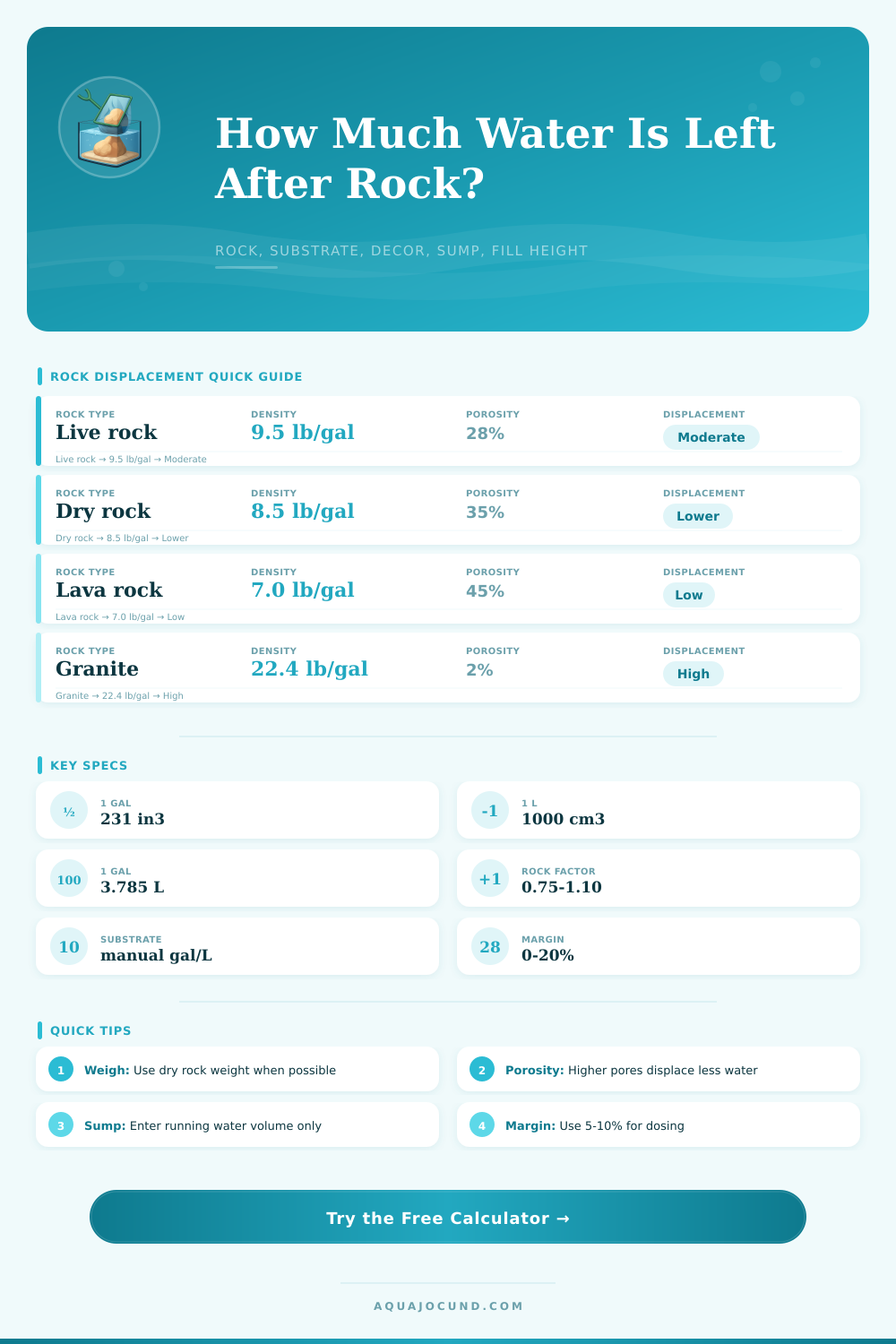
| Rock type | Default density | Default porosity | Water displacement behavior |
|---|---|---|---|
| Live reef rock | 9.5 lb/gal / 1.14 kg/L | 28% | Moderate displacement because connected pores hold water. |
| Dry reef rock | 8.5 lb/gal / 1.02 kg/L | 35% | Lower net displacement after pores hydrate and fill. |
| Lava rock | 7.0 lb/gal / 0.84 kg/L | 45% | Very porous; weight alone can overstate lost water. |
| Dragon stone | 14.0 lb/gal / 1.68 kg/L | 16% | Irregular shape with moderate voids between pieces. |
| Seiryu stone | 19.0 lb/gal / 2.28 kg/L | 6% | Dense stone; most volume removes water from the tank. |
| Slate | 22.0 lb/gal / 2.64 kg/L | 3% | Dense stacked plates displace nearly their full volume. |
| Granite or dense river rock | 22.4 lb/gal / 2.68 kg/L | 2% | High displacement per visible volume, low internal water. |
| Ceramic bio media blocks | 7.8 lb/gal / 0.94 kg/L | 50% | Very pore-heavy; count only the solid fraction for net loss. |
| Common tank | Dimensions | Typical rock load | Net water planning note |
|---|---|---|---|
| 10 gal nano | 20 x 10 x 12 in / 51 x 25 x 30 cm | 8 to 12 lb / 3.6 to 5.4 kg | Expect about 7 to 9 gal after rock, sand, and air gap. |
| 20 long | 30 x 12 x 12 in / 76 x 30 x 30 cm | 15 to 25 lb / 6.8 to 11.3 kg | Long tanks lose proportionally more to shallow substrate. |
| 40 breeder | 36 x 18 x 16 in / 91 x 46 x 41 cm | 30 to 50 lb / 13.6 to 22.7 kg | Usually a strong default for reef dosing volume checks. |
| 75 gal | 48 x 18 x 21 in / 122 x 46 x 53 cm | 55 to 90 lb / 25 to 41 kg | Add running sump water before applying dosing margin. |
| 125 gal | 72 x 18 x 21 in / 183 x 46 x 53 cm | 90 to 140 lb / 41 to 64 kg | Large displays often hide 10+ gal in rock and substrate. |
| Displacement factor | Use case | Effect | When to choose it |
|---|---|---|---|
| 0.75 | Open arch / lifted rock | Reduces counted displacement | Large open caves, elevated shelves, or sparse hardscape. |
| 0.85 | Porous loose scape | Slightly reduces counted displacement | Branching reef rock or rubble with visible water channels. |
| 1.00 | Normal rock volume | Uses calculated effective rock volume | Best default when the scape is typical and partly open. |
| 1.10 | Packed dense scape | Adds a conservative displacement cushion | Wall-style scapes, tight stacks, or dense stone layouts. |
| Component | Calculator treatment | Useful input | Common source of error |
|---|---|---|---|
| Display tank | Volume from dimensions and fill height | Inside dimensions if known | Using outside glass dimensions or rim height. |
| Rock | Weight divided by density, adjusted for porosity | Dry or drained rock weight | Ignoring connected pores that refill with water. |
| Substrate | Manual displacement volume | Measured bucket volume or depth estimate | Counting bag volume instead of submerged displacement. |
| Sump | Added as running system water | Operating water level only | Using total empty sump capacity. |
Fill up a forty gallon breeder with some saltwater. Stack rock in there to make a landscape. Pick up your alkalinity supplement and notice you don’t have a clue as to how much water’s actualy in there. Forty gallons. That’s what it says on the side. But that’s size of container, not its contents. Water doesn’t dissolve in stone or float through air. You can’t dose chemicals into that.
Many new aquarists go off deep end because they don’t understand difference between actual water volume in their tank and nominal tank size. Use calculator above to run those numbers for you. Dose the water instead of guessing.
Why Tank Size Is Wrong for Dosing
Here’s the thing: Anytime anything sinks into your tank, it shoves aside some water. What we mean by “displaces” is that a pound of porous lava rock doesn’t push more water away than a pound of dense granite does, because the lava rock take up more space for its weight. However, most folks think all rock is the same…so they uses whatever they can get their hands on without considering porosity or density.
By considering both porosity and density, your tool knows that certain types of heavy live rock contains water within their pores. And that water form part of your chemical buffer in the system. If you ignore it, you’re under-dosing. Then you have to figure out why you crashed slowly over weeks instead of having a quick crash you could pin down to a single cause.
The same hold true for substrate. Even a couple inches of sand on bottom may appear shallow but will quickly account for several gallon of volume in most tanks. Your other equipment and decorations also take their own little toll. Often people lump all of this into one number and that’s why the calculator allow you to input each separately.
What is eating away at your capacity? Know your enemy! If you treat everything as one big block of hardscape, you won’t see the small ways different material react with water chemistry.
The most misunderstood variable is porosity. The higher the porosity, the greater the internal water volume and more surface area for beneficial bacteria. If you treat very porous rock as solid stone, you will think there is much less water than what realy exists. This leads to overdosing supplements while trying to maintain parameters.
Density and porosity vary from material to material such as ceramic media blocks vs. Seiryu stone. How does that apply? See the table below (on the page) to help determine if you should go by the shape or weight of your hardscape.
It’s all about your sump. If you have an under tank sump, a deep sump set to operate at full height, or a large refugium tied into your display, your total system volume may double. This is true regardless of how small your display tank may be. Only count the water that’s actualy being circulated. Don’t worry about empty space in a dry sump; that won’t buffer your pH spikes. The tool handles those adjustments nicely and allows you to get to the true starting point for dosing calculations.
Precision keepers are not known for compromise when it comes to safety margins. While they can measure exactly, there’s always some wiggle room because of uneven rock pockets and evaporation. Adding a five to ten percent safety margin eliminate any chance of overdosing the tank even if you measured perfectly. You should of added extra cushion. Better to be slightly underdosed with dosing than to chemically shock the tank.
You will notice that calculator provides not only the raw net volume but also the trimmed usable volume. That avoids any need to perform mental math in the middle of the night with a bottle of calcium chloride in hand.
Once you know how much water you have, aquarium keeping becomes less about guesswork and more about measurement. It’s about controlling knowns instead of battling unseen factors. Once you account for variables, the numbers stop changing. Each adjustment, each test, each dose is done confidently. It turns out that clarity is just as important as circulation when trying to keep life alive in glass.