
Look into your reef tank. What do you notice? A little hazy, huh? That’s not dirt; that’s a cloud of dissolved organic matter (DOM). Even after changing the water, that stuff won’t go away. Perhaps you’ve upped the number of water changes and/or added some activated carbon. Despite your efforts, nitrates continues to increase while your corals appear duller then they used to be.
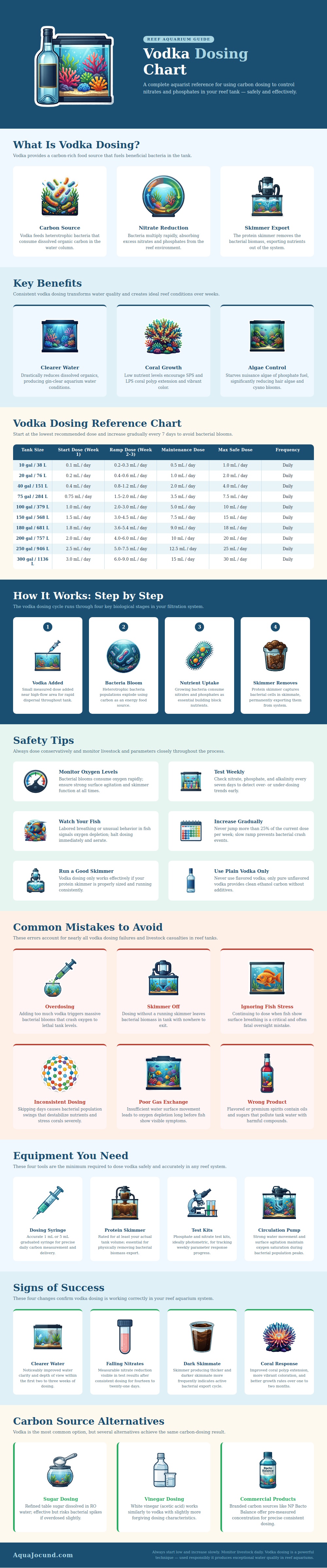
Here’s where vodka dosing comes into play: As a biological tool, vodka dosing can help. At first glance, this sounds odd, add ethanol to an ecosystem?! Yes, but remember it nourishes the right kind of bacteria (the good guys) and starves the wrong kind (the bad guy). Without getting into any complicated chemistry, the flowchart lays it out plainly in infographic. Heterotrophic bacteria use vodka as their carbon source. They use up nitrates and phosphates and then your protein skimmer take care of the rest. You aren’t pouring booze into your tank. You’re establishing a carefully cultivated bacterial bloom that feeds off unwanted stuff you can’t see.
How to Dose Vodka in Your Reef Tank
To make this work properly, the chart details proper starting dose based off your tank size. Why? Because if you start with too much carbon all at one time, you risk overloading your smaller system. When bacteria doubles, they do so rapidly and deplete oxygen quickly. So start slow. That’s when most folks go wrong. Because they want it now. So they skips to their volume’s maintenance dose. Within hours, they see their fish gasping for air on the surface. Instead, the “ramp up” period is more important than eventual dosage. Start low. Very low. Maybe a few drops (a fraction of a milliliter) daily if you have a small tank. Wait a week then bump up a bit. Allow your established bacterial population time to adjust while not overwhelming your O2 level. It takes some patience but it also rewards you with clear water and happy corals down the road.
To drive home this point about doing things slow, the visual guide depicts specific steps from starting doses to dosages that is safe. This guards against stressing out your livestock as you move through the process. A protein skimmer must work properly for it to be efficient. Otherwise, all those bacteria will stay in the tank and they’ll die off eventually. When they do, they’ll give up their nutrients which means they’ll go back in the water column. In other words, the only way to remove that “biomass” is by having an efficient skimmer running. A good analogy would be to consider it like a microscopic trash compactor. If your skimmer cup isn’t filling up with brown gunk, chances are high that either you aren’t dosing enough vodka OR your skimmer require some TLC. That’s the stuff you want to find in there since it shows true nutrient removal (not just temporarily bound).
The most common mistakes involve incorrect product or inconsistency in use. Any vodka containing sugar, oil, flavors etc. It will pollute your tank immediately. It creates another type of bacterial explosion. All you need is pure (unflavoured) ethanol. The advice section spells this out clearly. The warning also explains the importance of watching dissolved oxygen levels for the first few weeks. Long before you see cloudiness, fish becomes sensitive to dropping dissolved oxygen levels. Keep an eye on how they’re breathing. If they appear stressed, stop dosing now and up your surface agitation.
As dissolved organics become undetectable, water clarity increases exponentially over time. As a result, corals show off their true colors while extending their polyps further outward. Why? Because there’s far less competition from nuisance algae. When phosphate becomes less available due to this natural bacterial consumption process, the algae starve. After roughly two to three weeks of continual dosing, you’ll see nitrate numbers start to fall on your test kit. That’s your confirmation that the system is functioning properly.
It’s not always about brute force… It’s also about observation and discipline. So, keep a log of the doses given and your weekly test results. That way, you’ll be able to see the trend lines develop. Remember that many corals actualy do better in the presence of some nutrients (don’t go on an aggressive chase for zeroes). You’re going for balance, not sterility. While the reference chart will serve as a good place to start, make final tweaks based off what your tank parameters are telling you. Remember that the rate at which carbon is consumed varies from one tank to another based on its unique livestock load and other flow patterns. Believe your eyes and your test kits more than any static number.
Begin small, remain consistent and let the clarity return gradually to your reef over time. The haze dissapears slowly, then all at once. Then you have deep blue water.
