Kalkwasser Top Off Rate Calculator
Match limewater strength, evaporation, alkalinity demand, calcium demand, reservoir size, pH cap, settle time, and ATO dosing window.
Calculation Breakdown
| Profile | Planning strength | Alk per 1% tank volume | Best use |
|---|---|---|---|
| Weak clear limewater | 35% | 0.40 dKH/day | Low-demand nano or pH-sensitive start |
| Half-strength clear kalk | 50% | 0.57 dKH/day | Soft coral and early mixed reef tuning |
| Three-quarter strength | 75% | 0.85 dKH/day | Moderate LPS and mixed reefs |
| Fully saturated clear kalk | 100% | 1.13 dKH/day | Higher demand when evaporation allows it |
| Sealed saturated reservoir | 105% | 1.19 dKH/day | Longer storage with less air exposure |
| Aged open reservoir | 82% | 0.93 dKH/day | Older mixed kalk exposed to room air |
| Inline stirred reactor effluent | 92% | 1.04 dKH/day | Frequent ATO pulses with mixing control |
| Cloudy slurry risk | 115% | 1.30 dKH/day | Not a target; flags unsafe suspended solids |
| Delivery style | Flow control | pH spike risk | Planning note |
|---|---|---|---|
| ATO pump pulses | Medium | Medium | Use short pulse caps and place outlet in high flow. |
| Peristaltic dosing pump | High | Low | Best for spreading kalk across a long night window. |
| Stirred reactor through ATO | Medium | Medium-high | Strength varies after stir bursts; keep effluent clear. |
| Gravity drip line | Low-medium | Low-medium | Simple, but drip rate changes as head pressure changes. |
| Manual measured additions | Low | High | Useful for testing, but avoid large single additions. |
| System | Typical true water | Common evaporation | Saturated kalk alk ceiling |
|---|---|---|---|
| 10 gallon nano | 8 gal / 30 L | 0.10-0.25 gal/day | 1.4-3.5 dKH/day |
| 20 long reef | 17 gal / 64 L | 0.20-0.45 gal/day | 1.3-3.0 dKH/day |
| 40 breeder with sump | 45 gal / 170 L | 0.45-0.90 gal/day | 1.1-2.3 dKH/day |
| 75 gallon mixed reef | 82 gal / 310 L | 0.70-1.20 gal/day | 1.0-1.7 dKH/day |
| 120 gallon SPS reef | 135 gal / 511 L | 1.20-2.00 gal/day | 1.0-1.7 dKH/day |
| 200 gallon reef system | 220 gal / 833 L | 2.00-3.50 gal/day | 1.0-1.8 dKH/day |
| Schedule | Assumed clarity factor | Minimum settle time | When to use it |
|---|---|---|---|
| Gentle mix, settle 2 hours | 0.96 | 2 hr | Small reservoir with careful intake height. |
| Standard mix, settle 4 hours | 1.00 | 4 hr | General clear kalkwasser reservoir planning. |
| Deep reservoir, settle 6 hours | 1.02 | 6 hr | Large bins where the pump intake sits above sediment. |
| Reactor stir bursts | 0.94 | After each stir | Works best with short, separated dosing events. |
| Fresh mix under 1 hour | 0.82 | 1 hr | Temporary estimate; allow sediment to fall before use. |
To keep a level of water inside your reef tank, you use an automatic top-off pump. This device replenishes any water that evaporates. When using kalkwasser, you aren’t just replacing lost volume; you are adding chemicals while replacing volume to replenish alkalinity and calcium.
To do so, you have to take into account two factors: one is physical (heater evaporation rate) and the other is chemical (coral consumption). If done incorrecty, you can end up stressing your livestock or creating cloudiness in the tank. Additionally, when adding, you don’t want to raise pH too much.
How to Use Kalkwasser Safely
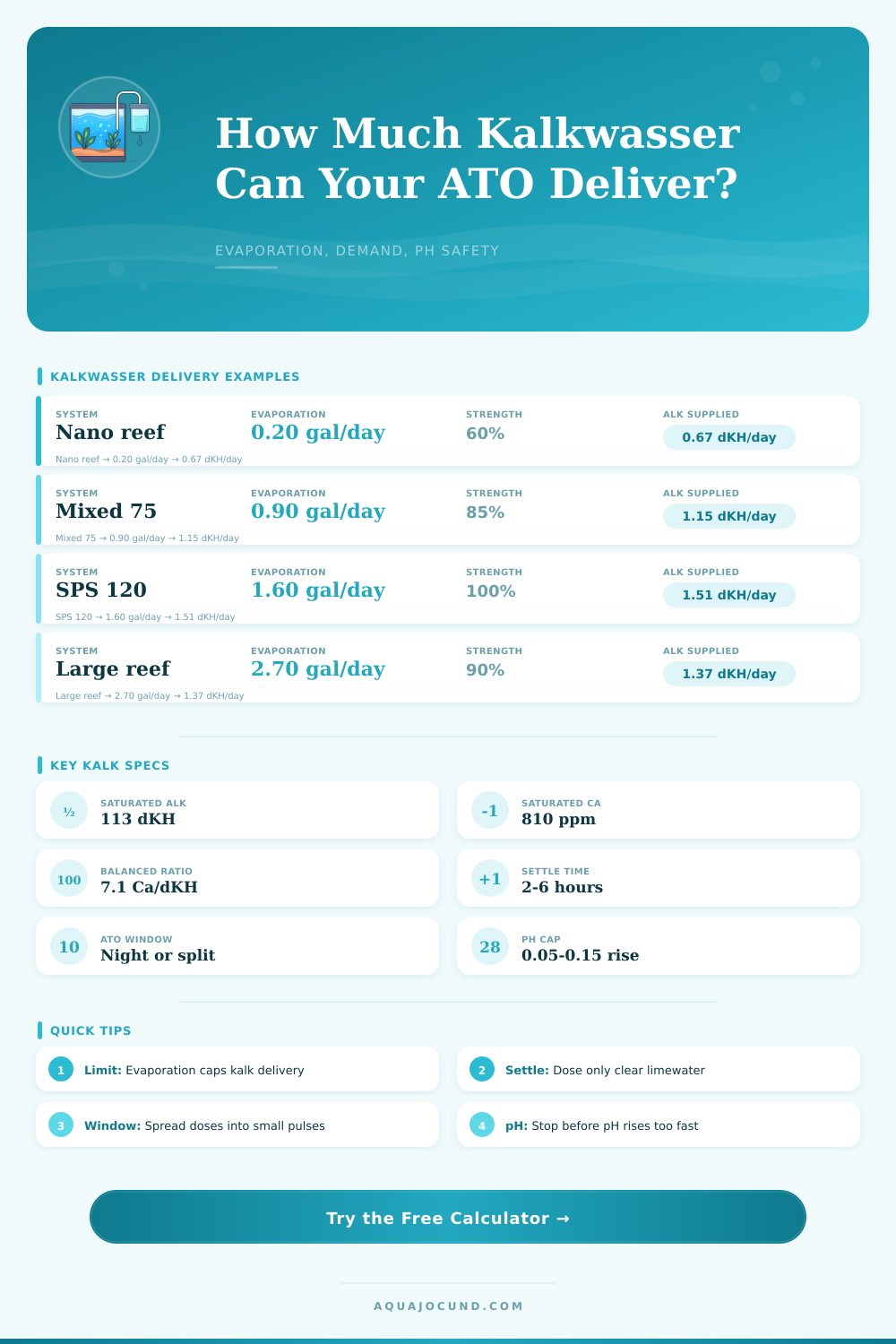
The biggest limitation is evaporation. For example, you can’t add more dissolved kalkwasser than what will evaporate from the system. If you do, then you’ll raise the water level and it’ll spill over. That’s a hard physical limit. It limits how much calcium and alkalinity you can deliver each day.
The calc tool calculates this limit based off your setup parameters. Knowing this limit helps you use result correctly. By specifying your evap rate, you’re also setting the upper bound of your delivery window. For instance, if your heater loses 0.5 gallons/day, you won’t be able to take any additional water because it’ll flood the tank. Many hobbyists forget about this physical limit. While they think about their corals hunger, they don’t think about capacity of the water.
Another consideration when using kalkwasser is clarity. Limewater that are fully saturated with calcium and dKH has significant calcium and dKH. It also represents an opportunity to precipitate calcium carbonate, if mismanaged.
By selecting one of the available profiles (weak through saturated), the amount of chemical dispensed will vary greatly. More concentrated solutions will contain more chemicals/gallon but take longer to settle out. Less concentrated solutions has less chance of fouling your display tank’s water but are safer for pH. Note that even cloudy kalkwasser creates a problem. It can block what happens in the display tank and throw off water quality tests.
Dosing introduces yet another variable: pH control. Because limewater is highly alkaline (sometimes as high as pH 12), dropping the entire amount into the tank immediately results in precipitate issues. The doser’s “dose window” in the calculator allow it to spread out the load gradually. Typically this occurs during the night, when natural pH is reduced by coral respiration. By spreading out the dose, you minimize local spikes causing calcium to fall out of solution.
How gentle your addition is matter more than amount added. Adding small amounts frequently is preferable to adding large amounts infrequently. This method applies even if your demand numbers aren’t consistent from day-to-day.
Kalkwasser consistency depends partly on reservoir size. The bigger the reservoir, the longer it takes to age between mixings and so it has more liquid to give you. That means that it will stay closer to its mixing consistency. But if you poorly place your intake tube then you might actualy be sucking up the stuff that settled out on the bottom. It shows that reality with settling time. And those settle time adjustments also impact effective strength.
How long did you stir? How long did you wait to use it? Two hours might of been enough for gently mixed solutions. Six hours is better for deeper reservoirs where gravity has to do more work.
Stability. The balance of these three variables (loss, demand and pH management) determines how much Kalkwasser should be dosed into the tank. Tables at the end gives a ballpark starting point for typical systems. Remember that each tank is different. Some are fast alkalinity users and some are quite stable with very little input.
Follow your test kits and set it accordingly. If you don’t have any, then dose conservatively and monitor the trends over a period of time. Tweaks to the inputs will follow the results. Consistency is what counts here, not perfection. Once the demand and evaporation equal out and the pH stabilizes smoothly, you got it down. That’s when it becomes routine. Keeping life moving in the tank.