Calcium Reactor Effluent Rate Calculator
Match a reef tank alkalinity demand to calcium reactor effluent dKH, effluent ml/min, bubble rate, pH setpoint, media type, and correction target.
| Media type | Modeled pH band | Dissolution response | Tuning note |
|---|---|---|---|
| Coarse aragonite media | 6.45 to 6.75 | Moderate | Good first tuning baseline with steady effluent flow |
| Fine aragonite media | 6.55 to 6.85 | Fast | Use gentle flow and avoid running it too acidic |
| Large chunk aragonite | 6.30 to 6.60 | Slower | Often needs lower pH or slower effluent to raise dKH |
| Dolomite enriched blend | 6.20 to 6.45 | Low until acidic | Useful as a portion of the bed when magnesium support is desired |
| Calcite dominant media | 6.35 to 6.65 | Moderate fast | Can deliver strong effluent dKH with stable recirculation |
| Coral skeleton style media | 6.40 to 6.75 | Moderate | Mixed pores can trap fines, so flush and retest effluent |
| Mixed grain reef media | 6.45 to 6.80 | Broad | Balances fast and slow grains but may stratify over time |
| Magnesium support mix | 6.25 to 6.50 | Variable | Run as a smaller fraction unless pH and alkalinity stay stable |
| System size | Demand | Effluent dKH | Estimated effluent |
|---|---|---|---|
| 20 gal / 76 L LPS nano | 0.30 dKH/day | 22 dKH | 1.1 ml/min above 8 dKH tank alk |
| 40 gal / 151 L mixed reef | 0.45 dKH/day | 25 dKH | 2.8 ml/min above 8 dKH tank alk |
| 75 gal / 284 L mixed reef | 0.55 dKH/day | 28 dKH | 5.5 ml/min above 8 dKH tank alk |
| 120 gal / 454 L SPS reef | 1.10 dKH/day | 32 dKH | 14.4 ml/min above 8 dKH tank alk |
| 180 gal / 681 L high demand | 1.50 dKH/day | 35 dKH | 26.3 ml/min above 8 dKH tank alk |
| 300 L / 79 gal metric reef | 0.70 dKH/day | 30 dKH | 6.6 ml/min above 8 dKH tank alk |
| Observed result | Likely cause | Calculator input to test | Practical adjustment |
|---|---|---|---|
| Tank alkalinity keeps falling | Effluent supply below demand | Raise demand or lower current effluent rate | Increase effluent or effluent dKH in small steps |
| Effluent dKH is weak | pH too high, flow too fast, or media too coarse | Lower pH setpoint or reduce ml/min | Add CO2 slowly and retest effluent after stability |
| Tank pH drops after tuning | Too much CO2 relative to degassing | Bubble rate and pH setpoint | Improve aeration, raise pH setpoint, or slow CO2 |
| Effluent clogs or surges | Fine media, trapped gas, or unstable drip | Media type and effluent ml/min | Flush line, raise flow slightly, and avoid compacting media |
| Alkalinity rises too fast | Correction and maintenance both too high | Correction target and max daily correction | Pause catch-up and tune to measured daily demand |
| Tuning band | Effluent flow cue | Bubble rate cue | Retest timing |
|---|---|---|---|
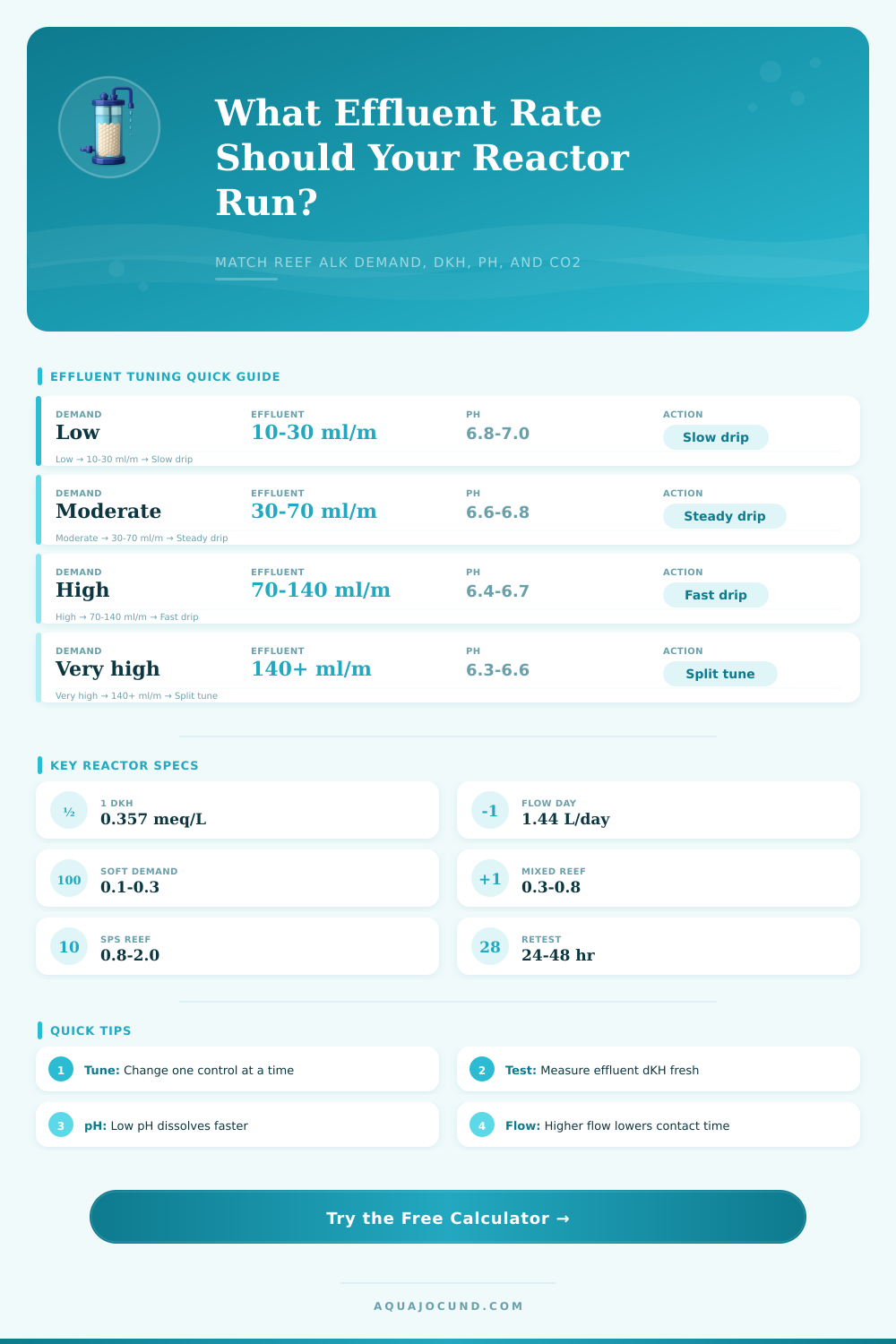
| Very small reef | Drip stream, 5 to 25 ml/min | 5 to 20 bubbles/min | Retest tank alk in 24 to 48 hours |
| Moderate mixed reef | Steady stream, 25 to 70 ml/min | 20 to 60 bubbles/min | Retest effluent dKH after pH stabilizes |
| SPS focused reef | Fast stream, 70 to 140 ml/min | 50 to 120 bubbles/min | Compare two daily tank alkalinity tests |
| Large high demand reef | High flow or split output, 140+ ml/min | Controller-limited CO2 | Log pH, dKH, and effluent flow before changing again |
| Correction mode | Temporary extra supply only | Avoid sudden CO2 jumps | Stop correction once target dKH is reached |
Calcium reactors is used to control chemical changes in a reef tank. Evaporation raises salinity levels while corals reduces the alkalinity. To keep things in check, you need to set the effluent rate appropriately. Too low and you risk starving your corals; too high and you might crash your pH. This calculator (above) figure out the right settings for you.
Simply input amount of water in your tank and measured demand, and it will provide the proper media dissolving rates, acidity, and flow. Next, the outgoing dKH (alkalinity concentration of the water leaving the reactor chamber) should be measured. Effluent dKH indicates the efficiency at which the media (aragonite/dolomite) is being dissolved within the reactor chamber. Too much and you may run out of CO2 or the acidic water could leak from the chamber eventually. Too little means that for all that water flowing through your system, there isn’t enough calcium carbonate being dissapears. Keeping a good range here keeps the system running well and safe.
How to Use Your Calcium Reactor
Substrate and what lives in your tank determines how much alkalinity you need. For example, a well-stocked tank full of small polyp stony corals may consume a whole dKH or more every twelve hours, while a very sparsely populated aquarium with soft coral may lose only two dKH per day. This is the daily deficit value that the calculator consider when calculating the volume of effluent needed. It also accounts for your existing alkalinity and where you want to bring it up to, plus a safety margin in case you accidently overshoot and cause stress to your critters.
Different types of media react differently to changes in pH (see reference table below). Because larger grains has higher surface area, coarse aragonite can be more forgiving since the water will pass through evenly over its surface area. This helps prevent channeling, which happens when water goes around the media without coming into contact with it. Smaller grains dissolve quicker but require much gentler handling with the effluent pump speed. You must balance dissolution rate against potential for compaction or clogging to find a sweet spot.
Once you change the grain size, you’ve reset your tuning baseline; select one and stick with that until you want to tune calcium/magnesium levels up or down. Many hobbyists gets into trouble by tinkering with several things at once. For example, they’ll crank up the effluent pump speed, raise the bubble rate, and drop the pH set point all on the same afternoon. How can you possibly tell what worked?
Incremental adjustment is ideal. Adjust just one thing, perhaps the frequency of your dosing pump or the setting of your CO2 regulator, and wait at least twenty-four hours before taking another measurement. Because of your sump’s mixing speed and the amount of water in the chamber, there is a pretty big lag time for your reactor. Accurately tuning your system requires patience.
Successful operation of a calcium reactor boils down to consumption and supply. What you feed your tank is what your tank consumes, nothing more, nothing less. If the rate at which the reactor produces waste match the biological demand in your tank, then the parameters will self-level out. The resulting steady state not only preserves your coral’s skeletons by keeping them strong but also eliminates night-time pH crashes. It turns a complicated chemical reaction into a silent and trustworthy task for your aquarium.
You should of used moddern media to see better results.