Carbon Reactor Sizing Calculator
Size activated carbon charge, media weight, chamber fill, reactor flow, contact time, and replacement interval for aquarium polishing reactors.
| Carbon type | Bulk density | Typical dose | Flow behavior | Best calculator use |
|---|---|---|---|---|
| Bituminous granular | 0.50 g/mL | 5-8 mL/gal | Gentle packed flow | Routine clarity and color polishing. |
| Lignite granular | 0.42 g/mL | 4-7 mL/gal | Low tumble after rinse | Fast color removal with extra dust attention. |
| Coconut shell | 0.48 g/mL | 5-7 mL/gal | Moderate flow | General polishing when low abrasion is wanted. |
| Pelletized carbon | 0.56 g/mL | 6-9 mL/gal | Even upward flow | Tall reactors where channeling is a concern. |
| Acid-washed carbon | 0.46 g/mL | 4-7 mL/gal | Gentle packed flow | Reef systems where low ash is preferred. |
| Low-dust rinsed carbon | 0.44 g/mL | 5-8 mL/gal | Slow start flow | Small reactors and fine mesh bags. |
| Macroporous carbon | 0.40 g/mL | 6-10 mL/gal | Slower contact | Heavy organics, tannin tint, and odor runs. |
| Powdered carbon in bag | 0.36 g/mL | 3-5 mL/gal | Very low flow | Short polishing runs where containment is secure. |
| Tank size | Dimensions | Light dose | Normal dose | Heavy polish |
|---|---|---|---|---|
| 10 gal nano | 20 x 10 x 12 in / 51 x 25 x 30 cm | 30-40 mL | 50-70 mL | 80-100 mL |
| 20 long | 30 x 12 x 12 in / 76 x 30 x 30 cm | 60-80 mL | 100-140 mL | 160-200 mL |
| 40 breeder | 36 x 18 x 16 in / 91 x 46 x 41 cm | 120-160 mL | 200-280 mL | 320-400 mL |
| 55 gal | 48 x 13 x 21 in / 122 x 33 x 53 cm | 165-220 mL | 275-385 mL | 440-550 mL |
| 75 gal | 48 x 18 x 21 in / 122 x 46 x 53 cm | 225-300 mL | 375-525 mL | 600-750 mL |
| 125 gal | 72 x 18 x 21 in / 183 x 46 x 53 cm | 375-500 mL | 625-875 mL | 1000-1250 mL |
| Contact result | Typical seconds | Flow cue | Adjustment |
|---|---|---|---|
| Very fast pass | Under 20 sec | Water shoots through bed | Slow valve or increase carbon volume. |
| Useful polish | 30-60 sec | Even packed flow | Good starting zone for routine clarity. |
| Deep contact | 60-120 sec | Slow steady effluent | Useful for tannins, odor, or post-treatment runs. |
| Too slow | Over 150 sec | Low outlet flow | Watch for channeling, clogging, or stagnant spots. |
| Polishing condition | Typical interval | Dose tendency | When to shorten |
|---|---|---|---|
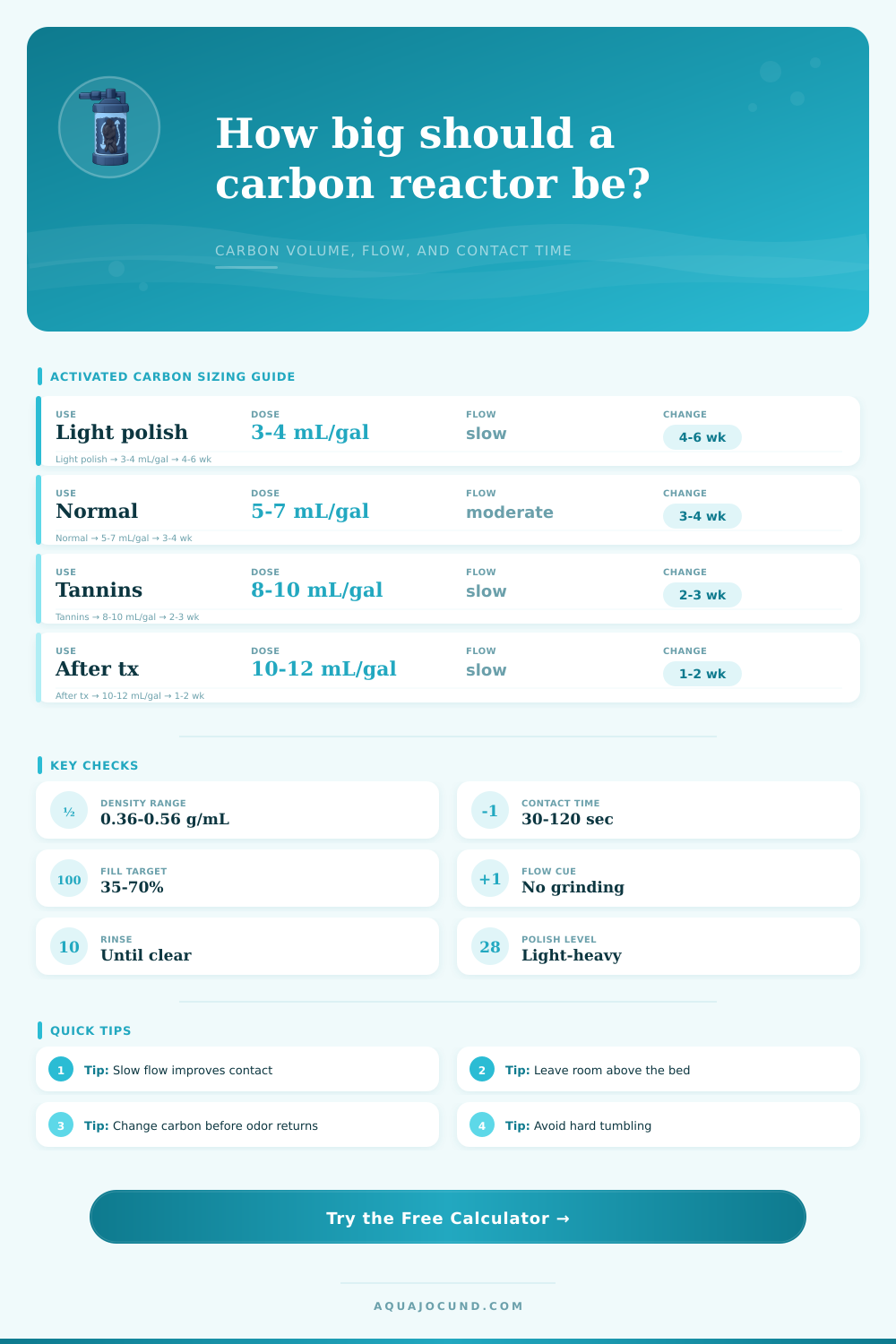
| Light maintenance | 4-6 weeks | Lower dose | Yellow tint returns before the plan. |
| Normal display polish | 3-4 weeks | Standard dose | Odor, tint, or reduced flow appears. |
| Heavy organics or tannins | 2-3 weeks | Higher dose | Wood tint or feeding load is high. |
| Post-treatment cleanup | 1-2 weeks | Short high-contact run | Remove and replace after the cleanup window. |
At some stage of your fish keeping journey, you’ll likely find yourself with aquarium whose water appears clear yet doesn’t feel right. It might look like a slight yellowish color due to tannin buildup or maybe just have a persistent hazy quality that no amount of filtering can elimenate. At this stage, many hobbyists turns to activated carbon. While carbon isn’t necessarily the problem, its application most certainly is. By that I mean many hobbyist place carbon in a filter sock and hope for the best. This strategy lacks consideration for contact time, flow rate, and volume which is why it never works.
So the calculator does all this for you (above). No more guessing about coefficients or geometry… It uses fluid dynamics and geometry to calculate an exact carbon charge for the amount of water you want treated within a specific contact time. The difference between contact time and just volume is critical here. Sure, you may put ten liters of carbon in the tank but if the water only has two seconds of contact time, nothing happens. You need residence time.
How to Use Activated Carbon Correctly
Consider making coffee. If you brew some coffee and then dump boiling water onto the grounds and instant pour it out, what’s left? Weak stuff. You need the water to stay with the grounds long enough for them to extract. This tool calculates the exact window based off your flow rate and internal diameter of the reactor.
But then there’s the question of what kind of carbon? This table gives you some help there as well, because not all black pellets are created equal. A generalist would be coal-based, and its relatively balanced pore structure make it a go-to choice for routine polishing. Coconut shell carbon is next in hardness and abrasiveness; it lasts longer but using too much flow may cause more turbulence. And lignite can be dusty and light, so be sure to rinse well before use.
You can account for these variations in density and dose in the calculator. For instance, selecting a hard pelletized carbon for a small reactor would yield a high fill percentage that might limit your flow. That conflict gets flagged by the system so you know either to cut down on dose or pick a diffrent media grade. Don’t overpack the chamber, The natural inclination is to fill it up as much as possible. After all, the more carbon in there, the better, right? Wrong.
In fact, packing the bed reduce performance. Water needs to have somewhere to go and void spaces are necessary for even distribution. Overstuffing the bed creates channels that allow water to bypass the carbon altogether by taking the easiest route. It tells you if you’re leaving enough room for water move around the carbon properly. Try to stick with the middle of the recommended range instead of maxing out every inch. Also, leave some open space above the bed so carbon doesn’t end up floating above it and entering the main tank, damaging your filtration setup.
And timing matters too. Carbon doesn’t last forever. When all of those little pores fill up with organics, they’re dead. This means the carbon will release whatever it’s holding onto and become useless. The replacement interval input will help you factor in the rate of decline. On the low end, it may be 4-6 weeks for minimal maintenance. On the high side: if you have super tannic water or just want things cleaned up after chemical treatment, you’re down to a week or less. By the time it smells bad, it’s already too late. More often than not, the water appears perfectly good when the carbon starts leaching out. Follow the schedule.
Included with the tool are a series of presets that provide a good starting place for common set ups such as large reef displays or small nano tanks. It takes away the hassle of having to enter data manualy but leaves you free to adjust the parameters to match your conditions. If you’re using a plant tank where some tannins need to be reduced or if you have a clean-water system aiming for crystal clarity, those are all fine-tuning off the basic concept. Use the correct sized bed, reduce the flow sufficiently to allow contact, and replace the media before it reaches failure.
When you get this basic stuff right, activated carbon stops being a fuzzy idea about getting things clean and becomes a trustworty tool for managing water quality. Clear water isn’t luck (clear water is an engineered condition), and learning how to size your reactor will help you get there.