Ozone Reactor Contact Time Calculator
Estimate chamber dwell time, applied ozone dose, transfer, ORP target pressure, gas ratio, and activated carbon off-gas load.
⚙Units And Presets
💧Reactor Inputs
🧪Ozone Reactor Comparison Grid
📊Reference Tables
| Reactor Style | Typical Transfer | Useful Dwell Range | Best Fit |
|---|---|---|---|
| Counter-current column | 65-85% | 60-180 sec | Dedicated reactors with tall vertical height |
| Venturi recirculation loop | 60-80% | 45-120 sec | Compact reef sumps and fish-room loops |
| Tall air-stone column | 50-70% | 60-150 sec | Low pressure systems with dry air feed |
| Inline static mixer | 45-65% | 30-90 sec | Pressurized plumbing followed by a chamber |
| Protein skimmer contactor | 40-60% | 20-75 sec | Reef polishing at conservative ozone output |
| Short contact chamber | 30-55% | 15-60 sec | Small tanks where off-gas carbon is strong |
| Contact Chamber | Dimensions | Approx Volume | Flow For 60 Sec Dwell |
|---|---|---|---|
| Small cylinder | 3 in x 18 in / 7.6 x 45.7 cm | 0.55 gal / 2.1 L | 33 gph / 125 L/h |
| Reef sump tube | 4 in x 24 in / 10.2 x 61 cm | 1.31 gal / 5.0 L | 79 gph / 299 L/h |
| Tall column | 6 in x 36 in / 15.2 x 91 cm | 4.41 gal / 16.7 L | 265 gph / 1003 L/h |
| Box chamber | 8 x 8 x 20 in / 20 x 20 x 51 cm | 5.54 gal / 21.0 L | 332 gph / 1257 L/h |
| Large column | 8 in x 48 in / 20 x 122 cm | 10.44 gal / 39.5 L | 626 gph / 2370 L/h |
| ORP Target Band | Typical Use | Ozone Pass Dose | Planning Note |
|---|---|---|---|
| 300-325 mV | Gentle water clarity | 0.01-0.04 mg/L | Often enough for small reef polishing |
| 325-350 mV | Moderate organic control | 0.03-0.08 mg/L | Common controlled aquarium range |
| 350-375 mV | High clarity target | 0.06-0.14 mg/L | Needs reliable probe control and carbon |
| 375-400 mV | Specialized polishing | 0.10-0.20 mg/L | Use caution and verify residual removal |
| Carbon Stage | Air Path Rating | Water Path Rating | Use When |
|---|---|---|---|
| No dedicated carbon | 0% | 0% | Not recommended for ozone off-gas |
| Small air carbon cup | 45% | 0% | Very small contactors with low output |
| Standard air and water carbon | 75% | 65% | Normal reef sump ozone installations |
| Dual air plus water carbon | 88% | 75% | Higher output or enclosed cabinetry |
| Oversized sealed carbon reactor | 94% | 88% | Large systems and high safety factor plans |
ℹPlanning Tips
If you believe that ozonation simply involves pumping in enough gas to clear it up, then think again. There’s one important thing you’re not considering, contact time. You need ozone to have time to break down and mix with water before it enters your display tank. If there isn’t enough dwell time, then you are actualy wasting money by venting expensive gas through your off-gas carbon filter without properly dosing the water. It is a balance between transfer efficiency, chamber volume, and flow rate.
Once you establish your physical constraints, calculator above will do the math for you, taking the guesswork out of geometry. Follow these instructions to use it:
How Contact Time Works in Ozone Systems
First: Measure your actual water volume within the contactor itself. A lot of people measure size of acrylic shell or PVC pipe on the exterior. That figure doesn’t represent your real wetted volume at all. Baffle plates and media baskets will reduces your available volume considerably if you are using a venturi loop. The shape also makes a difference. A tall narrow column functions different than a wide short chamber. Counter-current columns need height (gas rises as water falls). Static mixers need width. They depends on turbulence. Select the shape that matches your hardware. You don’t get extra points in a catalog if your device looks fancy.
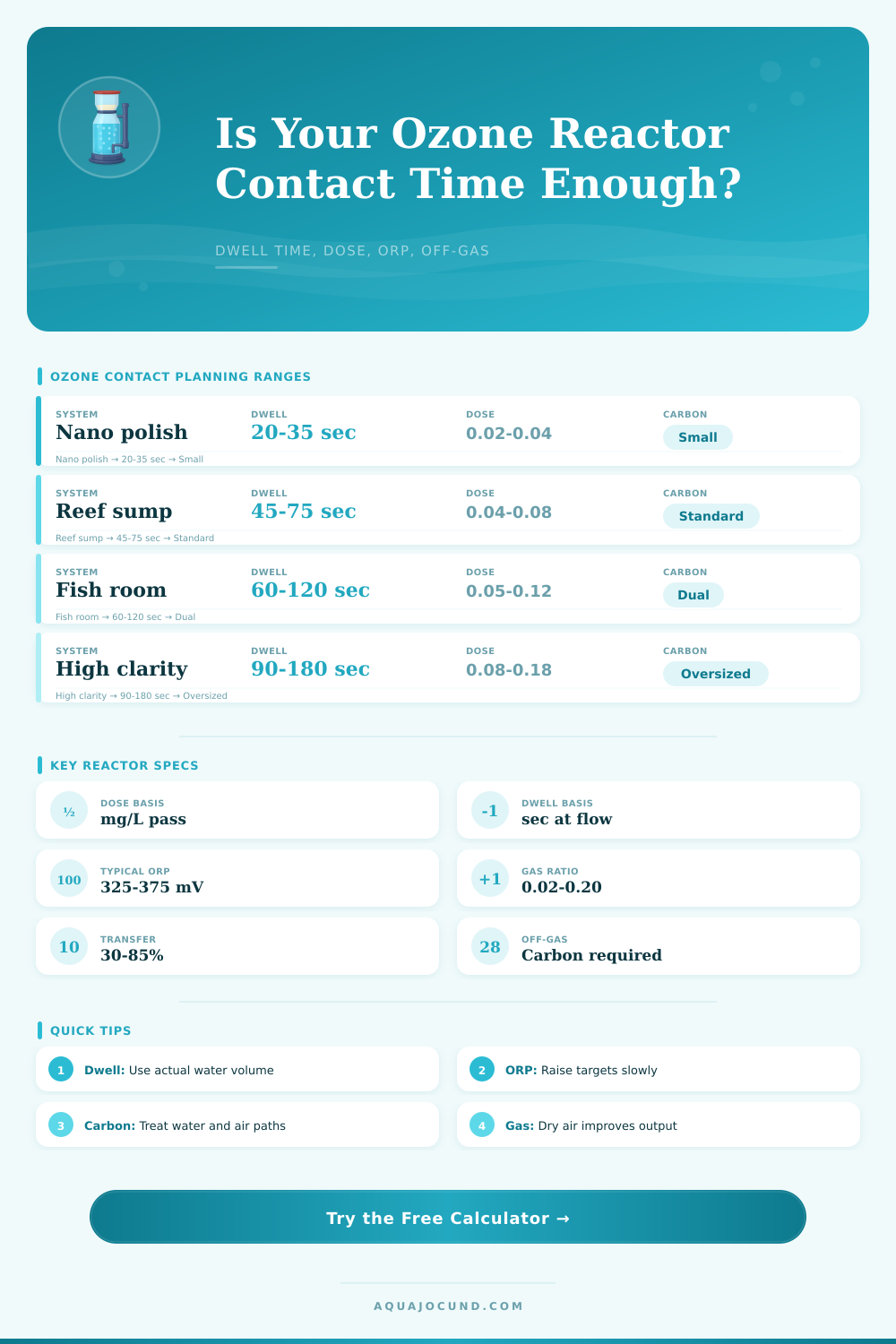
Now that we’ve got flow, what about volume? Flow rate and volume is two different things you need to balance. Pumping three hundred gallons per hour into a small tube in your sump means very little dwell time. Remember: Ozone doesn’t dissolve immediately. In order to be effective it must break apart organic chains and oxidize pathogens. To oxidize those pathogens, it require additional time. For most reef applications, a goal of 45-90 seconds is ideal for dwell. Anything shorter requires exponentially higher amounts of ozone to make up for lower transfer efficiency. Anything longer could result in residual problems if your carbon can’t keep up.
Reactor style makes a big impact in transfer efficiency. For instance, a basic inline mixer may have a transfer rate of only about fifty-five percent. A tall counter-current column or a packed tower could approach eighty percent transfer rate. You could of being wasting half the ozone you’re generating by using a bad reactor design! The wasted ozone places a burden on your off-gas carbon filter, so it needs to be sized correctly for both longevity AND safety. Each type of reactor has a general range of transfers listed in the reference table on this page. It’s meant to help set your expectations. Don’t expect dedicated column of contactor to have less efficiency than a protein skimmer used as a contactor.
Calibrate your ozone output based off that fact. Just because the manual says you can don’t crank up the generator. Instead, watch your ORP readings. For most systems, 325-350 millivolts is effective and safe. Going higher requires accurate control and heavy-duty carbon filtration. This prevents uncontrolled spikes from affecting livestocks.
Ozone production increases dramatically as humidity decreases in feed gas. This lowers the concentration. And humid air will shorten electrode life/lamp life. Check your drying medium if you see poor transfer even though volume appears good on the calculator. Molecular sieve or silica gel needs to be changed periodicly. If the gas source is wet, perfect dwell time doesn’t matter because you will get zero usable ozone output.
Last but not least, honor the off-gas path. Activated carbon neutralizes the leftover ozone that didn’t dissolve into the water. More flow and/or an aging system will cause a greater residual load. Off-gassing with an oversized carbon reactor protects your lungs and prevents equipment failures (pumps, seals, etc.) from occurring in your fish room.
When done right, good ozonation is invisible. You won’t see bubbles escaping, smell anything or worry about stressing your livestock. The outcome? You get less maintenance and clearer water. Begin conservatively. Use a probe to check and don’t force it into action. Let contact time do the work instead. Balance is the name of the game. Don’t max out on output. Make the math add up to chemistry and the rest speaks for itself (without any guessing required).