Medication Redose Schedule Calculator
Plan generic aquarium label timing, water-change redose amounts, missed-dose shifts, and carbon reminders from your product instructions.
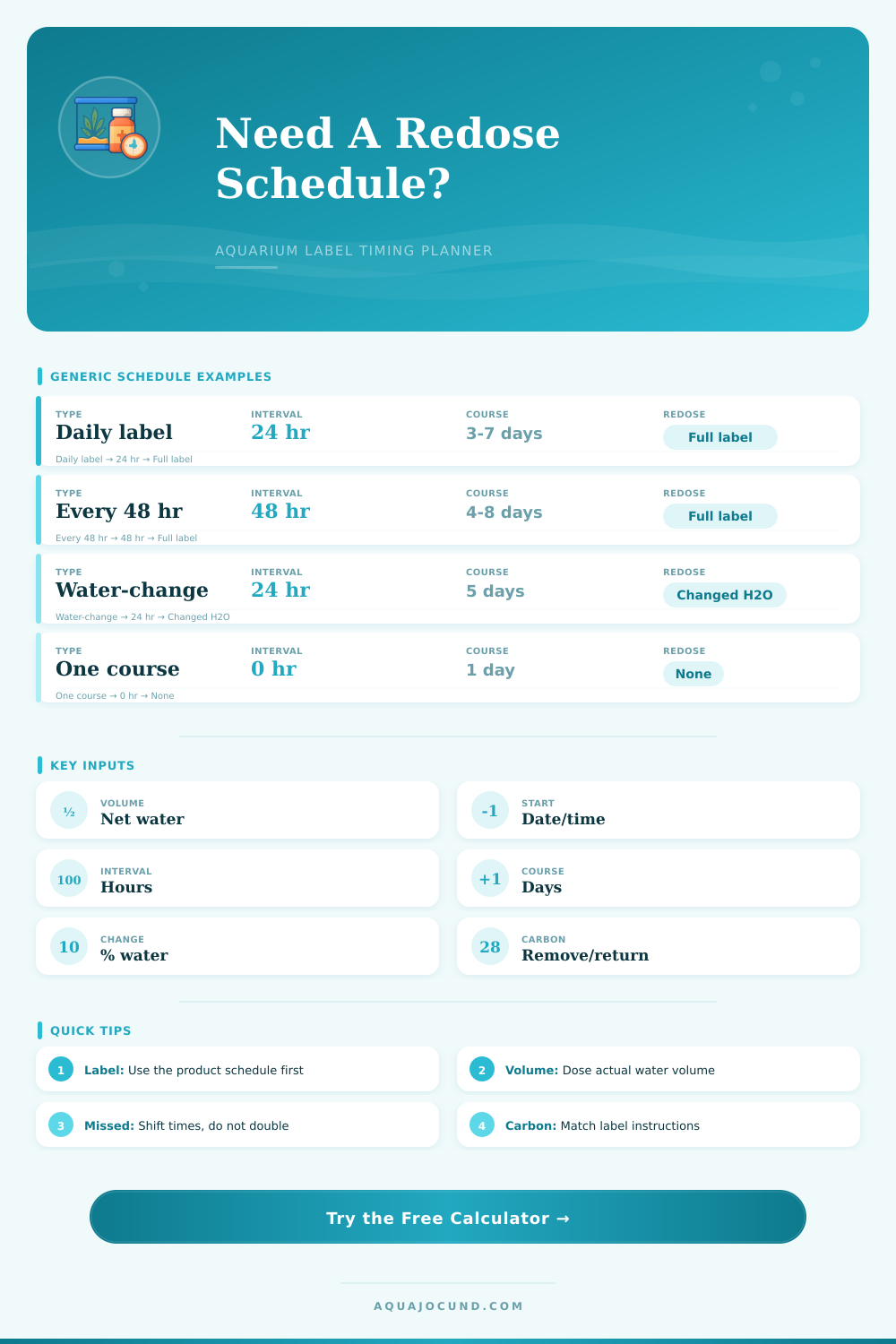
Common label schedule presets
| # | Date/Time | Action | Dose Math | Reminder |
|---|
| Generic category | Common label pattern | Carbon planning note | Calculator use |
|---|---|---|---|
| General liquid label | Daily or every 24 hours | Often removed before dosing | Use product label dose exactly |
| Antiparasitic-style label | Repeat after 24-48 hours | Follow label before/after course | Schedule repeats and water changes |
| Antibacterial-style label | Multi-day course | Usually held out during course | Check course end and total amount |
| Antifungal-style label | Daily until label endpoint | Return only when label allows | Plan steady interval reminders |
| Copper-style monitored label | Test-guided label range | Carbon may remove active product | Use only as timing math, not test advice |
| Salt/bath-style label | Short contact or separate bath | Usually not a display-tank media issue | Use single dose or manual schedule |
| Plant-sensitive label | Reduced or cautious repeat | Label may require special handling | Use redose factor below 1 if label says so |
| Quarantine course label | Fixed course in isolated tank | Remove or return by label timing | Use actual quarantine volume |
| Schedule type | Best for label wording | Primary calculation | Missed-dose handling |
|---|---|---|---|
| Fixed interval redose | Repeat every X hours | Start time plus interval steps | Shift, skip, or next-dose rule |
| Single dose only | Dose once, then observe label endpoint | One event and course end | Manual label check if missed |
| Redose after water change | Replace removed concentration | Full dose x water change % x redose factor | Rebuild schedule from actual time |
| Hold until carbon return | Remove carbon during treatment | Course end plus return reminder | Do not double without label support |
| Tank example | Net volume | 5 mL / 10 gal equivalent | 25% WC redose at 1.0x |
|---|---|---|---|
| Small quarantine | 10 gal / 38 L | 5 mL | 1.25 mL |
| Standard breeder | 40 gal / 151 L | 20 mL | 5 mL |
| Medium display | 75 gal / 284 L | 37.5 mL | 9.38 mL |
| Large display | 125 gal / 473 L | 62.5 mL | 15.63 mL |
| Water change | Concentration left | Replacement redose at 1.0x | Planning note |
|---|---|---|---|
| 10% | 90% | 10% of full dose | Small top-up math |
| 25% | 75% | 25% of full dose | Common scheduled change |
| 50% | 50% | 50% of full dose | Large dilution event |
| 75% | 25% | 75% of full dose | Recheck label before continuing |
Aquarium medications are generaly like chemistry homework made into some sort of hobby upkeep chore. Pour a bottle of blue stuff, witness a bit less of your fish gasping for air and hope that you didn’t just poison the water column.
The issue isn’t necessarily with the medication but with the logistics of maintaining its concentration at therapeutic level. Concentrations drops because of routine water changes, absorption by filter media, or biological breakdown. Treating loosely create a sublethal environment where pathogens aren’t killed but taught how to become resistant.
How to Dose Aquarium Medicine Correctly
While volume is a critical factor in dosing accuracy, precision matters more then volume. After defining your real-world tank parameters, the calculator (above) do the math for you. It converts ambiguous label directions into measurable time and date entries on your calendar.
For instance, you may think a set dose applies to all tanks, say, a forty gallon (but water displaces other things). Rocks, substrate, and décor greatly shrink your tank’s net volume. So if your tank contain only thirty gallons of water, and you dose for forty, then you’re dosing one-third more than is necessary.
That’s what the tool prompts for: your net volume. This prevents an all-too-common mistake in dosing.
The other gotcha is intervals. Many product label say to treat every two days or repeat daily, but most of the time this is just shorthand for a twenty-four or forty-eight hour interval. This means if you miss by six hours, you don’t go early to do another one. Instead, you move the whole schedule ahead to keep the correct spacing.
Don’t double up if you forget yesterday, you’re on a quick road to toxicity. Using the calculator you can set a missed-dose rule and the process know whether to push things along or skip something altogether. Chances are your fish will be happier with a late dose then a double dose.
One more variable few keepers consider is water changes. Assuming you’re keeping your tanks clean by changing 25% of the water every week, that also means you’re removing 25% of the medication dose during the water change. If you don’t monitor it, the treatment will continue to get diluted until it’s no longer effective.
To compensate for the dose lost with every scheduled water change, the calculator tells you how much more to put back into the tank so it’ll be at therapeutic level again. It’s not magic chemistry…it’s simply the math of proportions. If you remove 25% of the water, just replace 25% of the dose with the replacement amount. That maintains concentration so you don’t have to guess if your fish are still getting enough medication.
The carbon does double duty as well. Not only is it filtering the tannins and odor out of the tank, but it’s also pulling active pharmaceutical ingredients (API) from water column. Most directions say to take carbon out prior to dosing and hold it until course ends. That means don’t accidentally run your medicine through your carbon.
This calculator will remind you when to manage your carbon so you don’t mess up. There are some medications that is now safe with carbon, but unless you check your meds, you could of wasting money and prolonging healing. To be safe, pull all of your carbon.
When do you quit? That’s driven by course length. Some keepers see improvement after three days and halt treatment early. Those surviving pathogens are still alive even if weakened and come back stronger then ever. For total eradication, use a five- or seven-day course. Again, those endpoints is tracked for you. You can focus on the progress instead of worrying if it was the third or fourth day. This gives you a clean finish line from the beginning.
Creating a treatment schedule is as much an exercise in self-control as it is insight. Follow the label’s suggested regimen, tweaking based off missed spots or net water volume. Use the calculator to find out what percentage is complete. How many hours have elapsed?” It provides a road map from first hit to last clean-up.
Enter your starting time & interval, then sit back… It’s all in the past now.
One tip: In little doses, precise is powerful.