Hospital Tank Dose by Volume Calculator
Estimate generic aquarium treatment amounts from actual water volume, label directions, displacement, water-change redosing, carbon status, safety margin, and course length.
⚙Quick presets
🧪Dose inputs
Calculated dose
📊Dose planning checkpoints
📋Treatment form comparison
| Form | Calculator unit | Useful conversion | Best input habit |
|---|---|---|---|
| Liquid | mL | 1 tsp = 4.92892 mL | Read the syringe at eye level |
| Drops | drops | 20 drops is commonly estimated as 1 mL | Use the same dropper each time |
| Teaspoon | tsp | 1 tsp = 4.92892 mL | Level the spoon, do not heap it |
| Powder | grams | 1000 mg = 1 g | Use a gram scale for small tanks |
| Tablet | tablet count | Split by equal pieces only | Use the label's tablet-per-volume direction |
| Packet or scoop | packet or scoop count | Count as label-defined units | Do not mix scoop sizes between products |
📏Common hospital tank examples
| Tank or tub | Dimensions | Gross volume | Typical actual water | Example at 5 mL / 10 gal |
|---|---|---|---|---|
| 5.5 gal rectangle | 16 x 8 x 10 in / 41 x 20 x 25 cm | 5.5 gal / 21 L | 4.6-5.0 gal / 17-19 L | 2.1-2.5 mL before margin |
| 10 gal rectangle | 20 x 10 x 12 in / 51 x 25 x 30 cm | 10 gal / 38 L | 8.5-9.4 gal / 32-36 L | 4.3-4.7 mL before margin |
| 20 long | 30 x 12 x 12 in / 76 x 30 x 30 cm | 20 gal / 76 L | 17-19 gal / 64-72 L | 8.5-9.5 mL before margin |
| 29 gal rectangle | 30 x 12 x 18 in / 76 x 30 x 46 cm | 29 gal / 110 L | 25-27 gal / 95-102 L | 12.5-13.5 mL before margin |
| 40 breeder | 36 x 18 x 16 in / 91 x 46 x 41 cm | 40 gal / 151 L | 34-37 gal / 129-140 L | 17-18.5 mL before margin |
🔄Water-change redose reference
| Water changed | Replace rule | Half rule | When it is useful |
|---|---|---|---|
| 10% | 10% of initial dose | 5% of initial dose | Small maintenance change during a course |
| 25% | 25% of initial dose | 12.5% of initial dose | Common partial change before repeating label dose |
| 50% | 50% of initial dose | 25% of initial dose | Large dilution when water quality needs correction |
| 75% | 75% of initial dose | 37.5% of initial dose | Major reset; confirm the label before repeating |
🔬Concentration reading guide
| Label wording | Use this unit | Calculator estimate | Important limit |
|---|---|---|---|
| 10 mg/mL | mg per mL | Dose mL x 10 mg | Works for liquid labels |
| 2.5% active | percent active | mL x 10 x percent | Assumes liquid density near water |
| 500 mg/g | mg per gram | grams x mg/g | Works for weighed powder |
| 250 mg tablet | mg per tablet or packet | units x mg/unit | Use label-defined unit count |
With the best of intentions and exact measurement, you place a sick fish into a separate (hospital) tank, but who realy knows how much water’s actualy in a small tank? Most of us guess the dosage when treating a sick fish because no one measures the water volume. It won’t hold ten gallons of water once you consider the space for debris away from intake, heater, sponge filter, and substrate. The amount of empty space can make all the difference in figuring out proper treatment concentration.
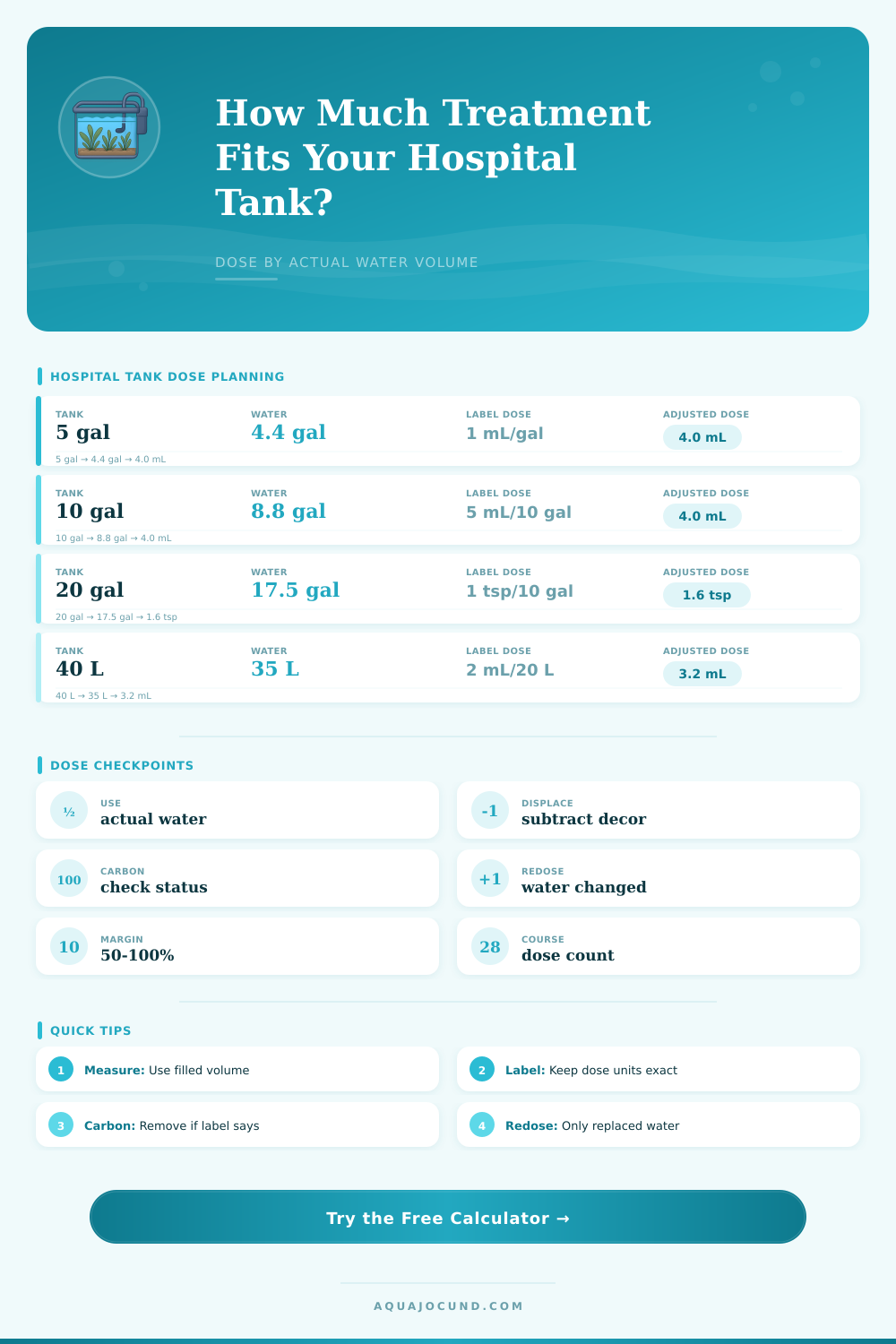
Stop guessing at what size tank fits in that small piece of glass and use the calculator above to plug in your measured water level or dimensions. It will do math for you. Decorations and equipment take up space that cannot be filled with water. Because of this physics, you are going to overdose by twenty-five percent if you dose your tank like it holds ten gallons when you only have eight gallons of water inside.
Stop Guessing: Measure Your Tank Water Exactly
That’s stressful when you realize most treatments go bad fast in biological system. It’s not just that they might not do their job, it’s also that they aren’t as potent anymore. So yeah, that stresses a stressed fish out.
The tool adjust for the lost volume, asking you to subtract what’s displaced before applying the label dose. That simple correction helps connect the real world and the world of marketing labels.
Beyond that, there’s the added complication of medication forms: how do you measure out tabs? Powder? Drops? Liquid (in milliliters)? These are different things that each require a different way of measuring. A tab that isn’t split perfectly or a powder that doesn’t weigh out exactly to the gram won’t work for something that requires an exact number of drops, a teaspoon, or a milliliter.
The page has a reference table explaining these conversions. This means you don’t need to convert in your head; you simply need to identify what it is that you’re trying to enter. Enter that into the tool and let it handle the rest.
How do you know when to redose? Meds are not very stable in water, and water changes have a major impact on their concentration level. Twenty-five percent water changes, designed to eliminate waste, also evacuate twenty-five percent of your treatment medications. Some folks replenish just this amount; others prefer to add half because they worry about overdosing. You’ll see there’s a model for both options to help calculate exactly how many drops or pills to give following every water change/maintenance cycle. This avoids the most frequent error: thinking that a single starting dose will last a whole week during quarantine.
Complicating things even more is activated carbon, which removes organic compounds (including medications) from the water. Running a carbon bed while treating means your filter will remove the drug at an accelerated rate, making your fish underdosed and still infected. Standard procedure is to remove the carbon prior to dosing. However, many of us forget to replace carbon following a water change, leading to a sudden spike in toxicity whenever the next dose encounters clean system. The tool’s status check reminds you to watch this variable so that you don’t inadvertently harm your patient by overlooking your filters.
There’s always wiggle room, Uncertainty is accounted for in safety margins. For sensitive livestock such as shrimp and more fragile species like bettas, it is advisable to go 10% under the max label dose. It may seem minor but it’s enough to ensure survival without stressing your fish.
Total course makes it easier for you to figure out how much medicine you need for an entire course of treatment. This helps you avoid running out mid-treatment, such as midway through a five-day regimen. When your fish are sick, you don’t want to make additional trips to the LFS so plan accordingly.
In the real world of fishkeeping, there are always compromises between chemical exposure and good water quality. On one hand you desire high levels of medicated water while on the other you seek a clean tank. Typically these two goals work against each other. The solution is this. Dilution effect and volume displacement become tools instead of guesswork.
Instead of randomly dosing based off symptoms, you know what dose to use and how long it will last so you can react logically when conditions vary from original measurements. This is where confidence in your quarantine protocol comes into play, methodically. Getting a dose right is far more important than getting it done fast. It’s easy to get an incorrect dose because you rushed through it. Over time, that adds up and you’re chasing your tail trying to make sense of things. If you just spend five minutes double-checking the status of filters and actual water volume, you’ll have better results, and less stressful results for you and fish.
Dosing with precision turns a frantic crisis into a treatable medical situation. You know what is within your power to control; now you can do something about it. You also know when to step back and watch how your fish are doing. Listen to the water. If you take the time to really listen, you will hear the truth.