Quarantine Tank Volume Calculator
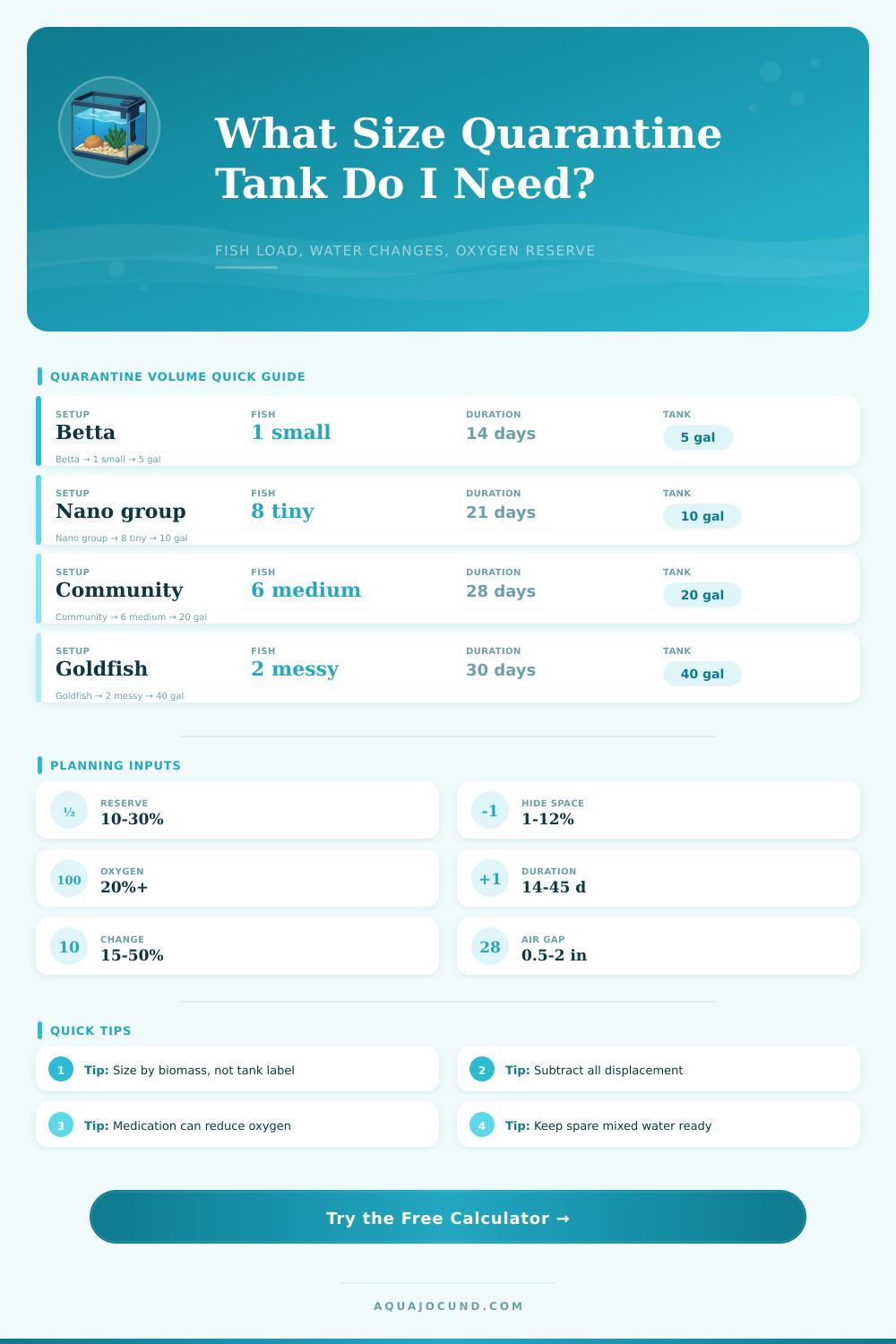
Size a quarantine or hospital tank from fish count, fish size, treatment length, waste load, water changes, displacement, hiding space, oxygen margin, and emergency reserve.
🐟Quarantine Presets
📐Tank Shape And Net Water
🧪Fish Load, Treatment, And Schedule
Quarantine Volume Estimate
📊Quarantine Setup Comparison Grid
🛠Quarantine Setup Comparison
| Setup | Best use | Displacement range | Planning caution |
|---|---|---|---|
| Bare glass tank | Medication and observation | 1-4% | Needs extra hides for stress control |
| Sponge filter QT | Routine new fish quarantine | 3-7% | Seeded sponge still needs testing |
| PVC shelter hospital | Shy or stressed fish | 5-12% | Hides reduce water volume |
| Divider quarantine | Separated fish in one tank | 4-10% | Shared water still shares medication |
| Round tub hold | Koi, goldfish, large fish | 2-8% | Measure fill depth, not label size |
| Marine hospital tank | Copper or hypo observation | 3-9% | Oxygen margin matters in warm saltwater |
🐟Fish Load Reference
| Fish profile | Typical examples | Volume factor | Waste note |
|---|---|---|---|
| Slim nano fish | Tetras, rasboras, small danios | 0.45 L per g | Lower individual waste, group oxygen still counts |
| Community tropical | Livebearers, corydoras, gouramis | 0.65 L per g | Good default for mixed quarantine |
| Stocky cichlid | Apistos, mbuna juveniles, rams | 0.90 L per g | Territory and waste push volume upward |
| Goldfish / koi | Goldfish, koi, pond fish | 1.55 L per g | High oxygen and ammonia load |
| Marine fish | Clownfish, wrasses, tang juveniles | 0.95 L per g | Saltwater has less oxygen headroom |
| Predator / large | Oscars, puffers, large catfish | 1.35 L per g | Messy food and stress need reserve |
💧Water Change Schedule Reference
| Schedule | Best fit | Reserve level | Volume planning note |
|---|---|---|---|
| 15-20% daily | Small hospital tank or high medication load | High | Useful when ammonia can rise quickly |
| 25-35% every 2 days | Routine quarantine with seeded sponge | Moderate | Good default for mixed community fish |
| 40-50% twice weekly | Larger tank with light feeding | Moderate | Requires stable temperature and matching water |
| 10-15% observation | Low biomass, no medication, short hold | Lower | Only use when tests stay stable |
| Emergency 50%+ | Ammonia, oxygen, or overdose event | Critical | Keep reserve water ready outside the tank |
📐Common Tank Benchmarks
| Tank or tub | Typical inside size | Net use after setup | Common quarantine role |
|---|---|---|---|
| 5 gal | 16 x 8 x 10 in | 4.2-4.7 gal | Single betta, tiny fish, short hospital use |
| 10 gal | 20 x 10 x 12 in | 8.5-9.4 gal | Small community arrivals or shrimp observation |
| 20 long | 30 x 12 x 12 in | 17-19 gal | Most small groups with room to separate hides |
| 29 gal | 30 x 12 x 18 in | 24-27 gal | Stockier fish and longer treatment runs |
| 40 breeder | 36 x 18 x 16 in | 34-37 gal | Goldfish, cichlids, marine observation |
| 75 gal | 48 x 18 x 21 in | 63-69 gal | Large fish, tang juveniles, emergency holds |
That’s where a proper quarantine tank comes in. After you bring your new fish home with perfect fins and eyes, within a couple of weeks something doesn’t look right. It could be velvet. It could be fin rot. Or heck, maybe your display tank wasn’t quite up to par for treating a sick fish.
That’s when you want a quarantine set up that actualy does the job. Most hobbyists just wing it. They throw some random bucket into use, guess on the size, and pray for success. But hospital tanks aren’t like display aquariums. This time you don’t care about how good it looks. You do care about the steadiness of water quality under a high medical load. And the volume gets you there. The difference can mean recovery for a fish or tragedy.
Why Your Quarantine Tank Needs More Space Than You Think
That’s why I say that people overestimate their tanks’ size; they trust what’s written on the glass. But a ten gallon tank is never really going to have ten gallons of usable water inside it. Subtract for the space taken up by heaters, and then for any air gaps (to prevent splash overflow), and for any equipment shoved into the tank like a sponge filter or some PVC pipes for hiding places. That ten goes down quickly. Fish don’t inhabit all of that empty theoretical volume inside your tank; only what’s left over after accounting for hidden losses.
That net water volume is what matters. How much space do you have left for oxygen exchange and water dilution? That’s what the calculator above does for you, run the numbers and subtract out those hidden losses so you can see at a glance how much water you’ve got to play with. It eliminates the guessing as to whether your set-up can support the biological load.
Everything changes in a small tank… Including waste profile and fish size. A slim tetra doesn’t produce as much ammonia as a stocky cichlid or messy goldfish. To keep toxicity low, you need different volume ratios. The stakes are even higher if you’re treating something serious like copper-based parasites. Meds not only cloud the water, they also reduce oxygen saturation and stress sick fish. You want a buffer. Include extra oxygen in your calculations. Ensure you have plenty of dissolved gas to keep them breathing comfortabley while their immune systems fight back. Hypoxia kills faster than most diseases in warm, medicated water.
It sounds simple. Another common gotcha is length of treatment. Planning for a 30 day antibiotics regimen differs from what you need when treating with something like a 2 week medication. Spending more time in the tank mean more accumulation of metabolic waste and food residue. Higher frequency feeding can significantly increase amount of bio load created. This will require a larger reserve supply to sustain your feed schedule. Refer to the chart located on the page. It clearly shows the relationship between schedule frequency and reserve volume.
There’s no way to have high turn-over with a little bucket. Displacement is the dead space you don’t get to control. Everything you put in the tank consumes space that could be used by water for filtering. That’s why it’s simpler to think about displacement with a bare tank, but it is more stressful for your fish without any visual barriers. Decor aids their mental health, which helps them recover from stress better, but uses up some of your working volume.
How do you juggle those requirements? The tool lets you instantly see this tradeoff. Before you buy decor items, you’ll know if adding caves reduces your effective volume below the safe level for your number of fish. You’ll then realize that you need to invest in a larger container first.
In the case of emergency, do you know how much water can be held as an emergency reserve? For example, medicated dosages can stop bacteria from breaking down waste products. This causes ammonia to spike rapidly even in smaller volumes. In those emergency situations, having premixed dechlorinated water on hand makes all the difference between life and death. Better to have some and not use it, rather than scrambling in the middle of the night when your parameters tank. Panic creates poor decisions; avoid this by sizing your reserve properly.
At the end of the day, though, a QT tank should be viewed as a temporary hospital room, not a place they will live permanently. Stability trumps sparkle; function is more important than form. With that understanding of the relationship between treatment intensity, waste load, and displacement, it’s clear what size makes sense. Don’t take chances with your fish’s well-being. Plan out the changes, measure out the amount of net water, and provide the space so they can recover. That change in mindset transforms an ordeal into a manageable routine. It keeps your fish alive for years to come and helps keep your hobby vibrant.