Nutrient Export Water Change Calculator
Plan nitrate and phosphate reduction from water changes, source water nutrients, export media, refugium uptake, and daily feeding input.
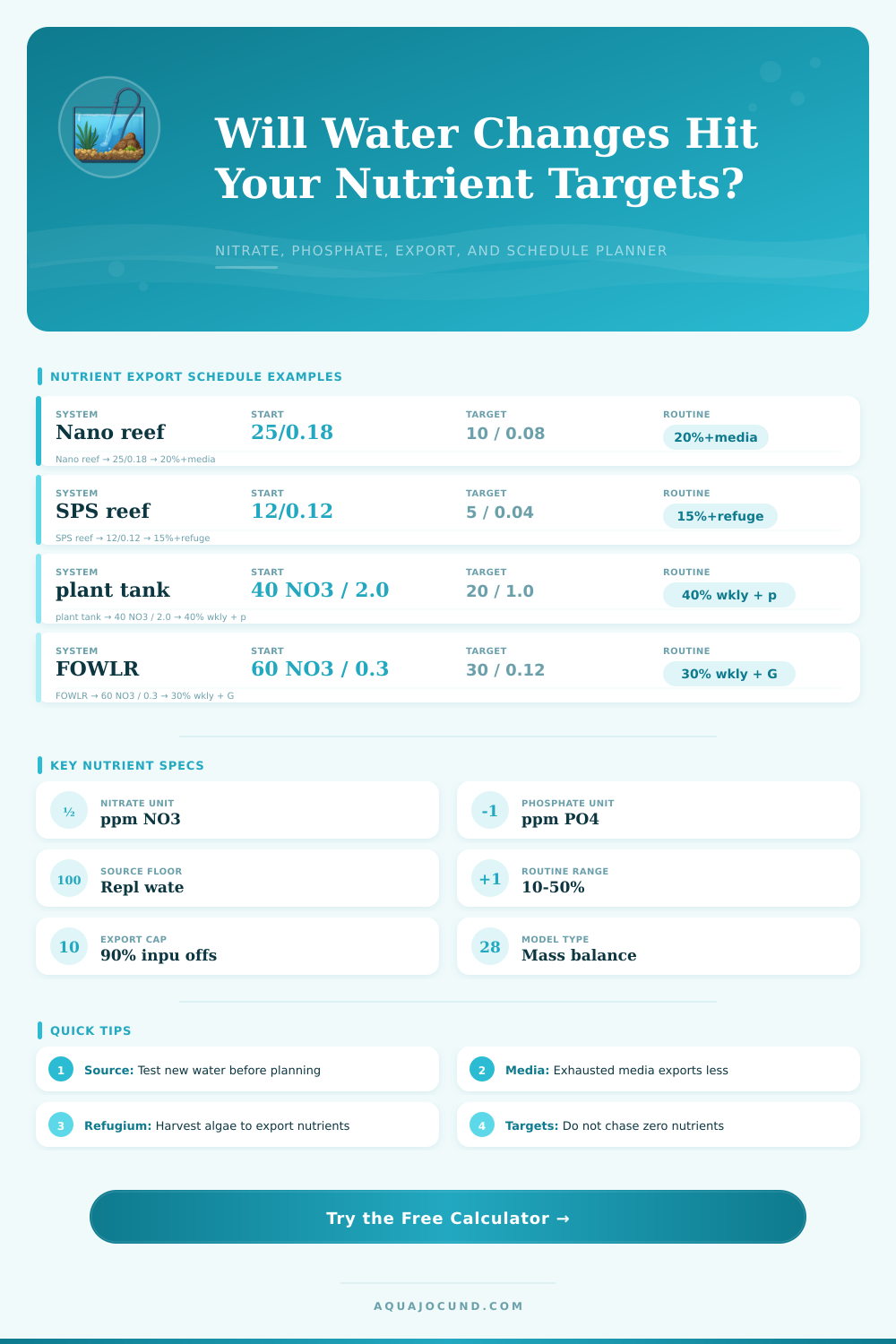
📌Nutrient Export Presets
⚖Water Change And Nutrient Inputs
Use display plus sump water after rock, sand, equipment, and operating level displacement.
Enter tap, RO blend, or freshly mixed saltwater nutrients.
Estimate from test rise between changes before active export is credited.
Percent of daily input removed by active media while it is not exhausted.
Percent of remaining daily input removed by algae, plants, or denitrifying habitat.
📊Calculated Export Benchmarks
🧪Export Method Comparison Grid
Water Change Only
Best when source water is clean and daily input is modest.
Typical offset: 0%Phosphate Media
GFO, resin, or binders mainly flatten phosphate between changes.
Typical offset: 20-55%Refugium Harvest
Algae or plant biomass removes both nutrients only when harvested.
Typical offset: 15-50%Biological Export
Carbon dosing, pellets, and denitrators mainly reduce nitrate input.
Typical offset: 20-60%📘Nutrient Target Reference
| System Type | Nitrate Working Range | Phosphate Working Range | Planning Note |
|---|---|---|---|
| Low nutrient SPS reef | 2-10 ppm NO3 | 0.02-0.08 ppm PO4 | Avoid abrupt drops; stability matters |
| Mixed reef | 5-20 ppm NO3 | 0.03-0.12 ppm PO4 | Good fit for moderate export and weekly changes |
| Soft coral reef | 10-30 ppm NO3 | 0.05-0.20 ppm PO4 | Do not force ultra-low nutrients |
| Fish-only marine | 20-50 ppm NO3 | 0.05-0.30 ppm PO4 | Large water changes can be practical |
| Planted freshwater | 10-30 ppm NO3 | 0.5-2.0 ppm PO4 | Plant uptake and dosing goals may dominate |
| Heavy cichlid or goldfish | 20-60 ppm NO3 | 0.2-2.0 ppm PO4 | Schedule is usually limited by feeding load |
💧Water Change Schedule Table
| Routine | Weekly Equivalent | Nutrient Swing | Best Fit | Main Caution |
|---|---|---|---|---|
| 10% every 7 days | 10% weekly | Small dilution | Low input, mature export | Can drift upward slowly |
| 20% every 7 days | 20% weekly | Moderate reset | Most balanced displays | Source nutrients set the floor |
| 30% every 7 days | 30% weekly | Strong weekly drop | FOWLR, soft coral, cichlids | Match temperature and salinity |
| 15% every 3 days | 35% weekly moved | Smoother curve | Automated or sensitive systems | More sessions or automation |
| 50% every 7 days | 50% weekly | Large reset | Emergency correction | Can shock if chemistry differs |
🗂Common Tank Change Volumes
| System Size | 20% Change | 30% Change | 50% Change | Typical Nutrient Use |
|---|---|---|---|---|
| 10 gal / 38 L | 2 gal / 8 L | 3 gal / 11 L | 5 gal / 19 L | Nano correction or quarantine |
| 20 gal / 76 L | 4 gal / 15 L | 6 gal / 23 L | 10 gal / 38 L | Nano reef or planted tank |
| 40 gal / 151 L | 8 gal / 30 L | 12 gal / 45 L | 20 gal / 76 L | Breeder or grow-out system |
| 75 gal / 284 L | 15 gal / 57 L | 22.5 gal / 85 L | 37.5 gal / 142 L | Mixed reef or planted display |
| 120 gal / 454 L | 24 gal / 91 L | 36 gal / 136 L | 60 gal / 227 L | Large reef with sump |
| 180 gal / 681 L | 36 gal / 136 L | 54 gal / 204 L | 90 gal / 341 L | Fish room or large FOWLR |
🔧Export Profile Reference
| Profile | Typical Factor | Stronger On | How To Validate |
|---|---|---|---|
| No active export | 0% | Neither nutrient | Trends follow feeding and water changes |
| GFO or phosphate resin | 25-55% | Phosphate | PO4 trend flattens until media exhausts |
| Lanthanum or binder | 35-70% | Phosphate | Effluent or filter pads show captured precipitate |
| Biopellet reactor | 20-50% | Nitrate | NO3 falls while skimmer export increases |
| Denitrator | 25-60% | Nitrate | Effluent nitrate tests below display water |
| Refugium or plant mass | 15-50% | Both nutrients | Regular harvested biomass leaves the system |
| Algae scrubber | 25-60% | Both nutrients | Screen harvest grows predictably each cycle |
I’ve seen it before, you dial in the equipment, spend hours watching the tank, yet still see the nitrates creep up. You can’t seem to keep nutrients at bay. More than anything else, nutrient control isn’t so much a matter of getting numbers down to zero but rather keeping those inputs in balance with regular exports.
Every time something in your tank breathe, eats, or excretes, some nutrients enter the system. Without a deliberate plan for removal, they will add up. This page’s tool models that balance.
How to Balance Nutrients in Your Tank
That tool consider the tank to be a changing volume; i.e., a volume subject to changes in concentration caused by biological uptake and dilution. Enter your water change frequency and percentage, and you’ve defined your mechanical export rate; your most predictable control tool. If you make a 20% weekly change, then you remove one fifth of the dissolved waste and replace it with fresh water.
After the swap, the calculator figure out the remaining nitrate and phosphate. Your starting point is your source water quality. If you have some kind of residual in your source water, whether it’s impurities or nitrates, you can’t dilute under that level. Your outgoing volume must equal or exceed nutrient load from your incoming water. That means you must test not only the tank water, but also the source water.
Even though you maintain everything perfectly, your refill water may already contain compounds you’re attempting to reduce. This model take into account active export methods such as refuge harvesting or adding granulated ferric oxide to aquarium. Both of these methods export nutrients but do not replace them.
If different method take care of the same portion of the nutrient load, they will be capped at a combined efficiency that does not exceed 100% (a biological system isn’t linear). You cannot remove more waste than exists in the daily input stream. The calculator shows net daily accumulation after all offsets are applied.
Low nutrient stress can be easily misunderstood by many hobbyist as the lowest number possible. In reality, stability trumps minimalism. Typically, having constant nitrates is better for your tank than having levels that swing wildly between zero and sudden high spikes. Reference tables depict the workable ranges of various biotypes: hardy fish systems, sensitive corals, etc. If your livestock match the level of your target, there’s no undue stress.
Export events like water changes establish a new baseline for chemicals. They predictably reduce nutrient/dissolved organic levels. Planning water changes based off known inputs shifts your approach from reactive guesswork to proactive management. The calculator does all the math for you. But knowing how the balance works is where the true value lies.
Every gram of food fed require an equivalent amount of waste removal somewhere in the system. This waste is removed by harvested macroalgae, a reactor, or a bucket. The balance has to close. Input = export. Livestock thrives while water gets clearer.