Algae Scrubber Screen Size Calculator
Size a turf algae scrubber screen from food input, system volume, nutrient target, screen type, lighting, lit sides, harvest interval, and safety margin.
⚙Unit system and presets
🌱Scrubber sizing inputs
Use the dry or thawed drained food weight fed per day.
Use actual system volume, not the display label.
Measure or estimate average PAR across the wet screen.
Calculation breakdown
📊Screen sizing reference
🧪Screen type comparison grid
📋Screen type sizing factors
| Screen type | Efficiency factor | Best use | Planning note |
|---|---|---|---|
| Waterfall roughed mesh | 1.00 | Mixed reef, fish room sump | Rough both sides until algae grips the plastic. |
| Waterfall slotted pipe | 0.94 | Compact vertical sump | Slot width and pipe level affect wet coverage. |
| Upflow air bubbler | 0.82 | Nano and all-in-one tanks | Air lift contact is gentler, so size a little larger. |
| Horizontal tray | 0.78 | Low cabinet trays | Use a level tray to avoid dry corners. |
| Floating mat scrubber | 0.64 | Ponds, refugium surface mats | Open surface light and flow vary widely. |
| Chaeto hybrid panel | 0.70 | Refugium add-on export | Treat as supplemental, not full turf capacity. |
| Nano hang-on screen | 0.88 | Small back chambers | Useful when harvests are frequent and gentle. |
| High-flow raceway | 1.08 | Large stocked displays | Works best with uniform red/blue coverage. |
📏Common tank examples
| Tank | Volume | Typical feeding | Double-lit screen |
|---|---|---|---|
| 10 gal nano | 38 L | 0.4-0.8 g/day | 4-8 in² / 26-52 cm² |
| 20 gal cube | 76 L | 0.8-1.5 g/day | 8-14 in² / 52-90 cm² |
| 40 gal breeder | 151 L | 1.5-3 g/day | 14-28 in² / 90-181 cm² |
| 75 gal display | 284 L | 3-5 g/day | 28-48 in² / 181-310 cm² |
| 120 gal reef | 454 L | 5-8 g/day | 48-76 in² / 310-490 cm² |
| 240 gal predator | 908 L | 8-14 g/day | 76-132 in² / 490-852 cm² |
💡Light and harvest adjustments
| Condition | Calculator effect | Why it matters | Best target |
|---|---|---|---|
| PAR below 50 | Raises screen area | Growth is light limited and slower to fill in. | Improve spread before shrinking screen. |
| PAR 70-120 | Near baseline | Good balance for steady turf growth. | Keep coverage even across edges. |
| PAR over 160 | Slightly raises area | Very high light can pale fresh growth. | Shorten photoperiod or diffuse hot spots. |
| Harvest under 7 days | Raises area | Short intervals leave less standing biomass. | Use only for very heavy nutrient export. |
| Harvest over 14 days | Raises area | Old mats shade lower layers and detach. | Keep most screens on a 7-14 day rhythm. |
📝Food load conversion table
| Daily food | Single-lit baseline | Double-lit baseline | Typical systems |
|---|---|---|---|
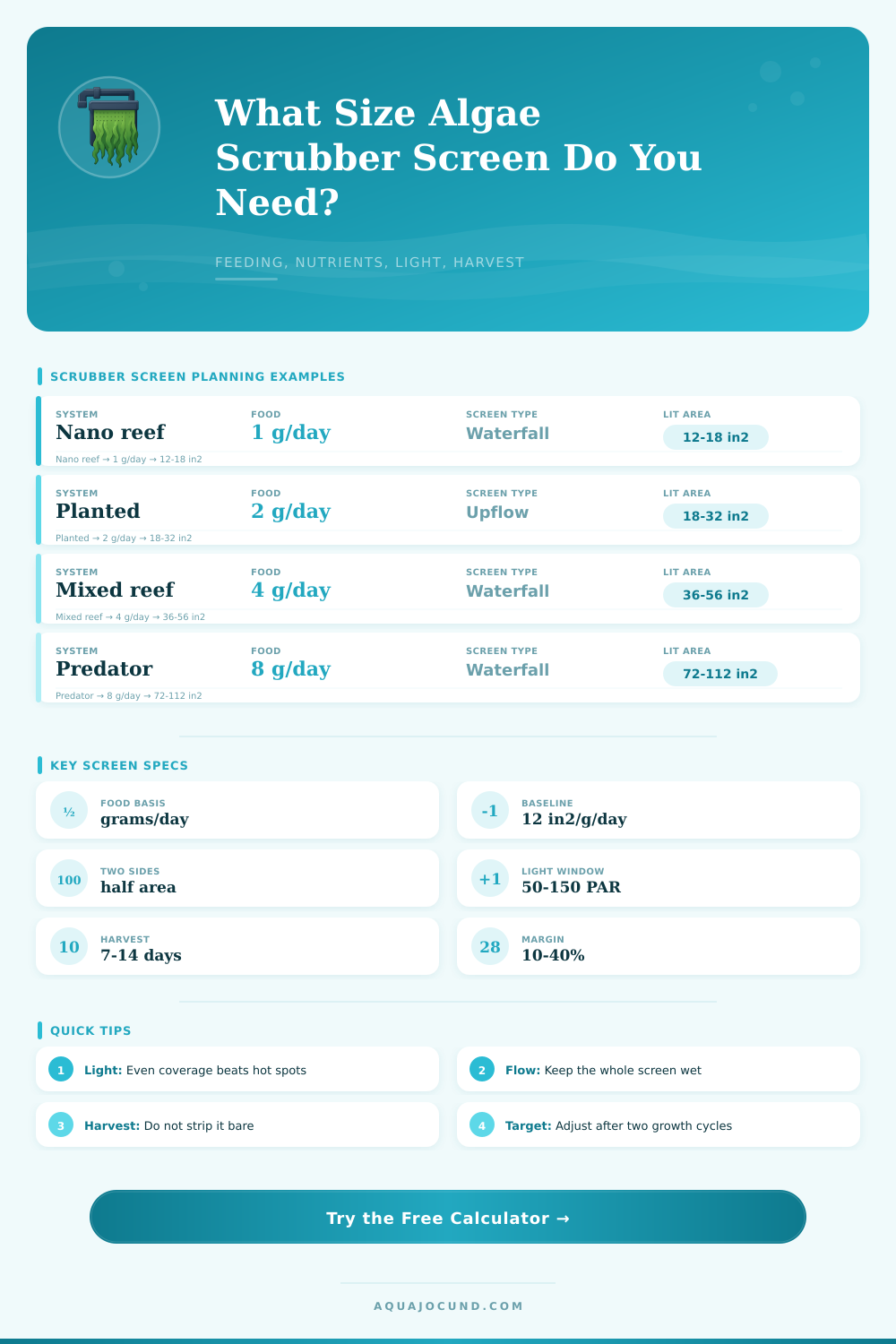
| 1 g/day | 12 in² / 77 cm² | 6 in² / 39 cm² | Nano reef, light community |
| 2 g/day | 24 in² / 155 cm² | 12 in² / 77 cm² | Small reef, planted display |
| 4 g/day | 48 in² / 310 cm² | 24 in² / 155 cm² | Medium mixed reef |
| 6 g/day | 72 in² / 465 cm² | 36 in² / 232 cm² | Stocked reef or cichlids |
| 10 g/day | 120 in² / 774 cm² | 60 in² / 387 cm² | Large predatory system |
This measures how much of the invisible stuff (nutrients) is produced by the fish and grows it out using turf algae. An algae scrubber are used to control the fish waste, which is the issue with most tanks today. Oftentimes it’s the waste and not even the livestock that cause an issue. Over-exporting nutrients = starving corals. Not enough waste = starving corals.
Use this to figure out what size screen to get so that it doesn’t over treat or under treat your water. It will keep you from having to guess at capacity. The idea is that the more food, the more you need to feed, and therefore the more you produces waste (nitrogen and phosphate). What you’re treating is not how much water there is but what’s in it (the waste from your fish). One gram a day from one feeder require less screen space than eight grams a day from another.
How to Choose the Right Algae Scrubber Size
The tool calculates roughly 12 square inches of screen for each gram of food per side under single-sided lighting. If you have double sided, then this number scale. If you have double-sided lighting, you double the efficiency and use half the space. It uses more electricity but takes up less space.
The light must be strong enough for algae growth (not too little or too much). Otherwise, your big screen is useless. Turf algae thrive between 50 and 150 PAR, so if you’re below that range, the growth stall and your scrubber becomes nothing but a wet piece of plastic. It won’t grow at all. This means your scrubber becomes nothing but a wet filter. More than 160 PAR might burn (bleach) the algae and/or promote bacterial blooms.
Every single square inch of mesh must get lit up consistently. Just like dark corners, hot spots is wasted energy. The effectiveness of the scrubber depend on how frequently it’s harvested. Never let algae mature to the point where it goes brown and slimy. Old algae shading new growth decrease efficiency.
Adjust your tool based off your harvest interval (ideally 7-14 days). For example, if you are harvesting more than once in three days, increase the size of the screen so there is enough biomass. Don’t take out too much algae or you will deplete the buffer that regulates water chemistry. Take out extra algae but leave enough “turf” to keep processing waste all day.
One other consideration is a target for nutrients. If you’re maintaining high nitrates, for instance, the calculator will recommend more screen surface area so that the scrubber can cope with any nutrient load spikes. There’s also the option to enter a safety margin based on a change in stock/feeding. Having some excess capacity is preferable than insufficient capacity. An undersize scrubber won’t alert you; it simply lets nutrient level climb back up and potentially cause another outbreak of algae in your display.
Designs differ in efficiency. Reference tables provides a guide for comparing different designs and how efficient they are. For example, roughed mesh and waterfall scrubbers is most efficient compared to basic upflow designs. Waterfall models tend to have better water contact and oxygenation, so perform better. The calculator will automatically take into account all of this when you select what type of filter you’re running. There’s no need to remember the exact efficiency percentage of each.
Typically, space limitations mean one design will fit your sump layout. Lighting access dictates how well it performs. To size an algae scrubber, consider it is a balancing act. On one hand, make it large enough to export waste while not stripping out necessary trace elements. Those leftover nutrients is consumed by beneficial bacteria and your corals.
Begin by following the calc’s output and run it through two complete cycles of harvesting. From there, tweak accordingly to your actual nutrient readings. Decrease the photoperiod before downsizing the screen itself if nitrates decreases excessively. That way you won’t experience nuisance algae growth but keep your livestock happy & healthy. It becomes more of a doable routine vs a guessing game.
You should of used this sooner.