Plant Pot To Tank Quantity Calculator
Estimate aquarium plant pots, tissue-culture cups, planting points, starting coverage, and spare quantity from tank area, planting zone, species type, spacing, pot size, and plantlets per pot.
📌Planting Presets
📏Tank Area And Planting Zone
Height is used for volume context while plant quantity is based on footprint area.
🌱Pot, Species, Spacing, And Coverage Inputs
Use the average nursery pot or cup diameter, not the leaf spread.
Measure center-to-center after each pot is split into usable planting points.
Use more spare for carpets, melt-prone plants, or very fine tissue-culture portions.
📊Live Pot Quantity Snapshot
🧪Pot And Tissue-Culture Comparison Grid
Retail Pots
Larger starts with visible roots and crowns. Best when you want faster early fullness.
0 potsTissue Cups
Many tiny sterile plantlets. Best for carpets, moss, and clean new aquascapes.
0 cupsMixed Start
Use pots for feature plants and tissue culture for dense front or detail work.
0 pots + 0 cupsDense Start
Closer spacing raises the count but reduces waiting time and open substrate.
0 pots🌿Species Spacing Reference
| Planting Style | Typical Spacing | Usable Pieces Per Pot | TC Cup Plantlets | Quantity Note |
|---|---|---|---|---|
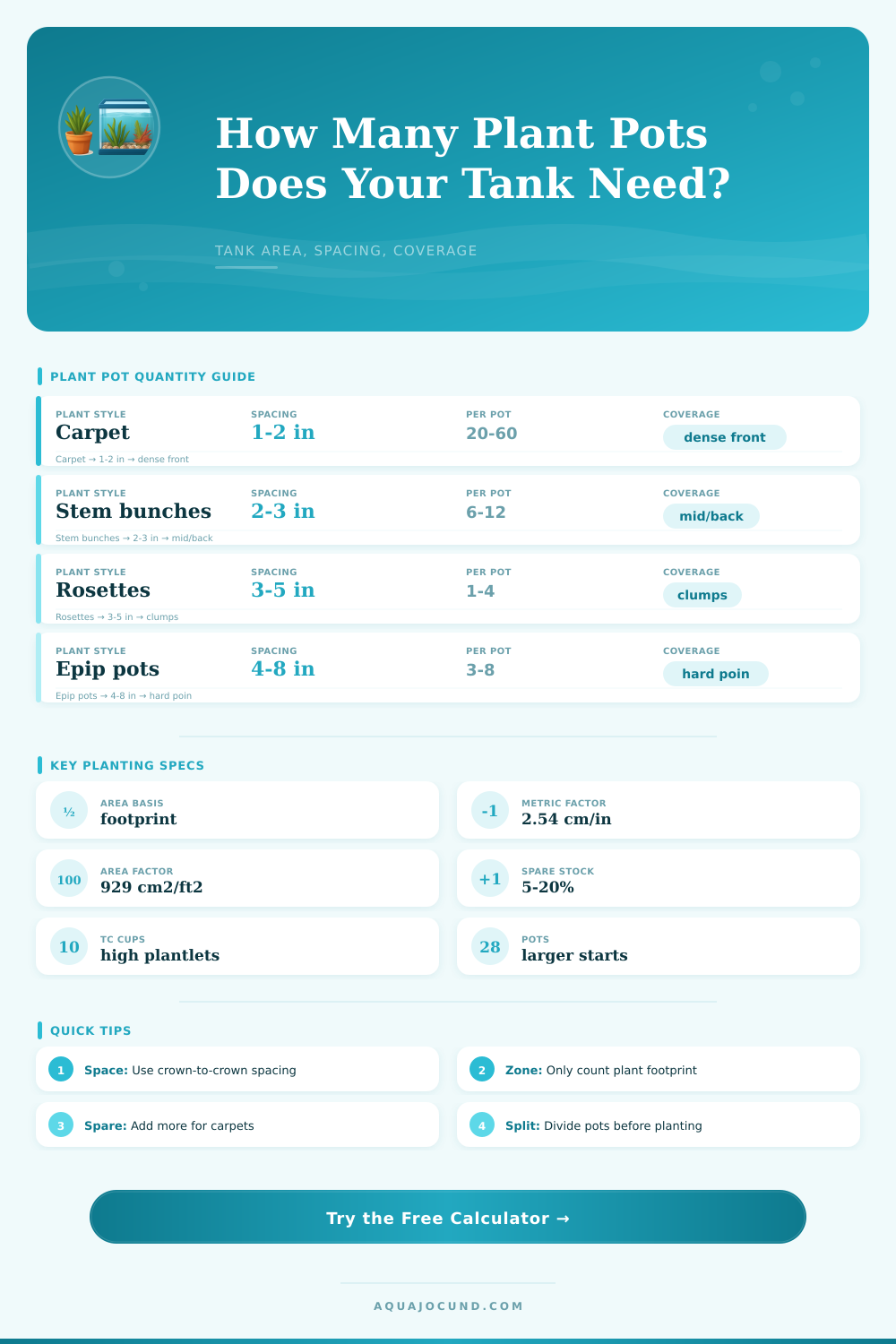
| Carpet plantlets | 1-2 in / 2.5-5 cm | 20-60 | 60-100 | Small pieces spread fastest when planted in a grid |
| Stem plant bunches | 2-3 in / 5-8 cm | 6-12 | 25-45 | Group stems by color and height for fuller rows |
| Rosette feature plants | 3-5 in / 8-13 cm | 1-4 | 12-25 | Count crowns, not leaves, for spacing |
| Crypt groups | 3-4 in / 8-10 cm | 3-8 | 20-40 | Allow spare for melt and slow recovery |
| Vallisneria or runners | 2.5-5 in / 6-13 cm | 5-12 | 20-35 | Use fewer starts when you can wait for runners |
| Epiphyte rhizomes | 4-8 in / 10-20 cm | 3-8 | 10-25 | Attach portions to wood or stone instead of burying |
| Moss portions | 1-3 in / 2.5-8 cm | 8-20 | 20-50 | Portion by pad size and tie-down points |
| Mixed community | 2-4 in / 5-10 cm | 6-14 | 25-55 | Use the average for planning, then adjust by zone |
📏Common Tank Area Examples
| Tank | Footprint | Planted Zone | Example Spacing | Typical Pot Range |
|---|---|---|---|---|
| 5 gal nano | 16 x 8 in / 41 x 20 cm | 0.4-0.7 sq ft | 1.25 in carpet | 2-5 pots or 1-3 TC cups |
| 10 gal standard | 20 x 10 in / 51 x 25 cm | 0.7-1.1 sq ft | 2 in mixed | 4-8 pots |
| 20 long | 30 x 12 in / 76 x 30 cm | 1.2-1.9 sq ft | 2.5 in stems | 6-14 pots |
| 40 breeder | 36 x 18 in / 91 x 46 cm | 2.3-3.8 sq ft | 2.5 in dense stems | 14-30 pots |
| 75 gal | 48 x 18 in / 122 x 46 cm | 3.0-5.0 sq ft | 3 in jungle mix | 18-40 pots |
| 120P layout | 120 x 45 cm / 47 x 18 in | 0.28-0.42 m² | 5-8 cm mixed | 20-45 pots |
🛒Pot Diameter And Division Guide
| Pot Or Cup Diameter | Nominal Area | Common Contents | Best Use |
|---|---|---|---|
| 1.5 in / 4 cm | 1.8 sq in / 11 cm² | small TC cup or mini pot | carpets, moss, very small rosettes |
| 2.0 in / 5 cm | 3.1 sq in / 20 cm² | common aquarium plant pot | stems, crypts, small rooted plants |
| 2.5 in / 6 cm | 4.9 sq in / 32 cm² | large retail pot | rosettes, swords, mature crypts |
| 3.0 in / 8 cm | 7.1 sq in / 46 cm² | large bunch or mat | feature plants and heavy starts |
| 5 cm TC cup | 20 cm² / 3.1 sq in | many small sterile plantlets | clean carpet grids and foreground blends |
🧾Pot Versus Tissue-Culture Planning Table
| Format | Strength | Quantity Behavior | When To Add Spare |
|---|---|---|---|
| Retail pots | larger rooted mass | fewer units, more visible start | when plants are split into very small pieces |
| Loose bunches | simple stem counts | count each usable stem as a point | when stems are short, melted, or uneven |
| Tissue culture | many clean plantlets | more planting points per cup, slower early size | for carpets, moss, and delicate plantlets |
| Mixed format | pots plus cups | pots anchor feature areas, cups fill gaps | when foreground and background use different styles |
| Dense-start plan | fastest coverage | closer spacing raises count by 25-80% | for competition tanks or dry-start transitions |
How do you know? Likely, you had an idea of what you wanted your aquarium to be like and maybe even made a sketch. Perhaps you saw something in a magazine or on someone’s tank, some lush, layered foreground. Or perhaps all you want is a bit of greenery to cover the filter intake. Regardless, the issue persists once you get into the store aisle. There are rows of retail pots and tissue culture cup in front of you and you don’t have any idea how many you need. Do you buy too many and end up spending money on plants that you never use because you only have room for a few? Or do you buy too little and then your tank sits sparse for months as your plants slow grow out?
Stop having to grab your tweezers just to do quick math every time. The planted footprint (the actual planting area) is the main metric. It is not total tank volume. Why? Because your hardscape takes up real estate. Because you’re ignoring the fact that hard scape take up real estate. Sure, some cool rock clusters and a big chunk of drift wood may impress, but they don’t accommodate plants. When you consider what’s actualy available to be covered in substrate where plants has their root zones, you’ll often find that your “plantable” area is significantly less than what you’d guess if you simply estimated it using length of the tank. To help you figure out exactly what your own unique zone looks like, the tool above lets you draw your own zone and it’ll do the geometry work for you no matter how standard or exotic your tank shape happens to be.
How to Plan Your Aquarium Plants
Next is spacing density. Here’s where folks trip themselves up, confusing plant spread with pot size. Just because you start with a two-inch pot doesn’t mean it’ll grow out in a two-inch circle right away. You’re starting with a root ball that size. Divide those pots into whatever smaller units you want and then use the math to look at center-to-center distances between planting spots. For example, when I’m planting midground stem plants, three inches apart is nice and naturaly but doesn’t look overcrowded. On the other hand, if I’m going for carpet work, maybe I go an inch or less. That input changes what the calculator outputs so you know exactly how many plugs or individual stems to plant.
Finally there’s the matter of size. A retail pot is full of an older, well-established plant, which looks great right out of the box, but has only a few usable divisions in it. On the other hand, a tissue culture cup is filled with dozens of tiny clones, ideal for making a carpet but not much use until they have had time to grow up, and they needs to be handled with care. In this case, perhaps you’ll want to mix things up a bit. Buy the bigger pots to place at the points of interest in the background, then use the tissue culture plugs for the foreground. That way, you get to plant a lot of points from each cup (or dollar spent), while still getting some instant gratification from the bigger pots.
This is basically an inventory exercise masquerading as landscape design. Don’t forget the buffer for melt. Aquatic plants suffers a lot of stress when they are shipped and acclimated. There’ll be some rotting at the base of some stems. Some delicate leaves will yellow and melt away. That’s normal biological turnover, but remember: Your initial count needs to exceed your theoretical minimum. Bring an extra ten to twenty percent so you can fill any gaps where things fails to take root. It is a little insurance policy against empty holes in your aquascape.
In the end, there is no substitute for planning. Improvising won’t help if your base is empty. Tomorrow isn’t soon enough for magic roots. Trimming stems down is easy. You can always trim back an overgrown stem later, but you could of magically generate roots in empty substrate tomorrow. Planning before leaving the house will give you space. It allows you to figure out where everything goes. It makes your planting more focused than just chaos.
If you have time to draw your zone, pick your spacing, and account for loss ahead of time, you will have a list to follow instead of having to guess when you walk in. That makes all the difference in how the entire build feels. Spend time with numbers so you can focus on the art with plants in the tank.