Planted Tank Lean Dosing PPM Calculator
Build a lean nitrate, phosphate, and potassium ppm plan from current tests, targets, plant mass, active substrate release, uptake estimates, dose interval, and water-change reset.
📌Lean Dosing PPM Presets
🧪Tank, Target, Uptake, and Reset Inputs
Use visible wet mass or recent trim mass as a repeatable estimate.
Low-tech tanks often use 4-12%; CO2 stem tanks may use 15-35%.
Lean Dosing PPM Result
⚗Live Lean PPM Breakdown
📊Lean Dosing Comparison Grid
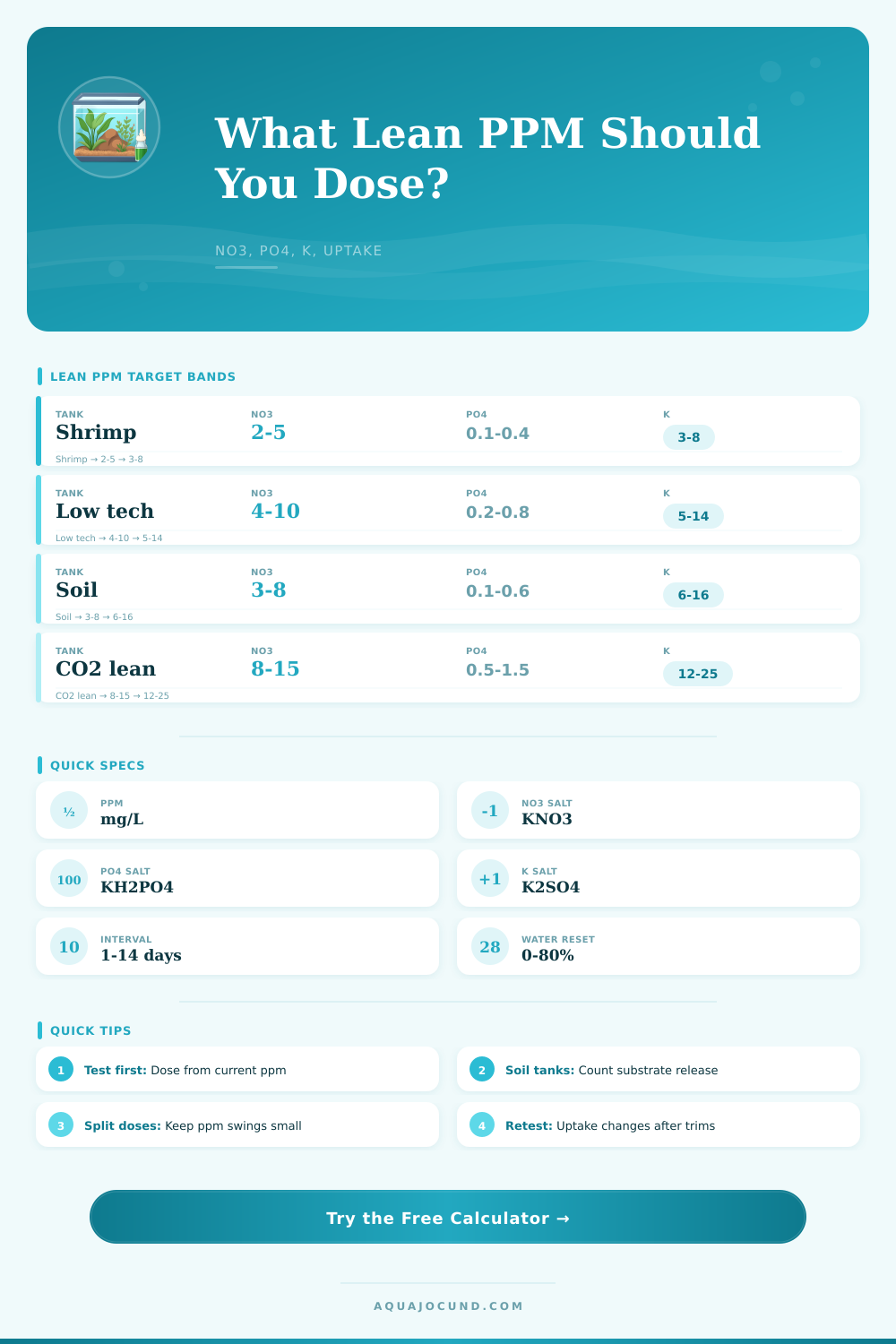
Shrimp Lean
Low nitrate, tiny phosphate, potassium held modest for sensitive livestock tanks.
NO3 2-5 ppm, PO4 0.1-0.4 ppm, K 3-8 ppmLow-Tech Lean
Non-CO2 tanks with slower uptake and longer intervals between macro additions.
NO3 4-10 ppm, PO4 0.2-0.8 ppm, K 5-14 ppmActive Soil Lean
Substrate supplies part of nitrogen or phosphate, so water-column dosing stays lower.
NO3 3-8 ppm, PO4 0.1-0.6 ppm, K 6-16 ppmCO2 Lean
Injected tanks with stronger uptake, split dosing, and wider potassium allowance.
NO3 8-15 ppm, PO4 0.5-1.5 ppm, K 12-25 ppm🌱Substrate and System Adjustment Table
| Mode | NO3 effect | PO4 effect | K effect | Use in calculator |
|---|---|---|---|---|
| Inert sand low-tech | none | slight binding | none | Good baseline for water-column lean dosing |
| Inert substrate with CO2 | none | none | none | Targets depend mostly on uptake and water changes |
| Fresh active aquasoil | adds nitrogen | binds phosphate | small reserve | Lower NO3 and PO4 additions at first |
| Mature active aquasoil | minor nitrogen | moderate binding | small reserve | Balanced lean dosing after the first months |
| Capped soil mineral layer | adds nitrogen | adds/binds PO4 | varies | Use wider reserve below target |
| Shrimp active soil lean | minor nitrogen | binds phosphate | small reserve | Keep additions conservative and split |
| Epiphyte wood and rock | none | none | none | Plant mass usually limits the dose |
| High-tech inert reset | none | none | none | Use stronger uptake and shorter intervals |
📏Common Planted Tank Lean Starting Points
| Tank size | Dimensions | Volume | Plant mass | Lean ppm start |
|---|---|---|---|---|
| 5.5 gallon | 16 x 8 x 10 in / 41 x 20 x 25 cm | 21 L | 1-5 oz / 30-140 g | NO3 2-5, PO4 0.1-0.3, K 3-8 |
| 10 gallon | 20 x 10 x 12 in / 51 x 25 x 30 cm | 38 L | 3-10 oz / 85-285 g | NO3 4-8, PO4 0.2-0.6, K 5-12 |
| 20 long | 30 x 12 x 12 in / 76 x 30 x 30 cm | 76 L | 8-24 oz / 225-680 g | NO3 5-10, PO4 0.3-0.9, K 8-16 |
| 40 breeder | 36 x 18 x 16 in / 91 x 46 x 41 cm | 151 L | 20-60 oz / 565-1700 g | NO3 6-12, PO4 0.4-1.1, K 10-20 |
| 75 gallon | 48 x 18 x 21 in / 122 x 46 x 53 cm | 284 L | 45-130 oz / 1275-3685 g | NO3 8-15, PO4 0.5-1.5, K 12-25 |
| 120 gallon | 48 x 24 x 24 in / 122 x 61 x 61 cm | 454 L | 70-220 oz / 1985-6240 g | NO3 8-15, PO4 0.6-1.5, K 15-25 |
🧪Dry Salt Equivalent Reference
| Nutrient goal | Common salt | Nutrient fraction | Side nutrient | Lean note |
|---|---|---|---|---|
| Nitrate as NO3 | KNO3 | 61.3% NO3 | 38.7% K | Count K carryover before adding K2SO4 |
| Phosphate as PO4 | KH2PO4 | 69.8% PO4 | 28.7% K | Useful in very small amounts for lean tanks |
| Potassium as K | K2SO4 | 44.9% K | sulfate | Best clean K top-up when NO3 and PO4 are capped |
| Combined macro stock | custom blend | label based | blend based | Use the stock result as a measured mL check |
💧Dose Interval and Water Change Planning
| Interval | Typical tank | Water change | Lean dosing behavior |
|---|---|---|---|
| Daily | High-tech stem or Dutch tank | 40-50% weekly | Small ppm swings and faster corrections |
| Every 2-3 days | Mixed CO2 planted tank | 30-50% weekly | Common lean split with visible growth |
| Twice weekly | Low-tech or mature soil tank | 20-35% weekly | Moderate additions with reserve below target |
| Weekly | Slow epiphyte or shrimp tank | 10-30% weekly | Lowest labor, but requires gentler targets |
What’s more, most new aquascapers are concern about starving their plants…or feeding their algae instead. Lean dosing attempts to achieve the perfect balance: Not too little, nor too much. It provide just the right amount of nutrient for consistent growth without blooming.
Sounds easy enough, except your tank isn’t some static box of water. Your tank is a dynamic system. Before you dose with liquid fertilizer, the baseline shift due to soil chemistry, fish waste, and daily light cycle. After entering your individual parameters, the calculator do the math for you (see above). No need to guess how much phosphate or nitrate to actualy inject into column.
Why Lean Dosing Works
What’s key: don’t ever dose as though it’s a blank slate each and every time. You’re not starting with an empty bucket. You’re topping up a full glass containing whatever leftover nutrients have remained after your plants has used them for several days. You are also adding whatever nutrients has been released from the active substrate and whatever nutrients exist in the tap water itself. Ignoring this will result in overdosing.
For example, the input values of current test levels is more important then simply the target value itself. A lot of people say they want 10ppm nitrate so they dose that amount of salt every day to achieve it. Many people fail to consider that their tap water may have two ppm nitrates. Alternatively, their mature aquasoil may be continuing to release some slow-release nitrogen from last year’s plants. That’s where the tool comes in. It take into account how much you’re losing to plant uptake. It also calculates how much of your target level you need to add each week to make up for dilution from your weekly water changes. In other words, it makes you look beyond the ideal situation and see what the true deficit is.
You also need to consider your substrate type, as this have a big impact on how much room you have with dosing regimen. Active soils are fresh, bind phosphate well, but slowly release nitrogen. It’s opposite of the typical high tech ratio. In fact, if you try to chase low phosphate numbers by dosing in inert sand set-ups, it will quickly become a cycle of chasing your tail. Because the soil acts as a sponge for phosphate (it soaks up precisely what you throw at it), there’s not much reason to dose for phosphate in those aquarium. The reference tables on the page shows the various release rates and nutrient holding capacities for different tank modes.
For most lean systems, potassium is the driver. It gets consumed quickly, but it doesn’t typically cause an algae problem if you use a little too much. It’s used by plants for water balance and structural integrity. Regardless of your nitrate targets, you’re going to need potassium due to active growth phase spikes. Most folks under-estimate stem potassium uptake from the water. This results in insidious deficiency symptoms such as slowed elongation or brown edge appearance before other nutrient exhaust. A good approximation for this demand can be tracked using wet plant mass. This gives you a rough idea of the biological consumption that is completly missed with static target numbers.
Quantity is important, but so is timing. If you dose everything weekly, the concentration of your nutrients will swing wildly. They’ll be at their highest immediately following a dose and back down to zero shortly before the next dose. Breaking those doses up into more frequent (e.g., daily/every other day) applications maintains constant nutrient concentrations. This allows the plants to always recieve what they need without being given extra nutrients that algae might use. It also shifts the nature of dosing from a time-based event to a regular part of life.
In the end, that’s what lean dosing is, less a quest for perfecting water parameters then it is an exercise in consistency. No, no need for lab grade accuracy to the decimal place. Rather, simply know which way the balance needs to be adjusted and do so. Test, dose the difference, then let your plants communicate their contentment level to you. Stop trying to fight the tank. Stop strictly applying rules against its natural rhythm. Instead, work with it and it’ll self-regulate.