Planted Tank Water Column Dosing Calculator
Plan a liquid water-column dose from tank volume, target ppm, current ppm, stock concentration, plant uptake, water-change reset, and dosing method.
📌Presets
⚙Dosing Inputs
🧪Live Dose Breakdown
| Step | PPM change | Milligrams | Stock dose | Planning note |
|---|---|---|---|---|
| Waiting | -- | -- | -- | Run the calculator. |
🔬Stock Source Reference
📊Dosing Strategy Comparison
| Method | First dose behavior | Routine dose behavior | Best fit |
|---|---|---|---|
| Water-change front load | Corrects the reset gap immediately | Covers only uptake between doses | Weekly maintenance after large changes |
| Equal split across week | Spreads correction plus uptake evenly | Same amount every event | Manual dosing with smaller swings |
| Maintenance only | Ignores existing gap | Replaces plant uptake only | Tanks already at target ppm |
| Lean ramp correction | Corrects half the gap plus uptake | Moderate follow-up dose | Shrimp tanks and cautious increases |
| Auto-doser micro split | Splits the week into many small events | Small repeatable pump output | Dosing pumps and high-light systems |
📏Common Tank Dose Planning
| Tank | Dimensions | Net water estimate | 10 ppm dose with 20 mg/mL stock |
|---|---|---|---|
| 5 gallon nano | 16 x 8 x 10 in / 41 x 20 x 25 cm | 16-18 L | 8-9 mL |
| 10 gallon | 20 x 10 x 12 in / 51 x 25 x 30 cm | 32-36 L | 16-18 mL |
| 20 long | 30 x 12 x 12 in / 76 x 30 x 30 cm | 64-72 L | 32-36 mL |
| 40 breeder | 36 x 18 x 16 in / 91 x 46 x 41 cm | 130-145 L | 65-73 mL |
| 75 gallon | 48 x 18 x 21 in / 122 x 46 x 53 cm | 250-270 L | 125-135 mL |
| 120 gallon | 48 x 24 x 24 in / 122 x 61 x 61 cm | 400-430 L | 200-215 mL |
🌿Target and Uptake Reference
| Nutrient | Typical planted target | Common daily uptake | Useful caution |
|---|---|---|---|
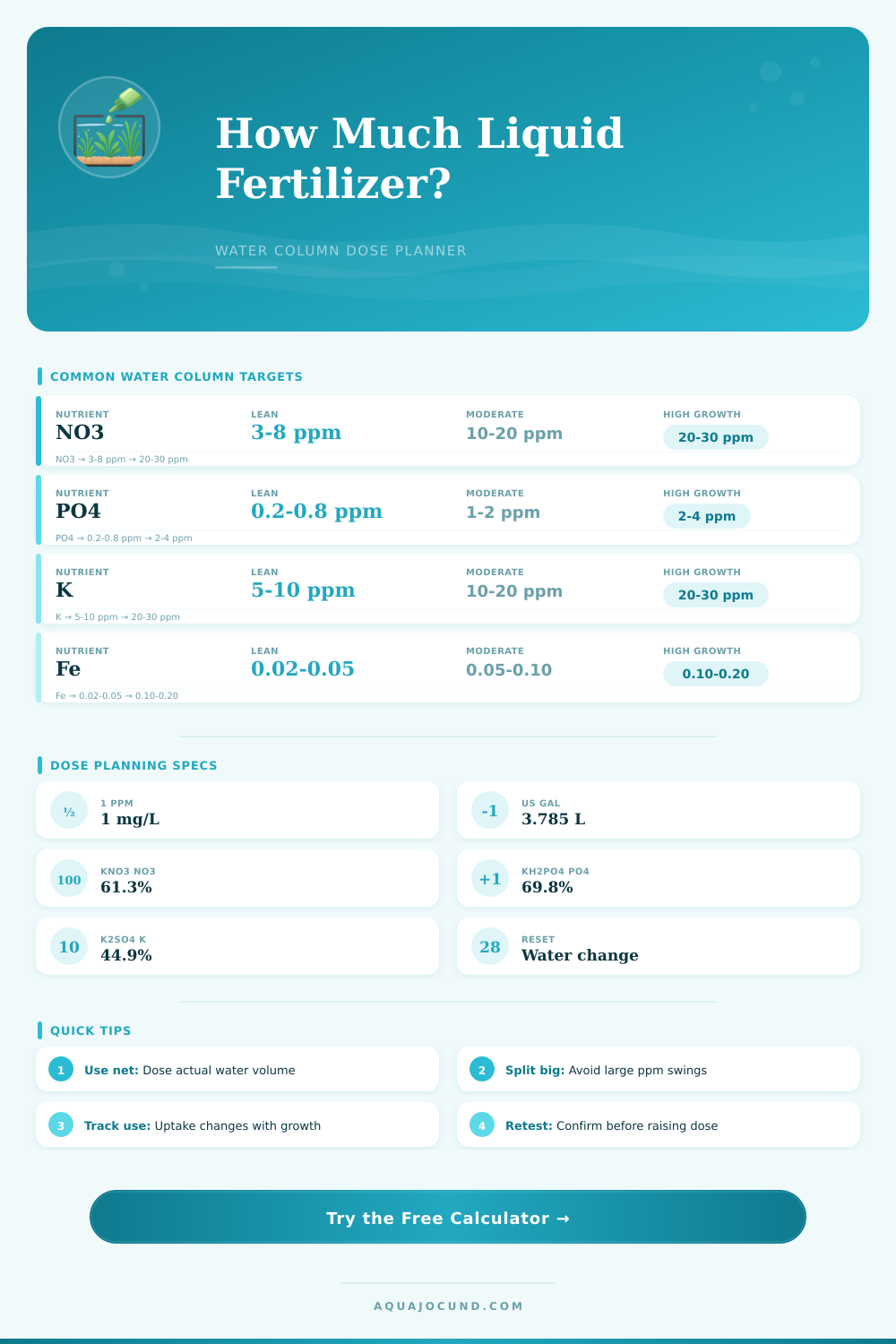
| Nitrate NO3 | 5-30 ppm | 0.3-3 ppm/day | Fish load can supply part of the target. |
| Phosphate PO4 | 0.3-4 ppm | 0.03-0.4 ppm/day | Very small stocks need accurate mL dosing. |
| Potassium K | 5-30 ppm | 0.2-2 ppm/day | K is also carried by KNO3 and KH2PO4. |
| Iron Fe | 0.02-0.20 ppm | 0.005-0.03 ppm/day | Trace dosing should be conservative. |
| Magnesium Mg | 2-10 ppm | 0.02-0.15 ppm/day | Usually changes slowly between water changes. |
| Calcium Ca | 10-40 ppm | 0.05-0.25 ppm/day | Check GH balance when adjusting Ca alone. |
💡Dosing Tips
Yes, there’s algae all over the place. But plant stems don’t grow as fast. So you look at your planted tank and wonder why. It’s simple: It’s arithmetic with consequence called water column chemistry. What does this mean? That plants really don’t give a hoot about what you purchased at LFS. All they care about is what is in the water right now.
You have to be careful to bridge the gap between your target ppm and your tap water. You need to know exactly how much nutrient you’re adding. You also need to know how much plants removes through growth, which is different from consumption, and how much the weekly water change remove.
How to Dose Your Aquarium Correctly
If you’ve ever tried to guess how much volume is actualy available given a tank’s size, most aquascapers does that first. This assumes that rock, gravel, or filter media doesn’t take up any space, which ignores test results shown below. So just because you have a twenty-gallon long doesn’t mean there’s twenty gallons of water left after the gravel, rocks, driftwood, and filters is all placed.
Remember: each ml of fertilizer gets diluted in net volume of usable water. Dosing based off your entire tank capacity instead of net water volume won’t hit your target ppm. By plugging in your actual dimensions, subtracting for hardscape (rocks, wood, etc.), and letting the calculator do the math for you, you avoid problem of assuming the total volume is some nice round number and overdosing accordingly.
Many folks trip here on stock concentration, but let’s understand it so we can get past this hurdle. Potassium nitrate sounds like a pure nitrates source, but the stuff contain about sixty percent nitrate (by mass) and remaining is potassium. So if your goal is raising nitrates while not exceeding your plant’s ability to take in potassium, you need to know that ratio.
Different salts delivers both primary and secondary nutrients as shown in reference table on page. If you do not take these into consideration, your main nutrient targets may look perfect on paper, but your water chemistry will become unbalanced over time because of side effects.
Most dosing strategies completely forget about the one reset button. Water changes. Yes, when you do a 50% change, you’re not only replacing dirty water but also reducing your nutrient levels by half. Following this with fertilizer helps you replace lost ppm. That’s why a front-load plan works well for a 50% change. You’ve got to replenish the missing ppm right after the water change.
By contrast, a maintenance-only plan assumes that your water is at steady state and that you’ll add replacement nutrients based off consumption since previous week. So which plan should you use? Well, if your tank are struggling to get to setpoints, then equal splitting would help avoid big swings (which can be stressful for fry and shrimp). But if you have a carpeting tank with super-high demand, then maybe you want to aggressively front load in order to sustain high uptake rate during the day.
There’s no substitute for testing. Biomass density, light intensity, and CO2 injection all affects how much your plants takes up from the water. A tank full of fast-growing stem plant will drain nitrates much faster than a scape-heavy tank with slow-growing bulbs.
Your uptake calculation may be incorrect if your test results is showing steady decreases below your desired number between dosages. Instead of automatically assuming you need to add more right away, maybe your uptake was overestimated or perhaps your water changes is larger than expected. Changing just one thing at a time keeps troubleshooting from becoming chaotic, rather than changing several things at once.
There’s no exact number. Dosing isn’t an exact science, it’s a range that keeps nutrients present but not so plentiful as to encourage nuisance algae. It’s consistency of both measurement and of routine. It’s small tweaks compounded week after week that convert an overgrown mess into a lush carpet or keep those background plants from turning brown. And it’s never “more.” It’s almost always “just enough” and letting the plants guide you there (testing the math), trusting the results, but verifying them all again later.