Planted Tank Potassium Target Calculator
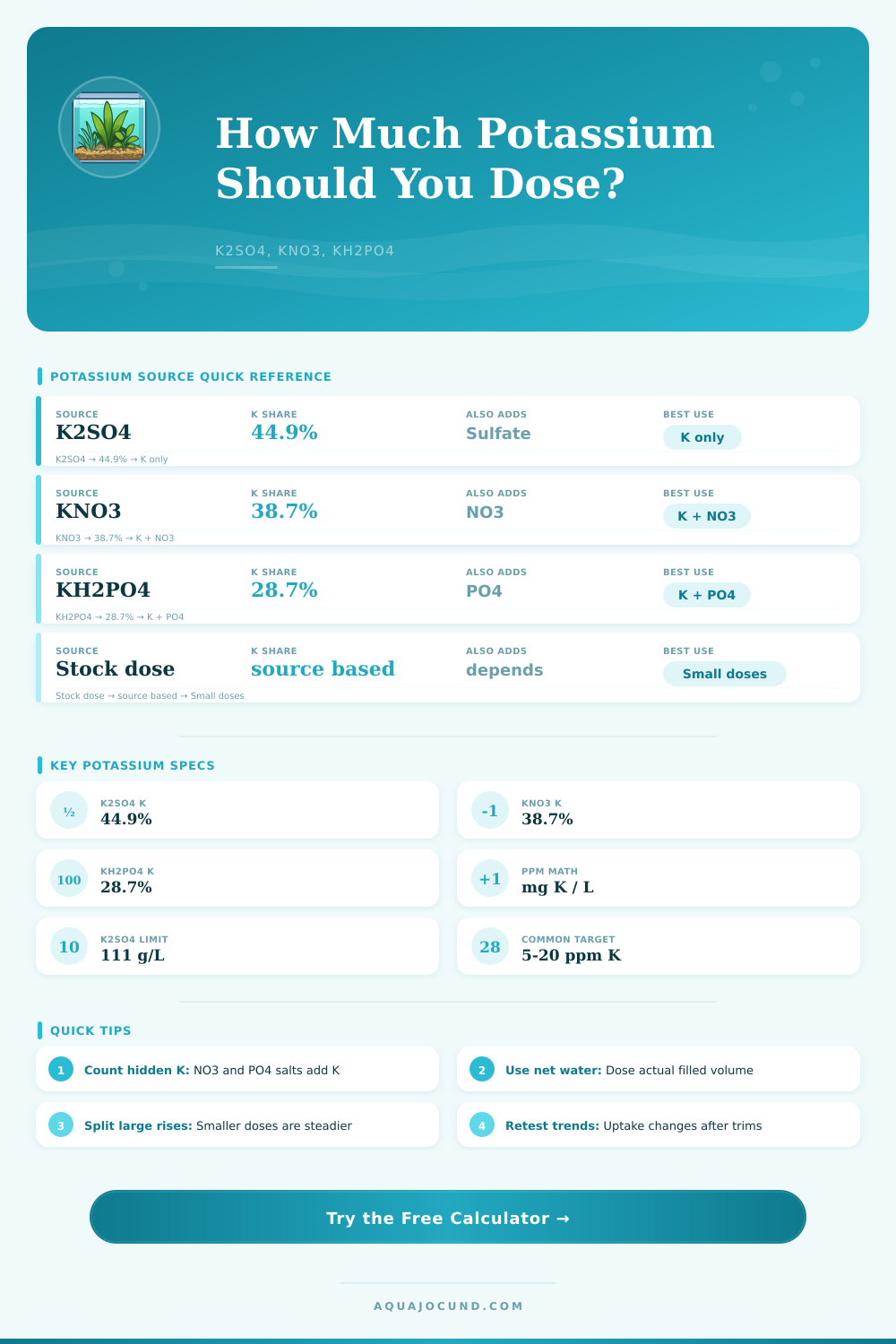
Set a potassium ppm target from current K, actual tank volume, water-change reset, plant uptake, dose size, stock strength, and the selected K2SO4, KNO3, or KH2PO4 source.
🌿Potassium Target Presets
🧪Tank Volume, Target, and Fertilizer Source
Potassium Target Result
⚗Potassium Source Comparison Grid
📊Potassium Source Comparison Table
| Source | K fraction | Secondary nutrient | Secondary per 1 ppm K | Planning use |
|---|---|---|---|---|
| K2SO4 potassium sulfate | 44.87% K | SO4 sulfate | 1.23 ppm SO4 | Potassium target when nitrate and phosphate are already set |
| KNO3 potassium nitrate | 38.67% K | NO3 nitrate | 1.59 ppm NO3 | Potassium carryover from nitrate dosing |
| KH2PO4 monopotassium phosphate | 28.73% K | PO4 phosphate | 2.43 ppm PO4 | Potassium carryover from phosphate dosing |
| Stock solution | Selected source | Selected source | Selected source | Repeatable dosing when dry weight is too small |
📐Common Tank Size K2SO4 Examples
| Tank | Dimensions | Approx water volume | K rise | K2SO4 needed |
|---|---|---|---|---|
| 10 gallon | 20 x 10 x 12 in / 51 x 25 x 30 cm | 38 L | 10 ppm K | 0.84 g |
| 20 long | 30 x 12 x 12 in / 76 x 30 x 30 cm | 76 L | 10 ppm K | 1.69 g |
| 29 gallon | 30 x 12 x 18 in / 76 x 30 x 46 cm | 110 L | 10 ppm K | 2.45 g |
| 40 breeder | 36 x 18 x 16 in / 91 x 46 x 41 cm | 151 L | 10 ppm K | 3.36 g |
| 75 gallon | 48 x 18 x 21 in / 122 x 46 x 53 cm | 284 L | 10 ppm K | 6.33 g |
| 125 gallon | 72 x 18 x 22 in / 183 x 46 x 56 cm | 473 L | 10 ppm K | 10.54 g |
🌱Target Range Planning Table
| Planting style | Typical K target | Weekly uptake estimate | Source note |
|---|---|---|---|
| Low light rhizomes and moss | 5-10 ppm | 1-3 ppm/week | K from KNO3 or KH2PO4 may cover demand |
| Mixed planted community | 10-15 ppm | 3-6 ppm/week | K2SO4 is useful for clean top-ups |
| High light stems | 15-25 ppm | 6-12 ppm/week | Split doses to avoid large swings |
| Dense Dutch-style growth | 20-30 ppm | 10-20 ppm/week | Track nitrate and phosphate carryover |
💧Water Change Reset Table
| Current K | Source water K | Water change | Post-change K | Meaning |
|---|---|---|---|---|
| 20 ppm | 0 ppm | 50% | 10 ppm | Half the potassium remains before dosing |
| 15 ppm | 2 ppm | 40% | 9.8 ppm | Replacement water softens the drop |
| 8 ppm | 0 ppm | 25% | 6 ppm | Small changes leave most K in place |
| 30 ppm | 5 ppm | 60% | 15 ppm | High source K should be counted |
Early on, potassium is treated as afterthought for many planted tank keepers. You spend time fussing over your CO2 injection rate and lighting schedule. You also check your nitrates and phosphates twice a week. During all this, potassium isn’t considered important. It is just as important to plant health as any other nutrient.
When everything else appear fine, yet growth grinds to a halt, potassium becomes a hidden bottleneck. Why are plant leaves turning pale green with yellow tips? It’s not a lack of nitrogen, it’s that the system doesn’t have the strength to move nutrients where they need to go if there isn’t enough K in water column.
Why Potassium is Important for Your Plants
Enter your water parameters and tank size, and it will do the rest of math for you (above). No need to remember dilution factors, molecular weights, etc. It’ll turn raw mass of fertilizer into the amount of actualy elements (in this case potassium) being delivered to your livestock.
The catch? Not every form of potassium are the same. Do you want pure potassium or is additional phosphate/nitrate in the system acceptable? As an additional ion, potassium sulfate introduce only sulfur to the mix. This makes it the cleanest path, assuming you’re already managing nitrates and phosphates via independent dosing regimens. It also maintains predictability in your macro balance.
That said, if you use monopotassium phosphate for phosphorus or potassium nitrate for nitrogen… And you do either (or both) of those things extensively, then there’s a good chance you may already be getting sufficient potassium and not even know it. Many folks mistakenly believe K2SO4 is mandatory every time. In many cases, primary macro salts provides plenty of ‘hidden’ potassium via high-dosing approaches.
To use this feature, you can specify which source salt(s) you plan to dose so the output shows exact amount of elemental K each one provide per gram. Things gets more complicated when we consider water changes. Each change resets your baseline. If you do big weekly water changes but your source water is low in potassium, you are diluting what you have done. This doesn’t allow new growth enough time to use up the excess before you change the water again.
The calculator takes into account the amount of water changed (as a percent) and the potassium level in that incoming water to give a realistic starting point post-water change. Then it calculates backwards from where you want to end up at the end of the week to determine how much to add in-between. This prevents underdosing. Instead of basing amounts on last week’s peak levels, you are basing them based off this week’s actual deficiency after the water change.
Also think about whether you will be fertilizing multiple times a week. If so, instead of dosing all at once one day a week, divide it up into several small dose each day (e.g., a big weekly amount divided into 3-4 daily doses). This keeps nutrient levels steady. It also avoids big jumps up or down that could stress your livestock or cause an algae bloom when plants is not using the nutrients.
Rapid fluctuations in nutrient availability throw off metabolism of plants. This makes them less efficient with resources and can result in cloudier water as bacteria respond to these rapid shifts. Moderate doses allows plants time to take up what’s provided before excess remains for other unwelcome guests.
Numbers on a spreadsheet are psychologically comforting… but real tanks are biological messes! Tank parameters shift by the season, such as temperature. They also shift by the day, as lighting levels change and water turnover and uptake fluctuate with trim cycles. You may have a dense carpet of foreground that takes up potassium much more efficient than scattered stem plants hanging out in mid-water.
While the calculator provides you a solid initial estimate based off chemistry and volume, you’ll want to visually monitor your plants. Typically, dark green = you’re on the right track; pale/spotty = time to bump the target range upward a bit. Begin with a conservative estimate and then increase accordingly based on increasing biomass and filling out hardscape. Better to be slightly deficient than overrun with excessive nutrients that cause nuisance algae!
Reference information on the page about which salts contain secondary nutrients, and allow the calculator to do the precise math. By mixing your calculated amounts with what you observe over time, you’ll build an intuitive sense of what your particular tank require. You want balanced growth without harming rest of the ecosystem. Think of it as adjusting your chemicals to match biological reality until all plants look healthy and vibrant.