Planted Tank Fertilizer Ratio NPK Calculator
Balance nitrate, phosphate, and potassium targets from current ppm, tank volume, generic salts, stock strength, uptake, and water-change reset.
📌Presets
⚙Tank and Target Inputs
🧪Stock Solution and Nutrient Sources
📊Dosing Breakdown Table
| Nutrient | Post-change ppm | Target gap | Entered stock adds | Recipe grams |
|---|---|---|---|---|
| NO3 | -- | -- | -- | -- |
| PO4 | -- | -- | -- | -- |
| K | -- | -- | -- | -- |
⚗Nutrient Source Comparison Grid
📘Reference Target Table
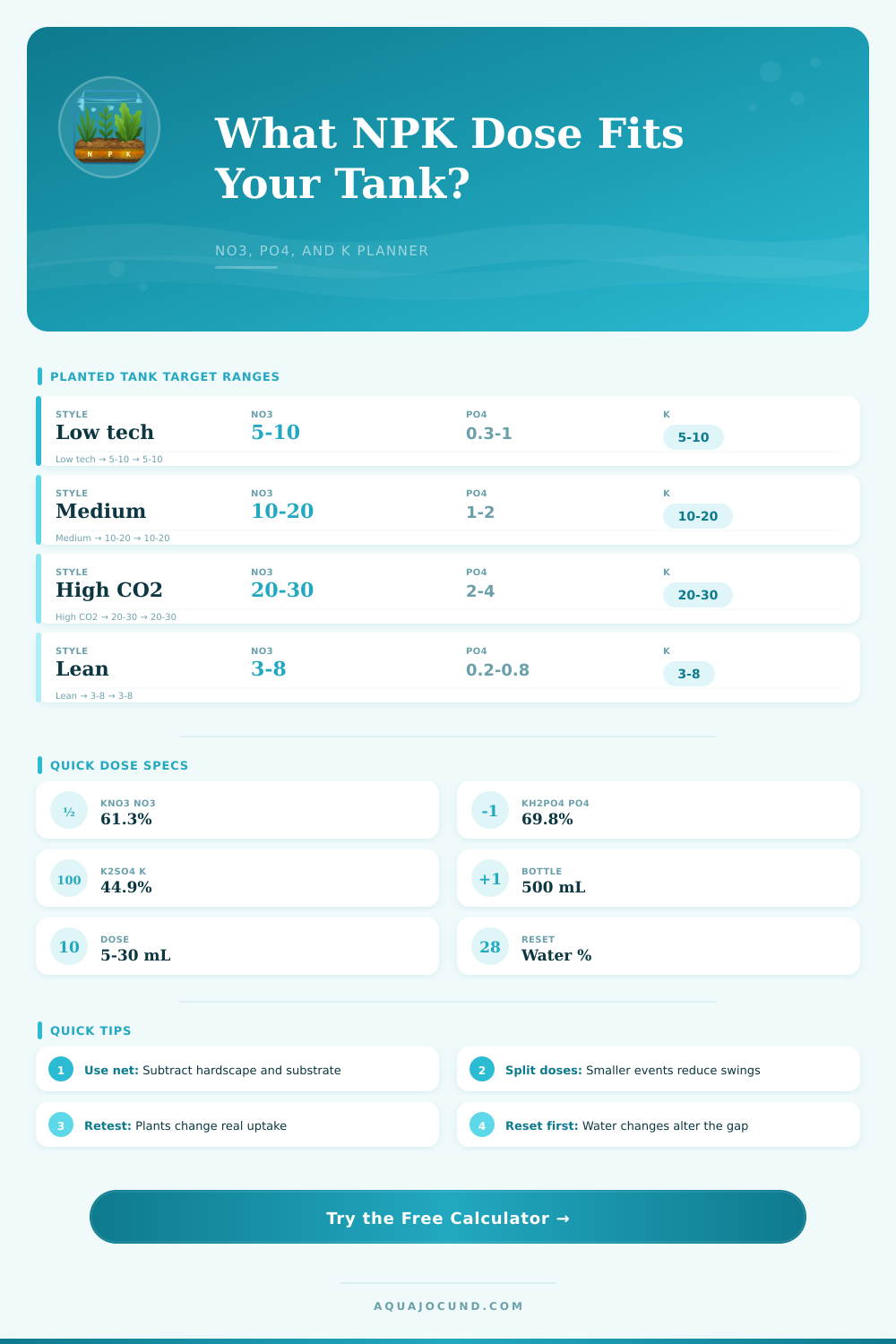
| Planted tank style | Typical NO3 target | Typical PO4 target | Typical K target |
|---|---|---|---|
| Low tech, slow growth | 5 to 10 ppm | 0.3 to 1 ppm | 5 to 10 ppm |
| Medium light, no pressurized CO2 | 10 to 15 ppm | 0.8 to 1.5 ppm | 10 to 15 ppm |
| High light with CO2 | 15 to 30 ppm | 1.5 to 4 ppm | 15 to 30 ppm |
| Lean aquascape maintenance | 3 to 8 ppm | 0.2 to 0.8 ppm | 3 to 8 ppm |
| Dense stem plant reset | 20 to 30 ppm | 2 to 4 ppm | 20 to 30 ppm |
🔬Generic Compound Fractions
| Compound | Primary nutrient fraction | Secondary nutrient carried | Best calculator use |
|---|---|---|---|
| Potassium nitrate, KNO3 | NO3 61.3% | K 38.7% | Main nitrate with potassium credit |
| Sodium nitrate, NaNO3 | NO3 72.9% | No potassium | Nitrate when K is already high |
| Monopotassium phosphate, KH2PO4 | PO4 69.8% | K 28.7% | Main phosphate with potassium credit |
| Potassium sulfate, K2SO4 | K 44.9% | Sulfate | Potassium-only macro adjustment |
| Potassium chloride, KCl | K 52.4% | Chloride | Small potassium correction |
| Potassium carbonate, K2CO3 | K 56.6% | Carbonate alkalinity | Special use where KH impact is acceptable |
🔄Water Change Reset Examples
| Water change | Current NO3 20 ppm, source 0 | Current PO4 2 ppm, source 0 | Planning note |
|---|---|---|---|
| 25% | 15 ppm remains | 1.5 ppm remains | Small reset, lighter correction dose |
| 40% | 12 ppm remains | 1.2 ppm remains | Common weekly reset for moderate growth |
| 50% | 10 ppm remains | 1 ppm remains | Simple half-reset math |
| 70% | 6 ppm remains | 0.6 ppm remains | Large reset, check livestock tolerance |
💡Dosing Tips
Stem plants stop growing. Panic ensues. You realize that plant are starving for food. However, you also know that most liquid fertilizers cause more algae than plant when added. The issue isnt nutrient addition. It’s nutrient ratio balance. A balanced tank has enough nutrients for plants to use… not feed microbes. Stop guessing… This NPK calculator does the work for you.
Instead of treating your tank like a supplement dumping ground, this treats it like a chemical system. It takes into account what’s in the water, what you want in it, and how much you’re using, and it will tell you precisely how much of each salt to add. That matches the ratios to plant biology… not hobbyist tradition.
How to Use the NPK Calculator for Healthy Plants
Plants need certain things to grow. These include nitrogen, which is usually provided by nitrates. They also need phosphorus, which comes from phosphate compounds. Finally, they need potassium, which helps with enzyme activity and cell wall structure. Sodium nitrate and potassium nitrate are common sources of nitrogen in a planted tank. Monopotassium phosphate is one example of a phosphate compound that provides phosphorus. And potassium nitrate has both potassium and nitrogen! Most common salts contain more than one nutrient.
That’s the problem, if you add lots of potassium nitrate to increase nitrogen levels, you may inadvertantly overdo it on potassium and cause it to spike above your plants uptake capacity. That leads to a algae bloom. Knowing the ratio of elements in a given compound makes all the difference. Because it allows you to choose exactly which compounds you’re dosing and adjust calculations appropriately, the calculator handles those hidden coincidences.
The problem is that water changes make this equation much harder. Every week (or two), you reset the starting point. You dilute what’s already there. You add new water with its own set of parameters (i.e., what comes out of your faucet). Most people base their dose based off the total volume of the tank. They ignore how much water you’ve replaced with fresh water and how much that displaces substrate. As a result, you end up undosed…and then depleted of nutrients when plants really need them.
The calculator above takes into account not only the volume of water in your tank but also the mineral composition of the water you use and, more importantly, the net volume that’s actualy present after your water change. Then it mixes current data with the resulting state after your water change to figure out exactly where you stand. You will no longer overdose right after a water change, which usually results in a temporary excess of nutrients followed by an explosion of algae growth.
Your nutrient consumption depends heavily on amount of plants and the strength of your lighting. A high-tech stem layout with pressurized CO2 injection and intense LED lights will consume nutrients far faster then a low-tech moss garden. In the former case, if you’re dosing as hard as possible to maximize growth, any excess nutrients sit there until algae eats them up. On the other hand, in a densely planted tank where you don’t dose very much, the plants wont grow as well. Their leaves may start to melt.
To fill the gap between water changes, you need an estimate of how many nutrients each day are consumed by your plants. The calculator lets you enter those daily nutrient consumption estimates (for potassium, phosphorus, and nitrogen separately). That way, when you dose each week, the nutrients replace what has been used without leaving behind potentially harmful surplus levels.
The 3rd parameter, phosphorus, is frequently the limiting element in most aquariums due to its strong tendency for binding to small particles in substrate. Most tap water has very little phosphates (sometimes they’re nearly non-detectable), but some hard water sources may include phosphate-type ions. Low levels mean testing can be tricky as cheaper test kits are not necessarily accurate at lower values. Getting this number wrong throws off the entire nitrogen-to-phosphorus ratio. Typically, a balance of nitrogen and phosphorous makes plants happy. Adding more or less of either will not help if one gets too low in relation to the other. Growth stalls regardless of how much of the abundant nutrient you add.
Setting clear parameters for what level you want each nutrient will allow the calculator to determine exactly how many milligrams to add to the tank with every dose. A predictable tank is what allows an aquascape to thrive rather than a chaotic battle against algae.
People often forget about potassium and only realize their plants lack it after seeing brown leaf tips or tiny holes. Potassium is added by accident through nitrate sources. However, those sources dont always provide enough potassium, especially for heavy feeders like water wisteria or amazon swords. This means you might think you’re adding enough when you actualy arent. With a separate potassium sulfate booster, you can fine tune this value without affecting other variables.
By breaking out how many grams to add per bottle, you’ll see why this can be helpful… Maybe your tank needs an extra dose twice weekly just for potassium whereas your nitrates aren’t budging? That’s what flexibility does, it lets you maintain balance in an established tank that now has much more plant biomass than when it started.
To conclude. Maintaining planted tanks isnt about being perfect. It’s about consistency. If you’re heading in the right direction, even small mistakes will average out over time. The calculator takes care of volume conversions and chemical amounts so you have that directional certainty. It converts the abstract world of chemical formulas into a doable dosing schedule targeted at your specific plant load and water parameters.
From there, all you have to do is watch your plants and adjust accordingly based on what they tell you visually. But having a firm mathematical foundation ensures that any tweaks you make are intentional (tweaking the variables) instead of blind symptom-chasing. Balance wont happen by accident. It would of been built through deliberate maintenance routines that respect the biological limits of your aquatic ecosystem while carefully measuring everything along the way.